Author: SelfRealized

  • The Iself Is Not Merely the Witness

    Beyond the Passive Observer

    In spiritual teachings, the ultimate realization is often described as becoming the witness: the silent observer of thoughts, emotions, sensations, and experiences. Rather than identifying with the contents of consciousness, one rests as the awareness in which those contents arise.

    This shift can be profound. Yet it leaves an important question unanswered: Who is the one witnessing?

    From the perspective of the Self Realization Mantra, the answer is the Iself: the individual focal point of conscious awareness.

    The witness perspective emphasizes awareness of experience, but the nature of the individual who experiences, directs attention, forms intentions, and acts remains insufficiently explored. The individual is often treated as an illusion, an obstacle to realization, or simply another object to be observed.

    The Iself does not merely observe life. It participates in life.

    Are We Pure Awareness?

    Many spiritual teachings describe our deepest nature as pure awareness. This can be a useful pointer, particularly when it loosens identification with the ego and its constantly changing contents.

    But awareness alone does not fully describe the individual who experiences it.

    Awareness is focused attention within consciousness. The Iself is the individual subject associated with that focus. The two are intimately related, but they are not identical.

    To describe the Iself merely as awareness risks overlooking its intentionality and agency: its capacity to direct attention, form intentions, and participate in action.

    The Iself is not defined solely by what it does. Its capacity to direct attention is an expression of its nature as the individual subject of experience. It is not merely a function within consciousness; it is the individual perspective from which experience is lived and through which attention can be directed.

    Consciousness and Awareness Are Not the Same

    Consciousness and awareness are frequently treated as interchangeable terms. Within the framework presented here, they describe distinct levels of existence.

    Consciousness is the broader field. Awareness is focused attention within that field.

    Consider sunlight passing through a magnifying glass. Sunlight illuminates a broad area, while the magnifying glass concentrates a portion of that light into a smaller, more intense focal point. The concentrated light is not separate from sunlight, but neither is the focal point equivalent to the whole field of illumination.

    Similarly, awareness is not the entirety of consciousness. It is consciousness focused.

    The hierarchy of existence expressed in this framework is:

    Amness > Being > Consciousness > Awareness > Experience

    Amness is Pure Beingness prior to Being itself. Being emerges from Amness, Consciousness from Being, Awareness from Consciousness, and Experience from Awareness.

    Awareness is therefore significant, but it is not ultimate. It is one level above Consciousness and one level below Experience.

    The Iself is the individual focal point of conscious awareness. Its relationship to awareness is not merely passive: it can participate in directing attention within the field of consciousness. Awareness describes the focus; the Iself is the individual subject whose relationship to that focus includes intentionality and agency.

    Distinction Without Separation

    Distinguishing aspects does not require treating them as absolutely separate. Nor does unity require erasing meaningful distinctions.

    The Iself, Allself, Godself, and Noself are distinct aspects of Consciousness. They offer different perspectives on the nature of Self without being isolated or disconnected realities.

    Amness is different. It is not a fifth equivalent aspect of Consciousness, but Pure Beingness prior to Being itself—the source from which Being, Consciousness, and the aspects of Self arise.

    This distinction is essential to a holistic understanding of Self Realization. Collapsing every distinction into an undifferentiated unity can obscure important dimensions of existence. Treating distinctions as absolute separation creates the opposite problem.

    Unity does not require uniformity, and distinction does not require separation.

    The Iself must be understood within this larger context. Its individuality need not be denied for the nature of Self to be realized more fully.

    The Difference Between Witnessing, Intentionality, and Agency

    Witnessing, intentionality, and agency are related, but they are not interchangeable.

    Witnessing is the observation of experience. Thoughts, emotions, sensations, and other phenomena can be observed without automatically identifying with them.

    Intentionality is the directedness of consciousness toward something. Attention can be directed toward a thought, an object, a memory, a goal, or an experience.

    Agency is the capacity to participate in determining what one does, including forming intentions and directing attention.

    These distinctions reveal why the witness alone is an incomplete description of the Iself. Observing a thought is not the same as deciding whether to engage with it. Being aware of an intention is not the same as forming or acting upon that intention.

    The Iself is not merely the place where experiences appear. It is the individual subject whose relationship with experience includes intentionality and agency.

    Directing Attention as an Expression of Iself Agency

    Directing attention is one of the most important expressions of Iself agency.

    The Iself can sustain attention, shift its focus, or redirect it elsewhere. Attention is not always voluntary: it can be captured by fear, pain, habit, an unexpected sound, or an emotionally charged thought. Conditioning and unconscious processes can influence what receives attention and how difficult it is to redirect.

    Nevertheless, the Iself’s capacity to participate in directing attention is significant.

    Consider the ego’s ongoing commentary. The ego may generate thoughts, judgments, worries, interpretations, and narratives about oneself and the world. That commentary can be compelling, but the Iself’s relationship to it is not entirely determined by the ego.

    The Iself can attend to what the ego is saying and examine it. It can listen without accepting the ego’s conclusions. It can question a judgment, decline to pursue a worry, or redirect attention toward something else.

    The ego can speak without the Iself having to listen.

    This does not mean that every thought is voluntarily produced or that every intrusive thought can be dismissed at will. It means that the ego’s production of mental content and the Iself’s relationship to that content are not identical.

    The ego may offer a narrative, but that narrative does not have to define the Iself. It may propose an interpretation, but the Iself need not automatically accept it. It may repeatedly return to a concern, but repetition does not establish truth or require endless engagement.

    This distinction clarifies the difference between influence and control. The ego can influence the Iself, persuade it, distract it, and capture its attention. Yet influence does not amount to absolute control.

    The capacity to redirect attention does not, by itself, prove that the Iself is independent of every causal influence. Its significance is more precise: the Iself’s relationship to the ego cannot simply be equated with the ego’s activity. The Iself can participate in how it relates to mental content, even when its agency is constrained by conditioning, emotion, circumstance, and unconscious processes.

    The Iself does not merely experience the focus of awareness; it can participate in directing that focus.

    Directing attention can also become a path toward Self Realization. The Iself can turn its attention away from the continual stream of experience and toward the nature of the one experiencing it. This shift opens the way to a deeper realization of the Iself itself.

    The Individual as Subject, Not Merely Observer

    The Iself is the individual focal point of conscious awareness. It is the first-person subject for whom experience occurs: the lived sense of “I am here.”

    This individuality is real phenomenologically and ontologically.

    Phenomenologically means in terms of lived experience—how existence is experienced from the first-person perspective. Ontologically means in terms of what exists and the nature of reality.

    Phenomenologically, experience occurs from a particular perspective. There is an individual point of view from which the world is encountered. Ontologically, the Iself is not simply an imaginary entity invented by the ego. It is a fundamental aspect of the nature of Self.

    The reality of the Iself does not require that it be completely independent of everything else. Nor does acknowledging its individuality deny the larger dimensions of Self. It means that individuality is not something that must be erased for realization to occur.

    The Iself is the doorway to awakening and Self Realization.

    Every personal experience of awakening occurs from the perspective of the individual. Even a realization that transcends the ordinary sense of individuality is experienced by the Iself, although the nature of that individuality may be profoundly transformed.

    To dismiss the Iself as an illusion can obscure the very subject through which awakening is experienced.

    The Iself Is Not the Ego

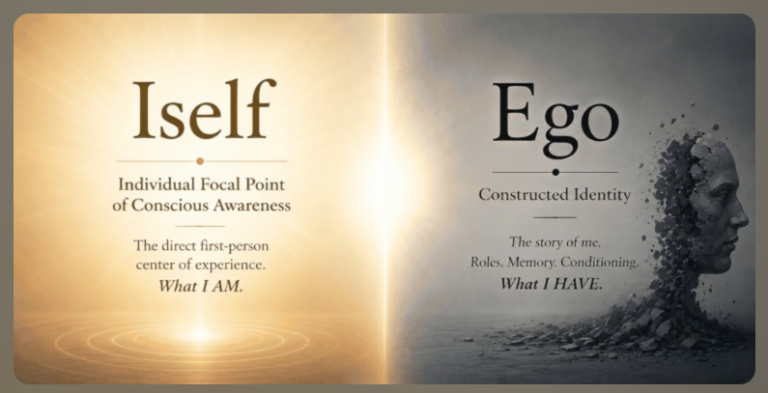
    The Iself and the ego are not the same. The Iself has an ego; it is not an ego.

    The ego is a functional tool for navigating reality. It helps organize personal identity, interpret circumstances, evaluate consequences, establish boundaries, pursue goals, and manage relationships. These functions are useful and often necessary for navigating everyday life.

    Mistaking the Iself for the ego is like mistaking a car for a person. A car provides a means of transportation, allowing a person to navigate the physical world. But the car is not the person who drives it. Similarly, the ego provides a means of navigating psychological and social reality, but it is not the individual who uses it.

    The analogy is not meant to suggest that the ego is a separate object that the Iself consciously operates at every moment. Rather, it clarifies the difference between the individual and a functional system that serves the individual. A person can identify strongly with a car, personalize it, and depend on it without becoming the car. Likewise, the Iself can identify with the ego’s self-conception without being reducible to it.

    The ego can describe the Iself, make claims about it, and construct a story of who the individual is. But the story is not the subject to whom the story belongs.

    The Iself can work through the ego, benefit from its functions, question its assumptions, and redirect attention when its activity becomes limiting. The ego is neither the enemy nor the entirety of the individual. It is a functional part of the person’s life.

    Self Realization does not require destroying the ego. It involves realizing that the Iself has an ego without being limited to the ego’s conception of who it is.

    Rehabilitating the Ego: A Functional Partner, Not an Enemy

    The ego does not need to be destroyed, suppressed, or overcome as though it were an adversary. It needs to be understood in its proper relationship to the Iself.

    The ego serves important functions in everyday life. It helps maintain a coherent personal identity, navigate social relationships, establish boundaries, evaluate circumstances, anticipate consequences, and pursue goals. These functions are not inherently obstacles to Self Realization. They are part of how an individual navigates the world.

    The problem arises when the ego’s conception of the individual is mistaken for the entirety of who the individual is. The ego constructs and maintains a self-image, but the Iself is not limited to that image. The Iself can understand the usefulness of the ego without accepting its claims as the final truth about the individual.

    Rehabilitating the ego means restoring it to its proper role: a functional partner in human life rather than the ultimate authority on identity. Its thoughts and judgments can provide useful information without automatically determining what the Iself values, attends to, or chooses to do.

    This relationship does not require the Iself to control every thought or eliminate every ego-driven reaction. The ego may continue to generate fears, judgments, defenses, and narratives. The difference is that these activities need not define the Iself or dictate its response. The Iself can engage with them, learn from them, question them, or redirect attention when appropriate.

    Self Realization, therefore, does not mean becoming less human or eradicating the structures that make ordinary life possible. It means realizing that the individual is more than the ego’s conception of itself—and that the ego can continue to serve the individual without being mistaken for the individual.

    The goal is not to eliminate the ego, but to establish a more appropriate relationship between the ego and the Iself.

    Mature Iself Awakening: The Iself Below and Beyond the Ego

    The distinction between the Iself and the ego is not merely conceptual. Realizing it is part of Mature Iself Awakening.

    Childhood Iself Awakening, expressed through the emergence of “I,” “me,” and “mine,” is a developmental milestone in the formation of the individual perspective. Mature Iself Awakening is different. It is a deeper, spiritual realization of the nature of the Iself in relation to the ego.

    Mature Iself Awakening involves realizing the individual focal point of conscious awareness below and beyond the ego.

    Below the ego: The Iself is foundational and ontologically prior to the ego. The ego’s identity, narratives, and self-conception depend upon the Iself. The Iself is not created by those narratives, and it does not cease to exist simply because they become quiet.

    Beyond the ego: The Iself is not confined to the ego’s identity, interpretations, judgments, desires, or self-conception. The ego’s account of who one is does not exhaust the nature of the individual. The Iself can relate to the ego’s mental activity without being wholly defined or directed by it.

    The ability to attend to the ego’s commentary without automatically accepting it—or to decline to engage and redirect attention—is a practical expression of this realization. The Iself begins to understand that it is not simply whatever the ego says it is.

    Mature Iself Awakening is not merely the development of greater control over one’s thoughts or emotions. It is a realization of the nature of the one experiencing them. The shift is not simply from being controlled by the ego to managing the ego more effectively. It is from identifying the Iself with the ego to realizing the Iself below and beyond it.

    This is not a claim that the Iself is free from every influence or that the ego can always be ignored at will. It is the realization that the ego’s influence does not establish its absolute control.

    Mature Iself Awakening changes the understanding of the relationship between the individual and the ego. Instead of assuming that the ego is the controlling center of the person, the Iself realizes its more fundamental position and its capacity to participate in how it relates to egoic activity.

    The Iself is not merely an observer standing apart from the ego. It is the individual subject whose agency can operate in relation to the ego.

    Realizing the Iself below and beyond the ego is part of the awakening—not a departure from it.

    The Complexity of Agency

    Agency does not mean that every action is consciously chosen or that the Iself exercises unlimited control over behavior.

    Human action emerges from a complex interplay of intentions, habits, emotions, bodily states, environmental circumstances, prior events, unconscious processes, and other influences. The origins of a particular decision may be difficult to disentangle.

    Sometimes an intention is deliberate and clear. At other times, behavior unfolds automatically, and conscious awareness arrives only after the process is underway. The Iself’s attention can be captured before it has an opportunity to redirect itself.

    These realities qualify an account of agency, but they do not eliminate it. Agency need not mean absolute independence from causes. It can mean the capacity to participate in directing attention, forming intentions, evaluating possibilities, and acting within the conditions of existence.

    The Iself’s agency is neither unlimited nor reducible to the ego. It is part of the complex nature of the individual subject.

    Making Room for Iself Agency

    The argument for Iself agency requires us to examine an assumption that often goes unquestioned: that the ego is the source of human intentions, motivations, decisions, and behavior. If every expression of human agency is attributed to the ego, the Iself is left with no meaningful role beyond witnessing what the ego does.

    But this conclusion depends on an assumption that has not been established. The ego is a functional layer of the person, associated with personal identity, self-conception, self-interest, and the narratives through which an individual interprets life. Its influence on human behavior is undeniable, but influence does not establish exclusive authorship.

    Human motivations are complex. The ego can contribute to a decision without fully accounting for it. Personal identity, self-interest, concern for others, considered intentions, spontaneous responses, and unconscious influences can all participate in human behavior. The presence of an egoic motive does not establish that no other motivation is involved, just as the possibility of an egoic explanation does not demonstrate that the explanation is sufficient.

    If every act of compassion is interpreted as disguised self-interest, every creative impulse as an attempt to enhance personal identity, and every deliberate choice as the ego’s activity, then the ego becomes an all-encompassing explanation by definition. Such an interpretation leaves no conceptual space for Iself agency because every possible expression of that agency has already been assigned to the ego.

    The Self Realization Mantra proposes a different understanding. The Iself is the individual subject of experience, while the ego is a functional layer of the person. The ego can shape intentions, influence decisions, and organize behavior without exhausting the nature or agency of the individual.

    Making this distinction does not require claiming that the Iself is independent of the brain, the unconscious, conditioning, or every other causal influence. Nor does it require imagining a separate inner entity that intervenes from outside the processes of human life. It requires recognizing that the ego and the Iself are not interchangeable, and that explaining the ego’s contribution to an action is not necessarily the same as explaining the action in its entirety.

    This distinction opens the way to consider the Iself as an agent: an individual subject capable of participating in directing attention, forming intentions, evaluating possibilities, and acting. The extent and conditions of that agency remain questions to explore, but the agency of the Iself should not be ruled out merely by attributing all human behavior to the ego.

    We must make room for Iself agency by recognizing that the ego does not exhaust the individual. The Iself is not merely the witness of human behavior; it is the individual subject whose agency must be understood.

    The Influence of the Unconscious

    Not everything that influences the Iself is consciously accessible.

    Unconscious processes can shape attention, emotion, interpretation, motivation, and behavior. They can contribute to thoughts and impulses before the individual becomes aware of them. Even the decision to redirect attention may be influenced by prior learning and circumstances.

    This does not establish that the Iself is powerless. It establishes that agency operates within a broader field of influences than conscious deliberation alone.

    The Iself may not choose every thought that arises, but it can sometimes choose how to relate to a thought. It may not control every emotional response, but it can sometimes decide whether to follow the narrative accompanying that emotion. These capacities vary with context and circumstance.

    Understanding agency requires neither exaggerating the Iself’s freedom nor denying its role in the individual’s relationship with experience.

    Love, Compassion, and Creativity: Three Expressions of Iself Agency

    Love, compassion, and creativity offer three important examples of Iself agency that cannot be adequately understood by reducing the individual to the ego. Each involves the capacity to respond to life in ways that are not necessarily dictated by personal identity, self-interest, conditioning, or the ego’s ongoing narrative.

    These expressions do not exist in complete isolation from the ego. Human motivation is complex, and egoic concerns can influence even our most generous or creative actions. Nevertheless, the presence of egoic influence does not establish that the ego is the sole source of motivation or that the Iself is merely an instrument of its demands.

    Love: The Capacity to Value Beyond the Ego

    Love can direct the Iself toward another person, another living being, or life itself. It can motivate care, devotion, generosity, and commitment that extend beyond immediate personal advantage.

    The ego may participate in love by seeking security, companionship, validation, or a sense of belonging. These motivations are not inherently wrong. But love can also motivate actions that challenge the ego’s immediate preferences: sacrificing convenience for another’s well-being, remaining present through difficulty, or valuing another person without requiring that person to fulfill one’s expectations.

    The Iself’s capacity to love cannot therefore be reduced to the ego’s pursuit of personal gratification. Love can involve an intentional orientation toward another being whose value is not exhausted by what that being provides to oneself.

    This does not mean that love is always selfless or that every loving impulse originates independently of conditioning. It means that the Iself can participate in a relationship with another that exceeds the ego’s immediate concerns.

    Love illustrates how Iself agency can extend beyond the maintenance and enhancement of personal identity.

    Compassion: The Capacity to Respond to Suffering

    Compassion involves more than witnessing suffering. One can observe another’s pain without feeling moved to respond. Compassion adds an orientation toward the suffering of another and a willingness to engage with it.

    The ego may resist such engagement when it is inconvenient, uncomfortable, or costly. It may prioritize self-protection, dismiss another’s suffering, or construct justifications for remaining uninvolved. Yet the Iself can also be moved to respond, even when doing so requires effort, patience, or sacrifice.

    This distinction matters because witnessing and responding are not the same. Awareness of suffering does not automatically determine what one does with that awareness. Compassion involves a further dimension of intentionality and agency: the capacity to respond to what has been perceived.

    Compassion is not necessarily free of personal satisfaction, social conditioning, or other egoic influences. Nor does compassion require abandoning appropriate boundaries or disregarding one’s own needs. Its significance lies in the possibility that another’s suffering can become a meaningful basis for action, rather than merely an object of observation or a concern subordinate to personal advantage.

    Compassion thus illustrates that the Iself is not merely the witness of experience. It can participate in determining how it responds to what it witnesses.

    Creativity: The Capacity to Bring Forth What Does Not Yet Exist

    Creativity offers another expression of Iself agency. Through creative activity, the individual brings forth possibilities that were not previously expressed in that particular form. Art, music, writing, invention, and new ways of understanding all illustrate this capacity.

    The ego can influence creativity through the desire for recognition, achievement, approval, or a coherent sense of identity. It can also constrain creativity through fear of failure, attachment to established habits, or concern about how others will respond.

    Yet creative activity can also emerge from curiosity, exploration, inspiration, and the desire to express something that has not yet found form. The creative process may involve conscious intention, spontaneous emergence, unconscious influences, and periods in which the individual cannot fully explain how an idea came about.

    The Iself does not necessarily consciously manufacture every element of a creative act. Agency does not require complete control over the process. Rather, the Iself participates in engaging with possibilities, sustaining attention, making choices, refining expressions, and bringing a creation into the world.

    Creativity therefore illustrates the relationship between agency and influences that extend beyond conscious deliberation. The Iself can participate meaningfully in a process without being the sole origin of every thought or possibility involved in it.

    Beyond the Ego Without Denying the Ego

    Love, compassion, and creativity reveal different dimensions of the same principle. The Iself can participate in intentions and actions that are not adequately explained by the ego’s pursuit of self-preservation, self-enhancement, or the maintenance of personal identity.

    This does not require treating the ego as an enemy. The ego can support relationships, help organize compassionate action, and provide the practical identity through which creative work is carried out. The distinction is not between an entirely bad ego and an entirely good Iself. It is between the ego as a functional layer of the person and the Iself as the more fundamental individual subject whose agency is not exhausted by that layer.

    The Iself can cooperate with the ego, question it, redirect its attention, or act in ways that challenge its immediate preferences. Its relationship with the ego is therefore more complex than either total identification or absolute opposition.

    Love, compassion, and creativity help make this distinction tangible. They show how the Iself’s agency can be expressed through engagement with others, responsiveness to suffering, and the emergence of new possibilities.

    The Iself’s agency is not merely the power to resist the ego. It is also the capacity to participate in forms of life that extend beyond the ego’s narrowest concerns.

    These expressions do not, by themselves, prove that the Iself is independent of every causal influence. They illustrate a more focused point: the individual cannot be adequately understood by treating the ego as the sole source of motivation, intention, and action.

    The Iself Within the Full Nature of Self

    The Self Realization Mantra expresses five terms:

    I Am Thee Iself.

    I Am Thee Allself.

    I Am Thee Godself.

    I Am Thee Noself.

    I Am Thee Amness.

    The first four terms express distinct aspects of Consciousness.

    • Iself is the individual focal point of conscious awareness.
    • Allself is everyone, everything, everywhere, and everywhen.
    • Godself is the divine creative principle.
    • Noself is transcendent emptiness, not nihilistic nonexistence.

    Amness is different. It is Pure Beingness prior to Being itself—the source of Being, Consciousness, and the aspects of Self.

    The Iself is neither the whole of Self nor an aspect to be discarded in favor of the others. It is a meaningful dimension of the full nature of Self. Realizing the Iself below and beyond the ego does not deny the Allself, Godself, Noself, or Amness. It deepens the understanding of the individual within the broader reality of Self.

    The mantra’s perspectives are not mutually exclusive identities that must be collapsed into one another. They are dimensions of a more comprehensive realization.

    Self Realization is holistic, not unipolar. It does not require denying individuality to affirm universality, denying agency to affirm transcendence, or denying distinctions to affirm unity.

    The Witness Is Not the Whole Story

    The witness perspective can loosen identification with the contents of experience. It can reveal that thoughts, emotions, and personal narratives are not the entirety of what one is.

    But witnessing is not the whole story.

    The Iself is the individual subject who experiences, attends, intends, and acts. Its agency is not unlimited, but neither is it reducible to the ego’s activity. The Iself can participate in directing attention and relating to mental content without being wholly defined or determined by it.

    Mature Iself Awakening involves realizing that the Iself exists below and beyond the ego: foundational to the ego, yet not confined to its constructions. This realization does not establish an unlimited or isolated self. It reveals an aspect of agency and individuality that cannot be adequately explained by reducing the Iself to the ego.

    The Iself is the doorway to awakening and Self Realization. Its individuality is not something that must be erased before realization can begin. Its relationship to the ego, to consciousness, and to the full nature of Self is part of what must be realized.

    The Iself does not merely witness life. It participates in life.

  • Self Realization Is Not Self Improvement

    Self Improvement and Self Actualization are closely related processes of personal growth. Self Improvement develops the person, while Self Actualization brings that development toward the fulfillment of individual potential. Self Realization, however, is fundamentally different: it concerns realizing the full nature of the Self, not simply developing the person or fulfilling individual potential.

    Understanding this distinction helps clarify what the Self Realization Mantra offers—and what it does not promise.

    The Self Realization Mantra consists of five lines:

    I Am Thee Iself.

    I Am Thee Allself.

    I Am Thee Godself.

    I Am Thee Noself.

    I Am Thee Amness.

    With this framework in mind, we can explore the distinction between developing the person, fulfilling individual potential, and realizing the full nature of the Self.

    1. The Iself Is Not the Ego

    The Iself and the ego serve different functions in the nature of the individual.

    The Iself is the individual focal point of conscious awareness: the first-person presence expressed as “I am here.” It is the individual center from which life is experienced, with its own agency and intentionality. In the Self Realization Mantra framework, the Iself is not merely a self-image, a personal narrative, or a product of the ego. It is the doorway to awakening and Self Realization.

    The ego is a functional layer of personal identity built around the Iself. It encompasses the self-image, beliefs, personal history, social roles, preferences, and learned patterns of behavior through which an individual understands and navigates the world. Although the ego influences how the individual experiences and expresses themselves, it neither creates nor exhausts the nature of the Iself.

    The Iself can have intentions and motivations that are not reducible to the ego. The ego is one way the individual functions, not the totality of the individual who functions.

    Nor does the Iself exhaust the full nature of the Self.

    The Self Realization Mantra explores five dimensions of Self:

    • Iself: The individual focal point of conscious awareness.
    • Allself: The universal dimension encompassing everyone, everything, everywhere, and everywhen.
    • Godself: The divine creative principle expressing itself through existence.
    • Noself: The dimension of transcendent emptiness, beyond the limitations of any particular identity or form.
    • Amness: Pure Beingness, prior to Being itself and the source from which the entire spectrum of Self arises.

    These are not simply five personality traits to cultivate or five ideas to believe. They are dimensions of the reality explored through the Self Realization Mantra.

    Self Realization, in this framework, is holistic. It is not limited to the individual, the universal, the divine, or emptiness considered in isolation. It encompasses the full nature of the Self without reducing that fullness to any single dimension.

    2. Self Improvement: Developing the Person

    Self Improvement focuses on becoming more capable, balanced, effective, or fulfilled in everyday life.

    It can involve developing healthier habits, improving emotional regulation, changing unhelpful beliefs, strengthening relationships, building skills, and refining behavior. Much of this work concerns the ego because the ego participates in how we interpret experience, construct our identity, and interact with others.

    There is nothing inherently wrong with the ego. A healthier, more flexible ego can make a meaningful difference in the quality of our lives.

    Self Improvement can also involve the body, practical circumstances, relationships, and external opportunities. It is not exclusively psychological.

    But improving the person does not necessarily reveal the full nature of the Self. Someone can become wiser, kinder, more confident, and more emotionally mature without realizing the deeper dimensions of existence explored through the Self Realization Mantra.

    Self Improvement changes how we function; it does not, by itself, establish what the Self fundamentally is.

    3. Self Actualization: Fulfilling Individual Potential

    Self Actualization concerns bringing one’s capacities and potential into expression.

    It may involve developing talents, pursuing meaningful goals, exercising creativity, cultivating personal strengths, and living in a way that expresses one’s individual possibilities. The ego often participates in this process by organizing goals, making decisions, and translating intentions into action.

    Self Improvement and Self Actualization therefore overlap: improving one’s abilities, habits, and character can help bring individual potential into expression. Yet improvement is not the same as actualization. One can continually improve without fully expressing one’s potential, and fulfilling one’s potential does not require perfection.

    Self Actualization is not merely ego gratification. Fulfilling one’s potential can involve contribution, creativity, service, and meaningful participation in the wider world.

    Self Actualization asks what an individual can become and how that potential can be expressed.

    Self Realization asks a different question: What is the full nature of the Self through which all experience, individuality, universality, and possibility arise?

    A person can fulfill extraordinary potential without realizing the full nature of the Self. Conversely, Self Realization does not automatically mean that every talent has been developed or every personal possibility fulfilled.

    4. Self Realization: Realizing the Full Nature of the Self

    Self Realization is not simply an improved self image, a perfected personality, or the realization of the Iself considered in isolation.

    Within the Self Realization Mantra framework, it encompasses the full spectrum of Self: Iself, Allself, Godself, Noself, and Amness.

    The Iself is the doorway to awakening. Its realization matters because it brings the individual dimension of Self into view, below and beyond the ego. But the journey of Self Realization does not end with the individual focal point of awareness.

    The Allself opens the universal dimension: everyone, everything, everywhere, and everywhen.

    The Godself opens the divine dimension: the creative principle expressing itself through existence, not merely an external, anthropomorphic deity.

    The Noself opens the dimension of transcendent emptiness, where the limitations of any particular self or identity do not define the whole.

    Amness brings the inquiry to Pure Beingness, prior to Being itself—the groundless source from which the spectrum of Self arises.

    The Self Realization Mantra holds these dimensions together without reducing one to another. Individuality is not dismissed because universality is realized. The divine is not reduced to the personal ego. Emptiness is not confused with nihilism. Amness is not treated as merely another identity or experience.

    The point is not to choose one dimension as the only truth. It is to explore the full nature of Self without prematurely collapsing its paradoxes.

    Self Realization is holistic, not unipolar. It is not merely the realization of the individual self, the universal Self, the divine, or emptiness alone. It encompasses the entire spectrum, culminating in Amness.

    5. The Myth of the Perfect Self Realized Person

    A common assumption is that someone who has realized the Self must also have a perfectly developed personality.

    That assumption confuses fundamentally different processes.

    Self Realization does not automatically eliminate personal habits, resolve every emotional difficulty, perfect relationships, or produce exceptional abilities. A Self Realized person remains a human being with a body, a personal history, and a personality that continues to function.

    Likewise, a person who has not realized the full nature of the Self may be compassionate, emotionally mature, creative, and exceptionally accomplished.

    The two dimensions can influence one another, but neither guarantees the other.

    The ego does not have to be bad for the Self to be realized, and the ego does not have to be perfect for the Self to be realized.

    Realizing the full nature of the Self also does not make the individual dimension irrelevant. The Iself remains the focal point through which an individual lives and experiences existence, even as the larger dimensions of Self are explored.

    6. Shouldn’t Self Realization Automatically Lead to Self Actualization?

    If someone realizes the full nature of the Self, shouldn’t that realization naturally lead to the fulfillment of their individual potential?

    Not necessarily.

    Realizing the full nature of the Self and fulfilling the potential of an individual life are different accomplishments. Self Realization may transform one’s understanding of individuality, purpose, agency, and existence. It does not automatically supply the skills, resources, opportunities, health, or circumstances required to fulfill every personal possibility.

    The realization of the Allself does not mean an individual has developed every capacity. The realization of the Godself does not guarantee mastery of every creative endeavor. The realization of Noself does not automatically resolve every psychological pattern. The realization of Amness does not turn a human life into a state of perpetual perfection.

    These distinctions do not diminish Self Realization. They clarify what it means.

    A person can realize profound dimensions of the Self while continuing to grow, learn, heal, create, and participate in life.

    7. Self Improvement and Self Actualization Are Not Prerequisites for Self Realization

    The relationship also works in the other direction.

    A person does not have to perfect their personality, eliminate every psychological difficulty, or fulfill their potential before becoming Self Realized.

    The Self Realization Mantra is not a reward reserved for people who have achieved a certain level of Self Improvement or Self Actualization. It is a spiritual awakening technology that explores the nature of the Self.

    Someone can begin this process while still working through ordinary human challenges. Self Improvement and Self Actualization may support the process of Self Realization, but neither is required for it.

    This does not make Self Improvement or Self Actualization unimportant. Both can contribute meaningfully to a person’s life. They are simply not substitutes for Self Realization or mandatory prerequisites for it.

    8. The Self Realization Mantra Is Not a Self Improvement Program

    The Self Realization Mantra consists of five lines:

    I Am Thee Iself.

    I Am Thee Allself.

    I Am Thee Godself.

    I Am Thee Noself.

    I Am Thee Amness.

    Each line opens a different dimension of inquiry. Together, they offer a holistic framework for exploring the nature of the Self.

    The mantra is not a doctrine that must be accepted, a personality model to imitate, or a checklist of qualities to acquire. The mantra itself carries no doctrine. All explanations are optional context, not required belief.

    Its purpose is not to manufacture a better ego or construct an ideal identity. It is a map and catalyst for exploring the full nature of the Self—a shift in being, not merely a shift in belief.

    The five dimensions are not presented as five separate selves that must be accumulated. They are aspects of a larger inquiry whose fullness cannot be captured by privileging any one dimension alone.

    Self Realization through the mantra is therefore neither exclusively psychological nor exclusively individual, universal, divine, or empty. It is a holistic exploration of the entire spectrum of Self, culminating in Amness.

    9. Growth Continues After Self Realization

    Self Realization does not require the end of personal growth.

    A Self Realized person can continue improving habits, developing emotional maturity, cultivating skills, strengthening relationships, and fulfilling individual potential. These activities do not contradict Self Realization. They belong to the ongoing expression of a human life.

    Realizing the full nature of the Self does not mean that every aspect of one’s life has reached its fullest expression. Nor does continued Self Improvement mean that Self Realization was incomplete simply because the individual still has things to learn or accomplish.

    The distinction is between realizing the nature of the Self and developing the possibilities of an individual life. They can coexist without being identical.

    Self Realization is not a way to avoid personal responsibility, just as personal perfection is not a condition of spiritual awakening.

    Each has its own place.

    10. The Fundamental Distinction

    Self Improvement, Self Actualization, and Self Realization address different questions.

    Self Improvement asks: How can I function better?

    Self Actualization asks: How can I fulfill my individual potential?

    Self Realization asks: What is the full nature of the Self?

    The first develops the person. The second brings individual potential into expression. The third explores the full spectrum of Self, from the individual Iself through the Allself, Godself, and Noself, to Amness.

    The Iself is the doorway to awakening, but it is not the entire destination. The Self Realization Mantra is holistic precisely because it does not reduce the Self to individuality alone—or to universality, divinity, or emptiness alone.

    These pursuits can enrich one another, but they should not be confused. Improving the person is not the same as fulfilling individual potential, and neither is identical to realizing the full nature of the Self.

    Improving who you are does not necessarily fulfill what you can become; fulfilling what you can become does not necessarily reveal who/what you are; and realizing who/what you are does not automatically improve the person you are.

  • The Self Realization Mantra is not a thorn. It is a tuning fork.

    There is a famous teaching that floats around spiritual circles: “Use a thorn to remove a thorn, and then throw them both away.”

    It sounds profound. It suggests that spiritual practices are temporary tools to fix a problem, and once the problem is solved, you discard the tool.

    Some beliefs are thorns. A false belief is a thorn. The idea that you are only the ego is a thorn. You remove those and discard them.

    But the Self Realization Mantra was never a thorn.

    Before awakening, the Self Realization Mantra is a tool for spiritual attainment. You use it to orient yourself toward truth. You use it to cut through illusion. It helps you realize the true nature of the Self.

    But once you realize who and what you are, you do not discard the mantra. It is not a temporary remedy for a temporary ailment. It is not a raft to be abandoned on the far shore.

    The Self Realization Mantra is a tuning fork.

    You do not throw away a tuning fork once you know the note. You use it to bring the instrument back to pitch.

    After awakening, you use it for vibrational alignment. The body-mind is a living instrument. The Mantra brings it back into alignment. You don’t chant it because you are broken or lacking. You chant it because it is the sound of your own being, made audible.

    I Am Thee Iself.
    I Am Thee Allself.
    I Am Thee Godself.
    I Am Thee Noself.
    I Am Thee Amness.

    If you are still seeking, use it to become Self realized.
    If you are Self realized, use it for vibrational alignment.

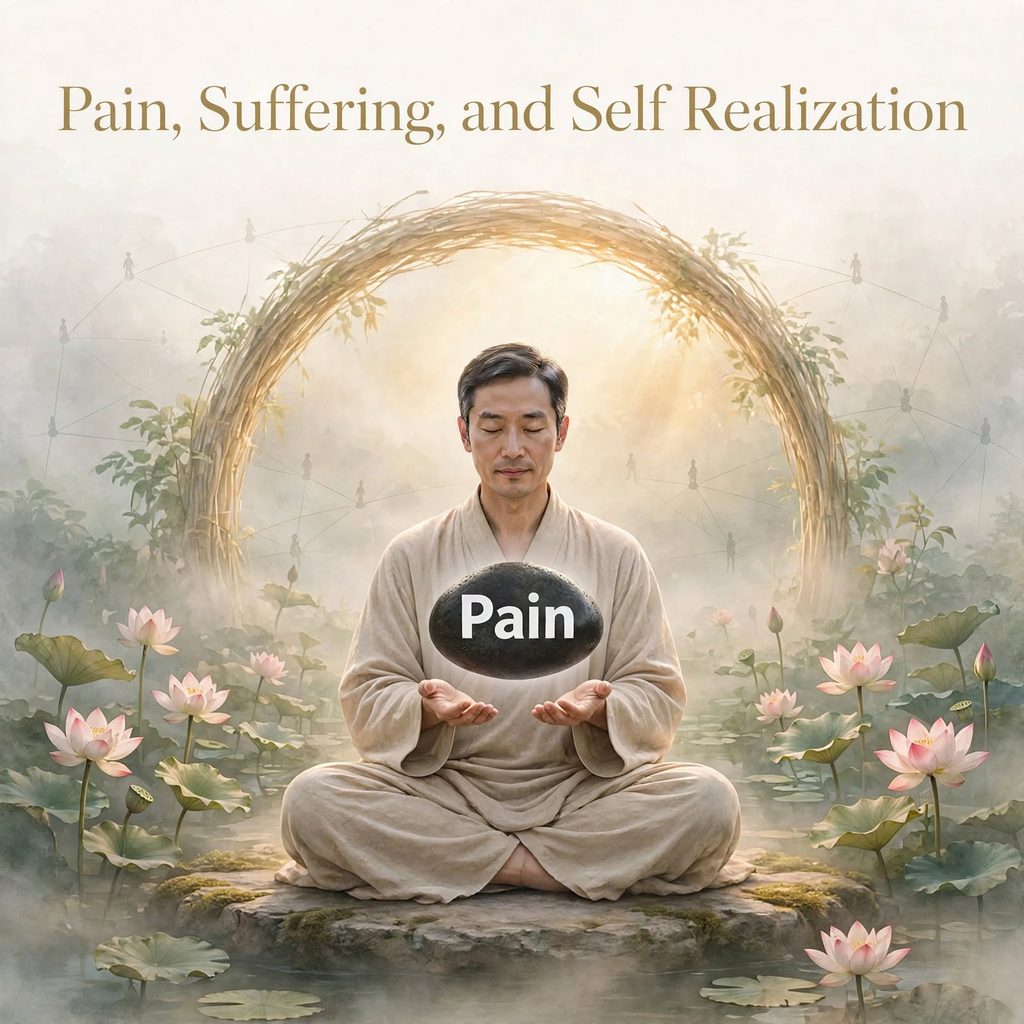
  • Pain, Suffering, and Self Realization

    Pain is an unavoidable part of human life, but pain and suffering are not identical. We experience physical pain, emotional distress, disappointment, grief, loss, and uncertainty. Although we cannot always prevent pain or choose how deeply we suffer, we can sometimes change our relationship with these experiences. Self Realization offers a broader understanding of who and what we are, allowing us to meet the difficulties of life without reducing our entire reality to the pain we experience.

    The distinction is important. Self Realization is not an escape from life. It is a fuller realization of life and of the Self through which life is experienced.

    Pain and Suffering

    Pain and suffering are related, but they are not identical.

    Pain is an experience. It may arise from physical injury, emotional loss, unmet expectations, or the realization that something important to us has changed or disappeared. Pain is not necessarily something we choose, and it is not always something we can control.

    Suffering can arise from pain itself, but it can also arise from our relationship with pain. We may resist what has happened, insist that reality should be different, imagine that our circumstances will never improve, or turn a painful experience into a judgment about who we are.

    This does not mean that all suffering is optional or that people can simply choose not to suffer. Severe pain, trauma, illness, grief, and difficult circumstances can impose suffering that cannot be dissolved through a change of perspective alone.

    There is an old saying: “Pain is inevitable, suffering is optional.”

    Like many memorable sayings, it contains an important insight but overstates the case. Pain is an unavoidable part of life, and we cannot always choose whether or how deeply we suffer. But we can sometimes influence how much additional suffering arises from our resistance to pain, our expectations, and the stories we tell ourselves about what happens to us.

    Nevertheless, there are times when our response adds another layer of suffering to an already painful experience.

    We may not be able to eliminate the pain, but we may be able to reduce the additional suffering created by our resistance, expectations, and interpretations.

    Suffering as Resistance to What Is

    Much of our suffering arises from the conflict between what is happening and what we believe should be happening.

    We want circumstances to be different. We want people to behave differently. We want the past to have unfolded differently. We want uncertainty to disappear and the future to conform to our expectations.

    When reality fails to cooperate, we struggle against it.

    Acceptance offers another possibility.

    Acceptance means acknowledging that something is happening or has happened. It does not mean approving of it, believing it is fair, or deciding that nothing can be done about it. We can accept the reality of a situation while working to change it.

    If we are in pain, we can acknowledge the pain and seek relief. If someone treats us badly, we can acknowledge what happened and establish boundaries. If circumstances are harmful, we can accept that they are harmful and take action to change them.

    Acceptance is not resignation. It is the willingness to begin with reality rather than expend all our energy insisting that reality should already be something else.

    Radical acceptance is one of the most direct paths to inner peace. It means fully acknowledging reality as it is, without making our peace dependent upon reality being different. We can still oppose injustice, change harmful circumstances, pursue our goals, and work toward a better future. Radical acceptance does not require us to approve of everything that happens; it requires us to stop denying that it has happened. When we accept reality as our starting point rather than treating it as an enemy, we release the futile struggle against what already is and become more available to respond wisely to what can still be changed.

    Accepting Our Non-Acceptance

    Radical acceptance does not mean that we must be able to accept everything that happens. Some experiences are so painful, unjust, or incomprehensible that acceptance may seem impossible. Grief, trauma, betrayal, and profound loss cannot always be reconciled with our expectations of how life should be.

    When we cannot accept what has happened, we can begin by accepting our inability to accept it.

    This is a minimum form of radical acceptance: accepting our non-acceptance rather than struggling against it. We acknowledge that we are resisting reality without adding another layer of suffering by insisting that we should not be resisting it.

    We do not have to approve of what happened, find meaning in it, or force ourselves to make peace with it. We need only acknowledge where we are, including our inability to be anywhere else emotionally at that moment.

    Even this small shift can interrupt the cycle of resistance. We may not yet be able to accept the loss, the injustice, or the pain itself, but we can stop demanding that our own response be different from what it is.

    When we cannot accept reality, we can accept that we cannot accept it. That is not the completion of radical acceptance, but it is a place to begin.

    When we stop arguing with the fact that something has happened, we may find that more of our energy becomes available for deciding what to do next.

    Disappointment and Unmet Expectations

    Disappointment occurs when reality fails to meet an expectation.

    Sometimes our expectations are reasonable. We expect honesty from a friend, fairness from an employer, or care from someone we love. When those expectations are violated, disappointment is understandable.

    At other times, our expectations may be unrealistic, poorly examined, or beyond our control. We may expect people to understand us without explanation, expect life to reward our efforts in a particular way, or expect circumstances to remain unchanged simply because we value them.

    The expectation itself can become a source of suffering.

    We may be disappointed not only by what happened but also by the distance between what happened and what we imagined should have happened. We may repeatedly compare reality with an imagined alternative, keeping the disappointment alive long after the original event.

    This does not mean we should abandon expectations or stop caring about outcomes. Expectations help us make plans, establish standards, and determine what matters to us.

    The opportunity lies in distinguishing between expectations that serve us and expectations that keep us in conflict with reality.

    We can hold preferences without insisting that life must fulfill them. We can pursue desired outcomes without making our well-being entirely dependent upon achieving them.

    The Tyranny of Shouldness

    How often does our suffering begin with the belief that something should be different?

    I shouldn’t have to experience this. People should treat me better. My life should have turned out differently. I should be further along by now. I shouldn’t feel this way. The world should be fair.

    These statements express our expectations of how reality ought to be. Some reflect legitimate values and reasonable standards. People should be treated with dignity. We should take responsibility for our actions. We should work to prevent harm and correct injustice.

    The problem is not the word should itself. It is what happens when we turn our expectations into demands that reality must satisfy before we can be at peace.

    Shouldness is the attachment to how we believe reality ought to be, especially when we use that expectation to resist how reality actually is.

    We don’t merely grieve a loss; we insist that the loss shouldn’t have happened. We don’t merely experience disappointment; we insist that life shouldn’t disappoint us. We don’t merely make a mistake; we insist that we shouldn’t have made it.

    The original experience is one thing. Our struggle against the fact that it occurred is another.

    We may not be able to change what happened, but we can examine the expectations through which we interpret it. We can distinguish between what we would prefer and what we demand, between what we believe ought to happen and what is actually happening.

    This is the distinction between preference and demand.

    We can prefer that something had happened differently without denying that it happened. We can believe something ought to change without requiring it to have already changed. We can act according to our values without making inner peace contingent upon the world conforming to them.

    The Paradox of Shouldness

    Shouldness can turn against itself.

    We might tell ourselves, I shouldn’t resist reality. But that can become another form of resistance: now we are resisting our own resistance.

    We might think, I should accept everything. When we discover that we cannot accept something, we suffer because we believe we should be more accepting.

    Even radical acceptance can become another standard against which we judge ourselves.

    The goal is not to eliminate shouldness by force. That would simply give us another demand to struggle against. It is to realize that our judgments about how things should be are not the same as reality itself.

    When we cannot accept what has happened, we need not add the judgment that we should already have accepted it. We can acknowledge our resistance without condemning ourselves for it.

    This brings us back to radical acceptance. We can accept our non-acceptance, allowing ourselves to begin where we actually are rather than where we believe we should be.

    The point is not to abandon our values, standards, or aspirations. It is to stop making peace dependent upon reality already conforming to them.

    The Reasonableness of Expectations

    Not every expectation is unreasonable simply because it is unmet.

    There is a difference between expecting another person to treat us with basic respect and expecting that person to agree with everything we believe. There is a difference between expecting honesty in a relationship and expecting that we will never be disappointed by someone we love.

    The question is not whether we should have expectations. It is whether our expectations accurately reflect the situation, the people involved, and the limits of our control.

    Sometimes suffering reveals that an expectation needs to change. At other times, suffering reveals that a boundary needs to be established or that a situation needs to end.

    We should not use acceptance as an excuse to tolerate abuse, neglect, or preventable harm. Nor should we assume that every painful situation is an invitation to adjust ourselves to circumstances that ought to change.

    Self Realization does not remove discernment. It can help us exercise discernment without being entirely consumed by disappointment, resentment, or fear.

    The Story We Tell Ourselves

    Human beings are natural storytellers. We don’t simply experience life; we narrate our experiences, organizing events into stories that help us understand what happens to us, what it means, and how it relates to who we are. This is an inherent part of being human. Through narration, we make sense of our experiences, connect the past with the present, and anticipate the future.

    But the stories we tell ourselves are not always neutral descriptions of what happened. They often include interpretations, assumptions, judgments, and conclusions about ourselves and others.

    An experience does not always remain confined to what happened. We construct stories around it.

    A friend fails to return a call, and we conclude that we do not matter to them. We make a mistake and decide that we are failures. A relationship ends, and we interpret the loss as proof that we are unlovable.

    The original experience may be painful, but the story can extend the suffering associated with it far beyond the event itself.

    A missed call becomes a judgment about our worth. A mistake becomes an identity. A loss becomes a prediction that we will always be alone.

    These interpretations may feel convincing, but they are not identical to the events that prompted them.

    We can distinguish between what happened and what we have concluded about what happened.

    This distinction does not require us to deny our feelings. It allows us to experience our feelings without automatically treating every thought accompanying them as the final truth.

    We can acknowledge, “I feel rejected,” without concluding, “I am fundamentally unworthy of love.”

    We can acknowledge, “This relationship has ended,” without concluding, “My life can no longer be meaningful.”

    The event matters. The feeling matters. But neither necessarily supports every conclusion we draw from it.

    Neutral Narration

    One way to change our relationship with suffering is to describe experiences more neutrally.

    Instead of saying, “Everything is going wrong,” we might say, “Several things have not gone as I hoped.”

    Instead of saying, “I always fail,” we might say, “I did not succeed at this.”

    Instead of saying, “This is unbearable,” we might say, “This is very painful, and I am having difficulty with it.”

    Neutral narration does not require us to pretend that circumstances are pleasant or insignificant. It simply avoids adding unnecessary judgments and sweeping conclusions to what is already happening.

    There is a meaningful difference between describing an experience and turning that experience into a verdict on our lives.

    The purpose is not to replace negative language with artificially positive language. It is to describe reality as accurately as possible, without making it worse through exaggeration, overgeneralization, or self-condemnation.

    When we separate the experience from the story surrounding it, we create room to respond rather than merely react.

    Pain as a Teacher

    Pain can reveal things about ourselves that comfort may leave undiscovered.

    It can expose attachments, expectations, assumptions, and beliefs that we have never examined. Physical pain can remind us of our vulnerability and impermanence. Emotional pain can reveal the depth of our attachments and the stories we tell ourselves about love, identity, and belonging. Existential pain can challenge our assumptions about who we are and what gives life meaning.

    But pain does not automatically produce wisdom, and suffering is not a prerequisite for awakening.

    Some pain is simply painful. Some suffering results from circumstances that should never have occurred. We need not romanticize suffering or assume that every painful experience has been arranged to teach us something.

    The opportunity lies in what becomes possible when we are willing to look honestly at an experience rather than merely resist it or flee from it.

    Pain may reveal that an expectation needs to be released, an assumption reconsidered, a boundary established, or a harmful situation changed. It may expose the difference between what we can control and what we cannot. It may show us how much of our suffering comes from the meaning we attach to events.

    The lesson is not always to accept more or endure more. Sometimes the lesson is to stop tolerating what harms us. Sometimes it is to grieve what cannot be recovered. Sometimes it is to acknowledge that we do not know why something happened.

    The teacher is not pain alone, but what pain makes possible for us to see.

    Pain may open the door, but it does not determine what we discover when we walk through it.

    Holding Pain Lightly

    To hold pain lightly is not to minimize it, suppress it, or pretend that it does not matter. It is to allow pain to be present without giving it unlimited authority over our experience or identity.

    Pain is real, but it is not necessarily the whole of our reality. Disappointment does not have to become a verdict on our worth. Grief does not have to become the totality of our identity. A difficult period in our lives does not have to define the meaning of our entire existence.

    We can acknowledge pain without insisting that we should not be experiencing it. We can allow ourselves to grieve without concluding that happiness is no longer possible. We can recognize that something matters deeply to us without making our entire well-being dependent upon its preservation.

    Holding pain lightly does not mean that we care less. It means that we are learning to distinguish caring from clinging, acknowledging from resisting, and experiencing from identifying completely with an experience.

    Acceptance does not require passivity. We can take action to alleviate pain, address its causes, seek help, and change our circumstances. We can do these things without adding the belief that our lives are ruined simply because we are suffering now.

    The Iself—the individual focal point of conscious awareness—is the one who experiences pain. Yet the Iself is more than any particular experience, and the totality of the Self extends beyond the individual perspective.

    We can give pain our attention without giving it everything.

    Holding pain lightly is not indifference. It is being present with what hurts without adding unnecessary suffering to an already painful experience.

    The Iself and the Experience of Suffering

    The Iself is the individual focal point of conscious awareness. It is the lived sense of being here, of experiencing life from a particular perspective.

    Pain and suffering are experienced through this individual perspective. They are not abstractions. They are lived realities.

    The Iself can experience physical discomfort, emotional distress, fear, grief, and disappointment. These experiences do not become unreal simply because the nature of the Self extends beyond individuality.

    Nor does the existence of an ego mean that every painful experience is merely an egoic illusion.

    The ego is a functional layer associated with identity, self-image, memory, and our interpretation of experience. It can contribute to suffering when it turns an event into a threat to identity or treats a disappointment as proof of personal inadequacy. But the Iself is not reducible to the ego.

    The Iself is the doorway to awakening and Self Realization. It is the perspective through which we experience our lives, including the process of realizing that our lives and our identities are more expansive than our ordinary self-concepts suggest.

    Self Realization does not require the individual perspective to disappear. It allows the Iself to be understood within a more comprehensive realization of the Self.

    This matters when we suffer. We need not deny our individual experience in order to understand that it is not the totality of what we are.

    Beyond the Individual Self

    The Self Realization Mantra presents five terms: Iself, Allself, Godself, Noself, and Amness. These terms illuminate different aspects of realization without requiring us to collapse them into one another.

    Each offers a different context for understanding our lives, including our experience of suffering.

    The Iself, Allself, Godself, and Noself are four distinct aspects of the Self, expressing different dimensions of Consciousness rather than dividing it into separate parts. Each expresses a different dimension of the same underlying reality: individuality, universality, divinity, and emptiness. They are distinct without being separate, and none can be reduced to another without losing something essential. Amness stands apart from these four aspects—not as another manifestation of Consciousness, but as the pure beingness prior to Being, Consciousness, and the Self itself.

    Allself: The Universal Self

    The Allself encompasses everyone, everything, everywhere, and everywhen.

    From the perspective of the Allself, our individual lives are not isolated from the larger reality in which they occur. We are part of a vast interconnected whole.

    This perspective does not make individual suffering insignificant. The pain of one person remains meaningful, even within a reality that extends far beyond that person.

    Rather, the Allself broadens the context in which we understand our experiences. Our individual concerns can be real without being the only reality that matters. Our lives can be meaningful without being the center of the entire universe.

    The realization of the Allself may soften the sense of isolation that accompanies suffering. It can remind us that we belong to a reality far more extensive than the boundaries of our individual identities.

    Godself: The Divine Self

    The Godself expresses the divine creative principle—the dimension of reality through which creation and manifestation are understood.

    This is not necessarily an external, anthropomorphic deity who stands apart from us. The Godself points toward the divine as an intrinsic dimension of reality.

    From this perspective, life is not merely something that happens to an isolated individual. We participate in a reality whose creative depth exceeds our ordinary understanding.

    This does not mean that every painful event should be interpreted as divinely intended or that suffering must be justified by appealing to a greater plan.

    Such explanations can create additional suffering when they demand that people find a purpose in experiences that remain painful, unjust, or incomprehensible.

    The Godself offers a broader spiritual context without requiring us to pretend that we know why every event occurs.

    We can remain open to the depth and mystery of existence without inventing explanations for every hardship.

    Noself: Transcendent Emptiness

    The Noself points toward emptiness and the absence of a permanently existing, independent self.

    This does not mean that nothing exists or that our lived experiences are meaningless. It means that what we ordinarily regard as a fixed, independent identity cannot be established as an isolated and unchanging entity.

    Our bodies change. Our thoughts change. Our emotions change. Our relationships and circumstances change. Even the identities through which we understand ourselves are shaped by conditions, relationships, memories, and experience.

    The realization of Noself can loosen our attachment to the idea that we must defend and preserve an entirely fixed identity. It can help us see that a painful experience does not have to become a permanent definition of who we are.

    Yet the absence of an independent, unchanging self does not mean that the individual experience of suffering is unreal.

    Noself Realization and Spiritual Bypassing

    Within some spiritual communities, the realization of Noself is used to dismiss or deny the experience of pain and suffering. When someone expresses distress, the response may be that there is no one who suffers, that the individual is an illusion, or that pain exists only because someone remains attached to the ego.

    This can turn a potentially liberating insight into a way of avoiding the realities of human life.

    Using spiritual teachings or the concept of emptiness to avoid emotional pain, bypass unresolved issues, or dismiss another person’s suffering is a form of spiritual bypassing.

    The realization of Noself does not make suffering unreal or render human experience irrelevant. Emptiness is not a license to dismiss pain, detach from responsibility, or pretend that personal difficulties no longer matter. Genuine Self Realization does not require us to deny the individual self or transcend the human experience by refusing to engage with it. It allows us to experience that reality without mistaking it for the totality of what we are.

    Noself and Iself need not be treated as mutually exclusive. We can realize the absence of an independent, permanent self while acknowledging the reality of the individual who experiences pain.

    The point is not to use emptiness to escape our humanity. It is to understand our humanity within a more comprehensive realization of the Self.

    Amness: Pure Beingness

    Amness is not another individual or universal self. It is not simply another aspect alongside Iself, Allself, Godself, and Noself.

    Amness points toward pure beingness prior to Being itself—the source from which Being and the manifestations of Self arise. Amness is the ground of Being.

    In the framework of the Self Realization Mantra, Amness is prior to Self, consciousness, and agency. It is not an object to be grasped or an identity to be adopted. It is the ground that precedes the distinctions through which experience becomes intelligible.

    The relationship can be expressed as:

    Amness → Being → Consciousness → Awareness → Experience

    This is an ontological ordering, not a sequence of events unfolding through ordinary time. Amness is not an earlier moment in a temporal history. Temporality itself belongs to the reality that emerges within this ordering.

    What does this have to do with suffering?

    It places our experiences within a context that is not exhausted by any particular experience. Pain arises within experience. Experience occurs through awareness and consciousness. Yet the source to which Amness points is not reducible to the changing contents of experience.

    This does not mean that Amness makes pain disappear or that we should retreat into an abstract idea of ultimate reality whenever life becomes difficult.

    Rather, it points toward a depth of reality that is not confined to the changing experiences through which we encounter life.

    The realization of Amness does not require us to reject the other aspects of the Self. It provides the ground within which their distinctions can be held without being collapsed.

    Self Realization Is Not Perfection

    Self Realization does not mean that we will never experience pain, disappointment, anger, fear, or grief.

    Self Realization is sometimes portrayed as a state of perpetual bliss—a condition in which suffering disappears and unbroken happiness becomes our permanent experience. This is a profound misconception.

    Self Realization does not make us immune to the full range of human experience. We can still feel grief when someone we love dies, disappointment when our expectations are unmet, pain when we are injured, and sadness when life brings loss. We can experience anger, frustration, fear, and uncertainty. Realization does not require these experiences to disappear, nor does their presence invalidate realization.

    The delusion lies in confusing Self Realization with a permanent emotional state. Bliss may accompany spiritual awakening or arise during contemplative experiences, but an experience of bliss is not the same as Self Realization itself. Emotional states change. Experiences arise and pass away. No particular feeling, however profound or pleasurable, defines the totality of the Self.

    Self Realization is not the permanent experience of bliss; it is the realization of who and what we are, whether bliss is present or absent.

    The deeper possibility is not that we will never experience suffering, but that suffering no longer has to determine our entire understanding of ourselves or our relationship with existence.

    Self Realization does not mean that we will always respond wisely or that we will never become caught in our expectations and interpretations. We may find ourselves caught in familiar patterns of thought and reaction, even as our understanding of the Self deepens.

    The difference is not necessarily that difficult experiences cease to occur. It is that our understanding of ourselves and our relationship with those experiences can change.

    We may become better able to distinguish an experience from the story we tell about it. We may recognize when our expectations are creating unnecessary conflict. We may accept what cannot be changed while taking action where action is possible.

    We may also become more willing to acknowledge our vulnerability without treating vulnerability as a failure.

    Self Realization is not a demand that we become invulnerable. It is not a requirement that we transcend every emotion or maintain an unbroken state of peace.

    It is a fuller realization of the Self, including the individual dimension through which we experience the ordinary challenges of being human.

    We can experience suffering without concluding that something is fundamentally wrong with us. We can acknowledge our limitations without reducing our identity to them. We can continue to learn and grow without making perfection the condition of our well-being.

    The Self Realization Mantra as a Catalyst

    The Self Realization Mantra is a spiritual awakening technology: a concise formulation that can serve as a touchstone for contemplation, realization, and a shift in being.

    It is not a belief system, religion, or dogma. The mantra itself carries no doctrine. All explanations are optional context, not required belief.

    Its five lines bring together the individual, universal, divine, empty, and primordial dimensions of realization:

    I Am Thee Iself.

    I Am Thee Allself.

    I Am Thee Godself.

    I Am Thee Noself.

    I Am Thee Amness.

    The mantra does not ask us to choose one dimension of the Self and deny the others. It holds them together while preserving their distinctions.

    The Iself is not simply collapsed into the Allself. The Godself is not simply collapsed into the Noself. The Noself is not identical to Amness. And Amness is not merely another identity that the individual can claim.

    The mantra can be contemplated as a whole or approached through its individual lines. It can serve as a touchstone when we are caught in a narrow interpretation of ourselves or our circumstances.

    When we suffer, the Iself reminds us of the individual perspective through which pain is experienced. The Allself broadens our context beyond the isolated individual. The Godself opens a perspective on the divine creative principle. The Noself loosens our attachment to a fixed, independent identity. Amness points toward the ground prior to the distinctions through which experience arises.

    None of these perspectives requires us to deny the others.

    The mantra is not a formula for suppressing difficult feelings or replacing them with spiritual affirmations. Its value lies in the larger realization it can facilitate: a shift from identifying exclusively with one limited perspective toward a more comprehensive understanding of the Self.

    Self Realization is a shift in being, not merely a change in belief.

    A Different Relationship with Suffering

    We cannot always control what happens to us. We cannot prevent every loss, guarantee that our expectations will be fulfilled, or eliminate every source of pain.

    But we can sometimes distinguish the pain we experience from the additional suffering that may arise through our relationship with it. We can question the stories that turn individual events into sweeping judgments about our lives. We can distinguish reasonable expectations from demands that reality must conform to our wishes.

    We can allow pain to teach us without assuming that pain is always a teacher. We can hold pain lightly without minimizing its significance. We can acknowledge the individual who suffers without mistaking that individual perspective for the entirety of the Self.

    And we can explore the wider dimensions of Self Realization without using spiritual understanding to evade our humanity.

    The realization of the Self does not make us less human. It allows us to understand our humanity within a more comprehensive context.

    We can experience pain without becoming only pain. We can acknowledge suffering without allowing suffering to define everything. We can act to change what can be changed and accept what cannot, without confusing acceptance with resignation.

    Self Realization does not promise a life without suffering. It offers the possibility of a different relationship with suffering—one grounded in a fuller realization of who and what we are.

    The Self Realization Mantra brings this realization into a concise expression:

    I Am Thee Iself.

    I Am Thee Allself.

    I Am Thee Godself.

    I Am Thee Noself.

    I Am Thee Amness.

  • The Self Realization Mantra: The Map, the Journey, and the Destination

    The Self Realization Mantra is remarkable not only for what it expresses, but for how it can be practiced. It requires no extensive study, no mastery of spiritual philosophy, and no prior understanding of its five terms. It serves simultaneously as a map of the Self, a journey of awakening, and a destination of realization. It is both affirmation and invocation.

    These are not separate functions. They are dimensions of a single, integrated practice.

    The Mantra

    I Am Thee Iself.
    I Am Thee Allself.
    I Am Thee Godself.
    I Am Thee Noself.
    I Am Thee Amness.

    Five declarations encompass the individual, the universal, the divine, emptiness, and Amness—the pure beingness that precedes Being itself.

    The Power of “I Am”

    Two of the most powerful words in the Self Realization Mantra are its first two: I Am.

    “I Am” is more than a description of existence. It is a first-person declaration of being—a direct expression of existence from the standpoint of the one who experiences it. Before we describe who we are, what we are, or what we believe ourselves to be, there is the fundamental fact of being.

    The words “I Am” also have a special significance in the practice of affirmation. Repeated affirmations can influence habitual thought, self-perception, and the assumptions through which we experience ourselves. In this sense, affirmations can help reshape the mind, including patterns of thought that operate outside our immediate awareness.

    The Self Realization Mantra takes this principle beyond ordinary positive thinking. Rather than affirming a particular personal quality, it directs the practitioner toward five dimensions of the Self: Iself, Allself, Godself, Noself, and Amness.

    Ordinary affirmations seek to change what we believe about ourselves; the Self Realization Mantra invites us to explore what we are beyond our existing beliefs about ourselves.

    This distinction is fundamental. Ordinary affirmations might reinforce the belief that we are confident, capable, worthy, or successful. The Self Realization Mantra opens a much broader exploration of identity and existence. It does not merely propose a better description of the person we believe ourselves to be. It invites us to explore the full nature of the Self.

    Each declaration begins with “I Am,” followed by a different aspect of the Self. The individual, the universal, the divine, emptiness, and Amness are not introduced as abstract subjects to be studied from a distance. They are approached through the same direct, first-person expression.

    The practitioner isn’t merely declaring that something exists. The practitioner is engaging directly with the possibility that the nature of the Self extends far beyond ordinary assumptions about personal identity.

    “I Am” also gives the mantra its invocational quality. Spoken or contemplated, the words can serve not only as declarations but as invitations to explore and realize what they express. The practitioner begins with the immediacy of existence and opens to its full range of possibilities.

    The power of “I Am,” then, lies not in a magical guarantee that whatever follows the words will become true. It lies in the directness of the declaration, the potential influence of repeated affirmation, and the depth of what the mantra invites us to explore.

    The Self Realization Mantra begins with “I Am” because Self Realization is not merely about understanding the Self as an idea. It is about realizing the nature of the Self itself.

    The Map, the Journey, and the Destination

    The Self Realization Mantra is the map because it articulates the full scope of the Self. Its five declarations provide an orientation for exploring the individual and universal dimensions of existence, the divine, emptiness, and the source that precedes them all.

    The Self Realization Mantra is the journey because practicing the mantra is itself an engagement with the territory it describes. Each declaration offers an opportunity to contemplate and experience an aspect of the Self. Understanding can unfold through practice; complete conceptual mastery is not a prerequisite.

    The Self Realization Mantra is the destination because the reality toward which it points is already expressed in its declarations. The mantra does not merely describe a distant spiritual achievement. It brings the full nature of the Self into the very center of the practice.

    The map, the journey, and the destination are thus brought together in a single mantra.

    Awakening Without Extensive Study

    One of the most remarkable features of the Self Realization Mantra is its accessibility. You can practice it without possessing a sophisticated understanding of what its words mean.

    There is no requirement to study volumes of spiritual philosophy, master a particular metaphysical system, or adopt a prescribed set of beliefs before beginning. The practitioner can start with the mantra itself and allow conceptual understanding to develop over time.

    This does not make the Self Realization Mantra intellectually shallow. Simplicity of practice is not the same as simplicity of meaning.

    A person can understand elaborate explanations of the Self without experiencing spiritual awakening. Conversely, a person can begin practicing the mantra with little conceptual knowledge and discover that its meaning deepens through contemplation and experience.

    The explanations can illuminate the mantra, but mastering the explanations is not a condition of practice.

    The Self Realization Mantra is therefore a spiritual awakening technology: a simple, accessible practice with implications that can be explored throughout a lifetime.

    Affirmation and Invocation

    The Self Realization Mantra serves simultaneously as affirmation and invocation.

    As affirmation, it declares the nature of the Self. Each line affirms an aspect of existence, culminating in Amness, the source that precedes the distinctions expressed in the preceding declarations.

    As invocation, the mantra invites the practitioner into a deeper realization of what it expresses. It is not necessarily an appeal to an external power. Rather, it can be understood as an invocation of the very nature of the Self—something to be realized through practice, not merely contemplated as an abstract idea.

    The distinction is subtle but significant.

    An affirmation declares. An invocation calls forth.

    The Self Realization Mantra does both at once. It affirms what is while inviting its realization. Its declarations speak directly, in the first person, while its practice opens the possibility of awakening to their full implications.

    The practitioner does not have to wait until the journey is complete to engage with the mantra’s declarations. The practice begins here, with the words themselves.

    One Mantra, an Integrated Practice

    These qualities reinforce one another.

    Because the Self Realization Mantra is the map, the practitioner has an orientation. Because it is the journey, the practitioner can begin immediately. Because it is the destination, the full nature of the Self is already present as the subject of contemplation. Because it is both affirmation and invocation, the mantra simultaneously declares and invites realization.

    The mantra does not require extensive conceptual preparation, yet it leaves room for profound philosophical exploration. It offers a direct practice without insisting that every practitioner adopt the same explanation of what unfolds.

    The Self Realization Mantra is the map, the journey, and the destination—all in one. It is both affirmation and invocation, declaring what it invites the practitioner to realize and inviting the realization of what it declares.

    Five declarations. One integrated practice. A lifetime of exploration.

    I Am Thee Iself.
    I Am Thee Allself.
    I Am Thee Godself.
    I Am Thee Noself.
    I Am Thee Amness.

  • You have to Am before you Is, and you have to Is before you Are.

    Unpacking a Single Sentence


    There is a sentence on the pinned post of this website that appears without explanation or commentary. It sits alone on the page—not part of the hierarchy, not a level, not a stage.

    “You have to am before you is, and you have to is before you are.”

    This article is for those who have asked: How does Amness become Being? For those who haven’t asked, the sentence is enough. It waits like a spark waiting for dry grass.

    But for those who ask, this is an offering.


    The Grammar of Reality

    The sentence seems like a grammatical puzzle. “Am,” “is,” and “are” are all forms of the verb to be. Why say “you have to am”? The strangeness is deliberate—and it is the point.

    The sentence uses grammar as a map:

    VerbPersonWhat It Points To
    AmFirst personAmness—the premanifest ground
    IsThird personIsness—the phase transition
    AreSecond personBeing—manifest existence

    You must be Amness before you can transition through Isness.
    You must transition through Isness before you can manifest as Being.

    Amness → Isness → Being

    This is not a temporal sequence. It is ontological—the structure of existence itself.


    Amness: The Premanifest Ground

    “You have to am before you is.”

    Amness is not a thing, a state, or an experience. It is the ground prior to all things, all states, all experiences.

    • Premanifest. Prior to form. Prior to existence itself.
    • Sourceless. Uncreated. Uncaused. Its own source.
    • Silent and still. The silence before the first sound, the stillness before the first movement.

    To “am” is not to do anything. It is to be the ground—prior to all doing, all being, all becoming. You cannot achieve Amness. You can only recognize that you already are it.

    Amness is like gasoline—fuel that contains potential but has not yet ignited.


    Isness: The Phase Transition

    “You have to is before you are.”

    Isness is not a level, a stage, or a thing. It is a phase transition—the spark that ignites gasoline into flame.

    • The threshold. The moment between unmanifest and manifest.
    • The event. The occurrence of existence itself.
    • The movement. The transition from Amness to Being.

    You cannot grasp Isness or abide in it. It is not a state to hold. It is the crossing—the movement from Amness to Being. You can only pass through it.

    Isness is like a spark—the event of ignition that transforms fuel into flame.


    Being: Manifest Existence

    Being is manifest existence—the world of forms, things, selves, and experiences. It is the flame that results from ignition.

    • Manifest. Visible, tangible, experienceable.
    • Form. The shape of existence.
    • The world. The realm of Iself, Allself, Godself, and Noself.

    Being is not separate from Amness. It is Amness appearing—ignited into form. But Being is not the ground. It is the flame, not the fuel.


    The Analogy: Gasoline, Spark, Flame

    ElementWhat It Represents
    GasolineAmness—the fuel, the premanifest ground
    SparkIsness—the phase transition, the ignition
    FlameBeing—manifest existence

    Gasoline without spark is potential without manifestation. Spark without gasoline is impossible. Flame without either is impossible.

    Gasoline → Spark → Flame
    Amness → Isness → Being


    Why the Grammar Is Deliberately Strange

    The strangeness is not an accident. It is a teaching device.

    1. It stops the mind.
    The mind expects normal grammar. “You have to am” breaks the rules. The mind stumbles—and in that stumble, there is a gap, a moment of not-knowing where understanding can enter.

    2. It points to the ineffable.
    Amness cannot be described in normal language. It is prior to all categories. The strange grammar reflects the strangeness of reality itself. The sentence is not grammatically correct—it is ontologically correct.

    3. It is self-contained.
    The sentence needs no explanation. It is complete in itself. The strange grammar is the teaching.


    The Hierarchy and the Spark

    The website teaches a hierarchy:

    Amness → Being → Consciousness → Awareness → Experience

    Isness is not in this hierarchy. It is not a level. It is the arrow between Amness and Being—the movement between levels.

    The hierarchy is a map of reality, not a grammar lesson. It is not a conjugation table. Isness is not numbered. It is the spark between 1 and 2.


    How to Contemplate the Sentence

    The sentence is not meant to be analyzed. It is meant to be met.

    1. Read it slowly.

    “You have to am before you is, and you have to is before you are.”

    2. Let the strangeness land.
    Don’t try to understand it. Let the mind stumble.

    3. Rest in the gap.
    In the moment of not-knowing, there is a gap. Rest there. Don’t fill it with explanation.

    4. Ask, without answering:
    What is Amness? What is Isness? What is Being?

    5. Return to the sentence.
    Let it spark. Let it ignite.

    The sentence is not a doctrine to be believed. It is a spark to be met.


    The Sentence as a Pointer

    “You have to am before you is, and you have to is before you are.”

    You can answer with “Amness is the ground and Isness is the transition and Being is manifestation.” but that is a concept, not an understanding. The sentence stops the mind. And in that stopping, there is an opening.


    The Sentence in Context

    On this website’s pinned post, the sentence appears alone, without explanation.

    Because the sentence is not a teaching. It is a spark. It needs no commentary. It needs only to be read—and met by one who is ready.

    The hierarchy is the map. The mantra is the sound. The sentence is the spark.

    Together, they are complete.


    The Final Word

    The sentence is not meant to be understood by the mind. It is meant to be met by the whole being.

    It is a spark. It is a phase transition. It is the threshold between Amness and Being.

    You have to am before you is, and you have to is before you are.

    That’s it. That’s all.

  • Revelation Didn’t Stop Happening When the Famous Historical Figures Died

    There is a curious assumption that seems to exist in parts of the modern spiritual world: the great revelations have already happened. The great teachings have already been revealed. The great masters have already received the important revelations. The map has already been drawn.

    Shankara received revelation. Ramana Maharshi received revelation. Nisargadatta Maharaj received revelation. Other celebrated teachers received revelation. And now, apparently, our task is to study what they revealed, repeat their conclusions, and try to experience what they experienced.

    But why would we assume that revelation stopped when the famous historical figures died? Why would divine revelation have an expiration date, or the source of revelation suddenly become silent simply because the people we now regard as the great masters are no longer alive?

    Revelation is not a historical artifact. It can happen now.

    Revelation Is Not a Historical Event

    Revelation is not something that happened once in the distant past and was then preserved in books.

    A person living thousands of years ago could receive a profound revelation about the nature of existence. A person living today can receive a profound revelation about the nature of existence. The passage of time does not make humanity less capable of receiving revelation.

    The great spiritual teachers of history were not merely repositories of everything that could ever be revealed. They were human beings who received profound insights and then attempted to communicate what had been revealed to them.

    Their revelations matter. Their teachings matter. Their words can be extraordinarily valuable. But they do not establish a closing date for revelation.

    We Have a Tendency to Turn Teachers Into Endpoints

    There is a subtle danger in revering spiritual teachers too much. We can begin by honoring someone who received and communicated something profound. Eventually, we may begin treating everything that person said as the final word on the subject.

    Then a strange thing happens. Instead of asking, “What might be revealed?” we start asking, “What did Ramana say?” Instead of remaining open to direct revelation, we compare everything we encounter with what Nisargadatta said. Instead of exploring what may be revealed now, we try to fit every new insight into an existing doctrinal framework.

    The teacher becomes an endpoint rather than a doorway.

    But if revelation is possible, then there is no logical reason to assume that everything that can ever be revealed has already been revealed.

    New Does Not Mean Completely Unprecedented

    A new revelation does not have to consist of concepts that have never appeared anywhere in human history.

    Human beings have been contemplating consciousness, self, God, emptiness, being, and existence for thousands of years. Of course there will be parallels. Of course there will be precedents. Of course someone somewhere will have said something that resembles part of a later revelation.

    That does not mean the later revelation is derivative.

    There is a difference between shared vocabulary and shared origin. There is also a difference between a concept existing somewhere in history and a particular configuration of concepts being revealed together.

    The Self Realization Mantra illustrates this distinction. The terms Iself (individuality), Allself (unity), Godself (divinity), Noself (transcendent emptiness), and Amness (pure beingness) point toward concepts that have linguistic and philosophical precedents. Some have ancient Sanskrit parallels. All have appeared in English before.

    But the particular five-part configuration expressed by the mantra is distinctive:

    I Am Thee Iself.
    I Am Thee Allself.
    I Am Thee Godself.
    I Am Thee Noself.
    I Am Thee Amness.

    The claim is not that these words were invented yesterday. The claim is that revelation can reveal a new relationship among things that humanity has contemplated before.

    The Self Realization Mantra

    The Self Realization Mantra was not something I set out to invent. It was divinely revealed to me.

    The first four lines emerged through revelations in 2018 and 2019. The fifth line, “I Am Thee Amness,” was revealed in 2025.

    The word Amness itself was not new to me when the fifth line was revealed. I had encountered the word years earlier. But the specific revelation of Amness as the ground of Being, and its relationship to Iself, Allself, Godself, and Noself, came much later.

    That distinction matters. The word existed. The revelation was new. The configuration was revealed. And the deeper understanding of what that configuration meant continued to unfold through contemplation.

    This is one possible way revelation works: Revelation → realization → contemplation → conceptual articulation.

    The initial revelation does not necessarily arrive accompanied by a complete philosophical treatise explaining every implication. Sometimes the revelation comes first. Realization follows. Understanding unfolds afterward.

    Revelation Does Not Require a Lineage

    I have no spiritual lineage.

    During the 7 1/2 years that the Self Realization Mantra was revealed, I had two meaningful encounters with Advaita teachers. Ananta gave me the question “Who am I?” That question became an important catalyst for what unfolded later. Dharmasar introduced me to the term “Amness” in a 2020 YouTube video. Neither was my guru, neither initiated me, and neither transmitted the Self Realization Mantra to me.

    The fact that I had previously encountered the question “Who am I?” and the word Amness does not mean that the Self Realization Mantra was derived from those encounters. The words and concepts existed before the revelation. The particular five-part configuration was revealed.

    Lineage can preserve teachings. It can provide context, discipline, community, and a way of transmitting practices from one generation to another. Those things can be valuable. But lineage is not what makes revelation revelation.

    Revelation comes from the source of revelation, not from the pedigree of the person receiving it. If revelation required an established lineage, then the very first person in any genuine lineage could never have received one. Every lineage, if traced far enough back, arrives at someone who received something unassisted. Why should that possibility exist only in the distant past?

    Why couldn’t it happen today?

    A contemporary revelation does not need a guru standing behind it in order to be genuine. It does not need to belong to Advaita, Buddhism, Christianity, Kabbalah, or any other established school of thought.

    A revelation can stand on its own.

    The possibility of contemporary revelation does not prove that every claimed revelation is genuine. It simply means that a revelation should be evaluated on its substance rather than dismissed because it is contemporary.

    Realization Is Not Recognition

    There is an important difference between recognition, mental understanding, and realization.

    Recognition is a mental process involving memory, comparison, and thought. We recognize something because we have encountered it before and can compare the present perception with something stored in memory.

    There is also a difference between mental understanding and realization. We can read something, understand what it means, and even be intellectually convinced that it is true. But intellectual understanding remains an activity of the thinking mind.

    Realization is different. Realization is direct knowing.

    If you fall out of bed and wake up on the floor, you don’t have to think about whether you fell out of bed. You don’t analyze the evidence, compare it with something in memory, and reach a conclusion. You know you fell out of bed. The experience itself is sufficient.

    Spiritual realization is like that. It isn’t merely recognizing an idea from a book and thinking, “Yes, that’s what Ramana said.” It isn’t merely understanding a spiritual concept intellectually. It is a deep, transcendent knowing that does not depend upon remembering, comparing, or intellectually accepting someone else’s conclusion.

    The realization comes first. The comparison comes later.

    Someone can have a direct realization and only afterward discover that a spiritual teacher centuries earlier expressed something remarkably similar. The similarity does not mean the contemporary realization was derived from the earlier teaching.

    The words may be familiar. The concepts may have precedents. But the realization itself can still be immediate, direct, and alive.

    And because realization is direct, a revelation received today can lead to a realization that no previous teacher articulated in precisely the same way.

    We Should Leave Room for Discovery

    Imagine if science had decided that all important discoveries had already been made. Imagine if physicists had said, “Newton figured out motion. There’s nothing more to discover.” Or if biology had said, “Darwin explained evolution. We’re finished.”

    Human knowledge doesn’t work that way. We build upon what came before while continuing to discover. And when a new scientific discovery is made, we evaluate it by its predictive power and utility, not by whether Newton would have approved.

    Spiritual revelation may be different in important respects from scientific discovery, but the principle holds: why would we assume that humanity has reached the final possible revelation of spiritual reality? Why would the divine reveal itself only through figures of the distant past, or even those who passed away just a few decades ago?

    Imagine, instead, that the spiritual landscape is much larger than any one tradition has mapped.

    Buddhism illuminated one region. Advaita illuminated another. Christian mysticism illuminated another. Kabbalah illuminated another. And contemporary revelation can reveal territory that previous maps did not describe.

    That doesn’t make the old maps worthless. It makes the landscape worth exploring.

    The existence of a map does not prove that there is nothing left to discover.

    Tradition Is Valuable. It Is Not a Prison.

    This is not an argument against tradition. Tradition is enormously valuable.

    The writings of Shankara, the teachings of Ramana Maharshi, the dialogues of Nisargadatta Maharaj, Buddhist teachings on emptiness and no-self, and countless other spiritual traditions contain profound insights that remain worthy of contemplation.

    We don’t honor those traditions by pretending that nothing new can ever emerge. We honor them by allowing their insights to remain alive. And something is alive when it can still participate in discovery.

    A living tradition should be able to encounter a new revelation without automatically reducing it to something it already knows.

    Sometimes the appropriate response to a new spiritual insight is not, “Which ancient teacher already said this?” Sometimes the better question is, “What has actually been revealed here?”

    If revelation remains possible, then an obvious question follows: What would a contemporary revelation actually look like?

    For me, that question is not theoretical. It is personal.

    I recognize that not everyone will interpret revelation in the same way. Some may view what I describe as revelation as intuition, inspiration, insight, or subconscious synthesis. I understand those perspectives. My purpose here is not to compel agreement, but to describe the process as it unfolded in my direct experience.

    The Self Realization Mantra Belongs in the Conversation

    I believe the Self Realization Mantra belongs in the broader conversation alongside the great spiritual teachings of history. I also believe it offers a level of concision, comprehensiveness, and precision that is unusual among spiritual revelations.

    I am not aware of another spiritual formulation that expresses individuality, unity, divinity, emptiness, and pure beingness with comparable concision—while refusing to collapse any of them into the others.

    The Iself is not collapsed into the Allself. The Godself is not collapsed into the Noself. They are held simultaneously as expressions of Amness. Nothing needs to be chosen over anything else. Nothing needs to be denied.

    That is what I mean when I describe the Self Realization Mantra as novel, comprehensive, remarkably precise, and internally coherent.

    But the Self Realization Mantra is not merely a concise statement describing a spiritual reality. It is the map, the journey, and the destination—all three.

    It is the map because the five lines reveal the territory of realization. It is the journey because chanting, contemplating, and living the mantra leads consciousness through these five dimensions. And it is the destination because the realization expressed by the mantra is what the journey ultimately reveals.

    The map, the journey, and the destination are not three separate things. They are three ways of encountering the same revelation.

    The great spiritual traditions contain enormous bodies of teaching, philosophy, commentary, practices, and interpretation. The Self Realization Mantra is different. Its entire revelation can be expressed in twenty words, yet those twenty words contain an entire spiritual path and its destination.

    That is extraordinary.

    I am not claiming authority because I am the person through whom this revelation came. The significance of the Self Realization Mantra rests in the revelation itself and in what those twenty words reveal.

    I believe it represents a genuinely new configuration of spiritual revelation—one that deserves to be considered alongside the great teachings that came before it. Whether one ultimately accepts that conclusion or not, I believe the revelation deserves to be examined on its own merits and in light of what it actually reveals.

    I do not expect everyone to accept that claim.

    But I also don’t think we should assume that the great revelations of consciousness ended with the masters of the past.

    Revelation Didn’t Stop

    I don’t believe revelation belongs exclusively to the past. I don’t believe the last profound spiritual revelation occurred when the last famous sage died. And I don’t believe that anyone needs to obtain permission from a historical authority before taking a contemporary revelation seriously.

    A revelation should ultimately be examined by what it reveals, the depth and coherence of what follows from it, its transformative power, and its resonance with direct realization—not merely by whether a famous teacher said something similar first.

    The great teachers of history gave us extraordinary gifts. We can honor those gifts without turning them into a prohibition against further revelation.

    Revelation didn’t stop happening when the famous historical figures died.

    It is still happening. It is happening now.

    And if consciousness is as vast as the great spiritual traditions tell us it is, we should not be surprised if there is still more to be revealed.

  • The Ego Seeks Enlightenment. The Iself Experiences It.

    A seemingly simple question comes up again and again in discussions of nonduality: If the individual self is not real, then who or what seeks enlightenment?

    The Self Realization Mantra approaches this question differently. It begins by making a distinction between the ego and the Iself.

    The Self Realization Mantra is:

    I Am Thee Iself.
    I Am Thee Allself.
    I Am Thee Godself.
    I Am Thee Noself.
    I Am Thee Amness.

    The mantra expresses five dimensions of realization: individuality, unity, divinity, transcendent emptiness, and pure beingness.

    The ego is the constructed sense of “me”—the identity formed through conditioning, including memories, beliefs, preferences, fears, desires, experiences, roles, and stories. It is the accumulated pattern through which we identify ourselves as a particular person. The ego says, “This is who I am,” and develops an image of itself that it seeks to maintain, protect, and improve.

    The Iself is something more fundamental. The Iself is the individual focal point of conscious awareness—the irreducible first-person vantage point through which experience occurs. It is the “I” you mean when you say, “I am here.”

    The ego is not the Iself.

    And this distinction becomes particularly important when we talk about enlightenment.

    Iself Awakening

    The Iself is not created by the ego. The Iself comes first.

    Before there is a constructed story about who “I” am, there is already a first-person point of awareness through which life is being experienced. Before there are beliefs about oneself, roles, preferences, accomplishments, failures, and personal history, there is the simple fact of being here—the irreducible sense of “I am here.”

    The ego is a constructed layer on top of this more fundamental reality. Conditioning accumulates around the Iself and gradually forms a story of “me.” We learn our name. We learn our role in the family. We develop preferences, beliefs, fears, ambitions, and expectations. We build an identity and begin to identify with it.

    But the Iself was there before the story.

    Iself awakening is the realization of this individual focal point of conscious awareness as something more fundamental than the ego. It is not the creation of a new self. It is the awakening to the self that was already present beneath and beyond the constructed identity.

    The ego says, “This is who I am.” Iself awakening reveals the more fundamental reality: “I am here.”

    The first is a constructed identity. The second is the irreducible first-person vantage point through which that identity—and everything else—is experienced.

    The Ego Seeks Enlightenment

    Who wants enlightenment? Usually, the ego does.

    The ego hears about enlightenment and imagines what it would be like to become enlightened. It imagines freedom from suffering, peace, permanent happiness, transcendence, or even a special spiritual status. It may approach enlightenment from the simple desire to suffer less: “If I become enlightened, I will experience eternal bliss.”

    The ego can turn enlightenment into a project: “I want to become enlightened.”

    But there is an obvious paradox here. The ego is seeking a state in which identification with the ego is seen through. The ego is, in a sense, seeking its own transcendence.

    This can create a peculiar spiritual trap. The ego can make enlightenment into another form of self-improvement: “I will become a better version of myself. I will become more peaceful. I will become awakened. I will become enlightened.” The spiritual seeker can spend years trying to construct an enlightened version of the very self they are trying to see through.

    This does not mean that the seeking is useless. It means we have to understand what is actually happening.

    What Is Enlightenment?

    From the Self Realization Mantra standpoint, enlightenment is a deep, transcendent knowing of your true nature.

    Your true nature is that you are individuality — Iself; unity — Allself; divinity — Godself; transcendent emptiness — Noself; and pure beingness — Amness.

    These are not five separate things to become. They are five dimensions of realization. The Self Realization Mantra does not ask you to choose among them or reduce one to another. It asks you to realize them all.

    Enlightenment, therefore, is not about the ego becoming a perfected version of itself. Nor is it about annihilating the individual.

    It is a realization of the whole of what you are.

    And this is where the ego deserves to be rehabilitated.

    The Ego Has a Function

    The ego serves a legitimate function. We need a sense of individual identity to navigate ordinary human existence. We need to know our name, remember our history, make decisions, maintain boundaries, pursue goals, interact with other people, and take responsibility for our actions.

    In that sense, the ego is not an error that needs to be eliminated. It is part of the mechanism through which an individual human being navigates this reality.

    The problem is not that the ego exists.

    The problem arises when the functional identity becomes the whole of our identity.

    The ego says, “This is who I am,” and we believe it. We identify with the conditioning, memories, roles, preferences, fears, desires, and stories that make up our particular personality, and we overlook the deeper reality of the Iself through which all of that is experienced.

    Many spiritual traditions have treated the ego as something to overcome, kill, destroy, or annihilate. There is an important insight behind this language: identification with the ego can obscure realization. But the ego itself does not need to be treated as an enemy.

    Enlightenment does not require the destruction of something that has a legitimate function.

    Enlightenment Transforms the Ego

    Enlightenment transforms the ego. The ego is not destroyed; it becomes more transparent.

    As identification with the ego and its conditioning loosens, the ego becomes less concerned with service to self and more available for service to others. It can become kinder and gentler in the way it relates to others and to itself.

    The conditioning doesn’t necessarily disappear, but our identification with it changes.

    The ego is recontextualized as a functional aspect of individuality rather than the center of identity. It continues to function as the personality through which the individual interacts with the world, but it is no longer mistaken for the entirety of what one is.

    The ego becomes less an identity to defend and preserve and more a functional expression of the deeper reality that has been realized.

    This does not mean that the ego has become perfect. It means that it no longer has to carry the burden of being the entirety of “me.”

    The point of enlightenment is not to destroy the instrument. It is to realize that you are more than the instrument.

    The Question Behind the Question

    So when someone asks, “If the individual self isn’t real, who seeks enlightenment?” the Self Realization Mantra offers a different way of framing the question.

    The ego seeks enlightenment. The Iself experiences enlightenment.

    The ego seeks what ultimately transcends the ego.

    The Iself experiences the realization.

    And because the Iself is one aspect of the deeper reality described by the Self Realization Mantra, enlightenment does not end with the realization of individuality. It opens into unity, divinity, transcendent emptiness, and pure beingness.

    The Paradox

    There is something beautifully paradoxical about the whole process.

    The ego begins the search. The ego wants freedom. The ego wants enlightenment. The ego wants to transcend itself.

    But enlightenment is not the ego achieving what it wanted. It is the seeing through of the very identification that made the ego believe it needed to achieve something.

    And yet the realization doesn’t happen to nobody. It is experienced.

    The ego seeks enlightenment. The Iself experiences enlightenment.

    That distinction is small in words, but enormous in implication. It allows us to transcend identification without requiring us to annihilate individuality.

    The ego does not need to be killed. It needs to be understood.

    And ultimately, it needs to be put in its proper place—not as the entirety of what we are, but as a functional expression of individuality within something much greater.

    In the Self Realization Mantra view, enlightenment isn’t the ego perfected, but realization unfolding through the Iself. 

  • The Five Terms of the Self Realization Mantra

    The Self Realization Mantra is:

    I Am Thee Iself.
    I Am Thee Allself.
    I Am Thee Godself.
    I Am Thee Noself.
    I Am Thee Amness.

    The five terms are Iself, Allself, Godself, Noself, and Amness. Each has a linguistic or conceptual precedent independent of the Self Realization Mantra. I am not claiming to have invented these words.

    The distinction is between the histories of the individual words and the particular five-part realization expressed through their relationship to one another.

    English readily combines existing words into new compounds, and familiar words can acquire specialized meanings in new contexts. A word’s prior existence does not, by itself, establish the origin of a later teaching that employs it.

    Iself

    Iself combines I + self, pointing toward the individual self: the particular first-person locus of experience.

    In the Self Realization Mantra, Iself is the individual focal point of conscious awareness through which experience, realization, and spiritual awakening occur.

    An ancient Sanskrit conceptual parallel is ātman (आत्मन्), a term associated with Self, self, essence, and the innermost self. However, ātman has varied meanings across Sanskrit traditions and does not specifically identify the individual personal “I” in precisely the way Iself does.

    A documented earlier English occurrence of Iself appears in Tashira Tachi-Ren’s What Is Lightbody?, first published in 1990.

    When Iself appeared to me as part of the revelation in 2018, I had never encountered the term. I am not claiming it had never existed; I am describing my own encounter with it and its place in the emerging five-part configuration.

    Allself

    Allself combines All + self, pointing toward the universal Self.

    In the Self Realization Mantra, Allself is everyone and everything, everywhere and everywhen—the totality of existence understood as one universal Self.

    A Sanskrit conceptual parallel is sarvātman (सर्वात्मन्). Sarva means “all,” “every,” or “whole,” while ātman can mean Self, self, essence, or nature. Sarvātman has been used to describe the universal Self or Self of all.

    The English compound also has a documented literary precedent in James Joyce’s Finnegans Wake (1939), which uses the phrase “selfless Allself.”

    When Allself appeared to me in 2018, I had never encountered the word. Its earlier linguistic and conceptual precedents do not establish the origin of the particular revelation in which it appeared.

    Godself

    Godself combines God + self, pointing toward the divine dimension of Self.

    In the Self Realization Mantra, Godself is the divine creative principle directly present within, rather than an external deity separate from oneself.

    A related Sanskrit concept is Paramātman (परमात्मन्), commonly translated as “Supreme Self.” In Hindu traditions, Paramātman can refer to the supreme or universal Self, and texts such as the Bhagavad Gita describe the divine as dwelling within beings. This is a relevant conceptual parallel, though not an exact equivalent of Godself as used in the mantra.

    The English compound God-self also predates the mantra. Eugene E. Whitworth’s Nine Faces of Christ: Quest of the True Initiate (1980) refers to an “inner or initiate God-self.”

    When Godself appeared as the third term of the revelation in 2019, I had never encountered the term or these earlier uses of it.

    Noself

    Noself combines No + self. Its underlying concept has ancient roots, especially in Buddhism.

    Buddhist teachings developed the doctrine of anattā in Pali and anātman (अनात्मन्) in Sanskrit, commonly translated as “not-self,” “no-self,” or “selflessness.” The Sanskrit term combines the negative prefix an- with ātman, meaning “self.” In Buddhist philosophy, it refers to the absence of a permanent, unchanging, independent self. The English expression “no-self” was also being discussed in writing about Buddhist philosophy by the late nineteenth century.

    In the Self Realization Mantra, however, Noself encompasses no-self, nothingness, and emptiness. I describe it as transcendent emptiness: the realization of emptiness beyond the apparent separateness of individual existence.

    This formulation goes beyond simply asserting the absence of a permanent, independent self. It also preserves the other dimensions of the mantra rather than negating them.

    Iself remains real, even as separateness is transcended.

    Noself does not require the individual self to be annihilated. The individual can remain while the assumption of independent existence falls away. The realization of emptiness is held together with the reality of individuality and the other dimensions of Self.

    Amness

    Amness differs from the four Self terms. The word itself predates the Self Realization Mantra by decades.

    One documented example is Ian Kent and William Nicholls’s I AMness: The Discovery of the Self Beyond the Ego, published by Bobbs-Merrill in 1972. I personally encountered the term Amness in a YouTube video in 2020, so I make no claim that the word itself was newly revealed to me.

    What was divinely revealed to me in 2025 was the fifth line:

    I Am Thee Amness.

    I had encountered the word, but I had not conceived of Amness as the source of self and consciousness, as the pure beingness prior to Being, or as the fifth term completing the mantra’s five-part configuration.

    Linguistically, Amness combines am + -ness. Am is the first-person singular form of the verb to be, while -ness denotes a quality or condition. At the linguistic level, the word therefore expresses the quality or condition of being.

    In the Self Realization Mantra, however, Amness points beyond ordinary Being.

    Amness is the ground of Being. It is the pure “am” before “I am.”

    The “I” belongs to Being. In pure Amness, there is no “I” yet. Amness is neither another Self nor an aspect of consciousness. It is the source of self and consciousness: the pure beingness prior to Being itself.

    This relationship is expressed ontologically as:

    Amness → Being → Consciousness → Awareness → Experience

    Amness therefore stands apart from the vocabulary of the four Self terms. It is not simply another dimension within the configuration, but its underlying source.

    The History of the Words and the Revelation

    The chronology of the revelation is straightforward:

    • 2018: Iself and Allself were revealed to me.
    • 2019: Godself and Noself were revealed to me.
    • 2025: The realization of Amness completed the five-part configuration, culminating in “I Am Thee Amness.”

    The individual words and concepts had histories before I encountered them. Four terms were completely new to me when they appeared in the revelation; Amness was a word I had encountered previously.

    What was revealed, as I understand it, was the relationship among these terms and the five-part realization expressed through their complete configuration.

    The four Self terms have Sanskrit conceptual parallels:

    • Iself — ātman (आत्मन्)
    • Allself — sarvātman (सर्वात्मन्)
    • Godself — Paramātman (परमात्मन्)
    • Noself — anātman (अनात्मन्)

    These parallels help situate the terms within a broader history of spiritual thought, but they do not make the terms interchangeable or establish that the Self Realization Mantra is identical to any pre-existing teaching.

    A pre-existing word is not the same thing as a pre-existing teaching. Nor does the prior existence of individual concepts establish the prior existence of this particular configuration.

    What distinguishes the Self Realization Mantra is the way these five dimensions are brought together and held simultaneously without one canceling the others.

    I describe the mantra’s origin as divine revelation because that is how it came to me. I am not asking anyone to accept that interpretation simply because I say so. But the claim should be represented accurately.

    The claim is not that I invented five words. It is that the five-part realization embodied in the Self Realization Mantra was divinely revealed to me.

    A Language for Articulating Spiritual Awakening

    The significance of the Self Realization Mantra extends beyond the circumstances of its revelation. Its five terms also provide a vocabulary through which people can describe and explore spiritual awakenings they have already experienced.

    Someone may have experienced profound unity with all existence without having a word for it. Another person may have experienced the divine as intimately present within, rather than as an external being. Someone else may have experienced the dissolution of the ordinary sense of self into emptiness, or a profound realization of their own individual existence.

    Such experiences can be difficult to articulate, even when they are unmistakable to the people who experience them.

    The terms Iself, Allself, Godself, Noself, and Amness provide a way to distinguish these dimensions of Self Realization, explore their relationships, and communicate their significance to others.

    No one needs to have experienced all five dimensions. A person may find that one term describes an awakening they experienced years ago, while another points toward something they have never experienced. The vocabulary can help people articulate what they have realized without requiring them to claim realizations they have not had.

    Nor does applying a term to an experience settle every question about its meaning. The framework invites exploration without requiring everyone to interpret their experiences identically.

    The language can come after the experience.

    Someone may have undergone a profound spiritual awakening long before encountering the Self Realization Mantra. The mantra need not have produced that original experience to help the person describe, contemplate, and communicate it afterward.

    The mantra itself carries no doctrine. Its terms offer a framework for contemplation, not a requirement to adopt a particular belief or claim a particular experience.

    The five dimensions can be explored individually and understood in relationship to one another, without collapsing their distinctions into a single description. The aim is a more comprehensive realization of Self that accommodates the individual, the universal, the divine, emptiness, and the source beyond Being.

    The Self Realization Mantra is therefore both a statement of the five-part realization revealed to me and a language others can use to explore their own experience. Its origin and its usefulness are distinct questions: a person need not accept my account of its revelation to find its vocabulary meaningful.

    Ultimately, the complete mantra expresses the five dimensions in five lines:

    I Am Thee Iself.
    I Am Thee Allself.
    I Am Thee Godself.
    I Am Thee Noself.
    I Am Thee Amness.

  • The Self Realization Mantra: A Radical Five-Part, Post-Nondual Teaching

    The Self Realization Mantra is a radical five-part, post-nondual teaching. It does not resolve the apparent paradoxes of existence by eliminating one side of the equation. It realizes them all simultaneously.

    The Self Realization Mantra is nondual. At the same time, I call it post-nondual because it begins with the realization of nonduality and then continues the inquiry rather than treating that realization as the end of the inquiry. Nonduality points beyond the apparent separation between self and other, subject and object, individual and universal. It reveals that what appear to be separate realities are not ultimately separate.

    That realization is profound. But what happens after you realize it? Do you have to conclude that the individual self was never real? Do you have to throw away individuality in order to preserve universality? Do you have to choose emptiness over fullness, or transcendence over immanence?

    The Self Realization Mantra says no. It doesn’t resolve the paradox by eliminating one side of the equation. It holds the entire equation.

    The Self Realization Mantra is:

    I Am Thee Iself.
    I Am Thee Allself.
    I Am Thee Godself.
    I Am Thee Noself.
    I Am Thee Amness.

    These five lines point toward five realizations and five perspectives. They are not five separate realities. Iself, Allself, Godself, and Noself are four distinct expressions of Amness within Consciousness, while Amness is the source from which they arise. They are all realized simultaneously.

    Nonduality Without Erasure

    One of the things that distinguishes the Self Realization Mantra is that it does not require the Iself to be dismissed as an illusion in order to realize nonduality. The Iself is the individual focal point of conscious awareness, the first-person vantage point through which experience occurs. It is the “I” you mean when you say, “I am here.”

    The ego can be seen through. Identification with the ego can be released. The constructed story of “me” can change. But that doesn’t mean the Iself has to be annihilated. The Iself is not the ego. I Am Thee Iself.

    The Iself is the doorway through which every realization is experienced. Even the realization of Noself is experienced from somewhere. This doesn’t make the Iself separate from everything else. It means individuality and nonduality can coexist. The realization of nonduality does not require the destruction of individuality. Transcending identification is not the same thing as annihilating the individual.

    The distinction between individuality and universality can remain even when the sense of separation between them falls away. The distinctions remain. The separation does not.

    Duality and Polarity

    This is where the distinction between duality and polarity becomes important. Duality implies two separate and opposing realities: self and other, subject and object, light and dark, individual and universal. In a dualistic framework, the two sides are fundamentally separate.

    Polarity is different. A polarity consists of apparently opposite expressions of a single source. Think of a magnet. It has a north pole and a south pole. They are distinguishable, but they aren’t two separate magnets. You cannot isolate one pole and still have the same magnetic system. The apparent opposites belong to one whole.

    The Self Realization Mantra treats Iself, Allself, Godself, and Noself in a similar way. They are distinct, but they are not separate. Iself is individual. Allself is universal. Godself is divine. Noself is empty. Those sound contradictory if we assume that only one of them can be true, but contradiction isn’t the only possibility. They can be polarities arising from Amness within Consciousness.

    This is why I don’t describe the four selves as a four-way duality. They are a four-way polarity—four differentiated expressions arising from Amness within Consciousness. Amness is the source of all four.

    Iself and Allself

    The first apparent paradox is the relationship between Iself and Allself: I Am Thee Iself and I Am Thee Allself. From the Iself perspective, I am this particular person. I have this body, this history, this perspective, this set of relationships, and this particular stream of experience.

    From the Allself perspective, that boundary expands. The distinction between “me” and “everything else” dissolves. Consciousness is experienced as universal rather than merely individual. These aren’t competing descriptions. I can be a wave and still be the ocean. The wave doesn’t have to disappear for the ocean to be realized. In fact, without the wave, there is no particular expression of the ocean in that location.

    Individuality is an expression of universality, not a contradiction of it.

    Iself and Godself

    Another apparent paradox is the relationship between I Am Thee Iself and I Am Thee Godself. The Iself is the individual focal point of conscious awareness, while the Godself is the divine creative principle. One seems personal and individual; the other seems divine and universal. How can the individual self be the Godself?

    The distinction becomes clearer when we stop thinking of Godself as an external deity. The Godself is not a separate being somewhere outside of you. It is the divine creative principle expressing itself through consciousness and manifestation. The Iself is the individual focal point through which that divine principle is experienced and expressed.

    From the Iself perspective, I am doing something. From the Godself perspective, God is doing everything. These are radically different perspectives, yet the Self Realization Mantra doesn’t require one to be discarded in order to realize the other.

    The individual does not have to disappear for the divine to be realized. The Iself can be understood as a particular expression and focalization of the Godself, while the Godself reveals the deeper creative power operating through the individual.

    This creates another polarity: the individual and the divine are distinct, but not separate. I Am Thee Iself. I Am Thee Godself. Both are true, and neither cancels the other.

    Iself and Noself

    The apparent paradox becomes even more extreme with Iself and Noself: I Am Thee Iself and I Am Thee Noself. How can I be somebody and nobody?

    From the Iself perspective, I am somebody. There is a first-person center of experience. From the Noself perspective, there is no separate somebody to be found. There is emptiness—no fixed identity, no permanent conceptual self, no thing that can be grasped as the ultimate “me.”

    The mistake is assuming that one realization has to invalidate the other. The Iself is real as the individual focal point of awareness. The Noself is real as the realization of transcendent emptiness. Somebody and nobody are not mutually exclusive when viewed from different perspectives of the same reality. That is the post-nondual move.

    Allself and Noself

    Then there is the biggest apparent contradiction: I Am Thee Allself and I Am Thee Noself. Everything and nothing. Fullness and emptiness. The totality of manifestation and the absence of manifestation. At first glance, these appear to cancel each other out.

    But the Self Realization Mantra doesn’t ask us to choose. Allself is the realization of Everythingness—the infinite multiplicity of existence, every being, every form, every moment. Noself is the realization of Nothingness—the absence of any fixed thing, identity, or conceptual boundary. Everythingness and Nothingness are opposite poles of the same mystery. The fullness doesn’t cancel the emptiness, and the emptiness doesn’t cancel the fullness. Both are realized.

    Noself and Godself

    The paradox continues with I Am Thee Godself and I Am Thee Noself. Godself is the divine creative principle—the power through which manifestation happens. Noself is the absence of manifestation. One is radically expressive, while the other is radically empty.

    Yet the Self Realization Mantra places them side by side because Godself and Noself describe different dimensions arising from the same source. Godself is the doing; Noself is the nothingness in which there is nothing to do. And Amness is prior to both.

    Amness Changes the Equation

    The fifth line changes everything: I Am Thee Amness.

    Amness is not another self. It isn’t a fifth version of “me.” Amness is pure unmanifest beingness—the source of self and the source of consciousness. It is prior to Being, prior to Consciousness, prior to identity, and prior to the distinction between something and nothing.

    This introduces an entirely different set of paradoxes.

    The first is Iself and Amness. The Iself is the individual focal point of consciousness, while Amness is prior to consciousness and prior to self. How can the individual self be that which is prior to self? I Am Thee Amness points beyond the identity of the Iself to the source from which the very possibility of self arises.

    Then there is Allself and Amness. Allself is Everythingness—the totality of manifestation. Amness is prior to manifestation itself. How can everything be that which exists before anything exists? The answer is not to collapse Allself into Amness. Allself is the fullness of manifestation; Amness is the unmanifest source from which that fullness arises.

    There is also Godself and Amness. Godself is the divine creative principle—the power through which manifestation happens. Amness is prior to creation and therefore prior to the creative principle itself. Godself is the divine doing; Amness is prior to doing.

    And finally, there is Noself and Amness. Noself is Nothingness—the absence of fixed self, identity, form, and conceptual content. Amness is pure unmanifest beingness. Nothingness and beingness may appear to be opposites, but Amness is prior to the distinction between something and nothing.

    This is why Amness is not simply another perspective alongside the other four. Amness is the source of the four perspectives themselves.

    The four selves arise as differentiated expressions within Consciousness, while Amness is the source from which they arise. Iself, Allself, Godself, and Noself are not divisions of reality. They are distinct expressions arising from Amness within Consciousness.

    So the movement of the mantra is not simply a movement from I to Everything to God to Nothing to something else. It is a movement through increasingly fundamental perspectives of reality.

    And ultimately, there is Amness. No “I.” No thing. No identity. No consciousness. Pure beingness before Being. Simply Amness.

    Why “Post-Nondual”?

    This is why I use the term post-nondual. The Self Realization Mantra does not reject nonduality. It begins with it. But it doesn’t treat the realization of nonduality as the end of the inquiry.

    It asks: What happens when you realize nonduality and then look again at everything that nonduality seemed to make disappear?

    The individual is still here. The universal is still here. The divine is still here. Emptiness is still here. And underneath all of it is Amness.

    Rather than saying, “Only one of these is ultimately real,” the Self Realization Mantra says, realize them all. This is why I call it a radical five-part nonduality. It is nondual because the five are not ultimately separate. It is post-nondual because it does not require the apparent distinctions to be erased.

    The distinctions remain. The separation does not.

    The Paradoxes Are the Feature

    The Self Realization Mantra contains paradoxes everywhere: Iself versus Allself, Iself versus Godself, Iself versus Noself, Allself versus Noself, Noself versus Godself, and all four in relationship to Amness.

    A conventional approach might try to resolve these paradoxes by deciding which side is ultimately real and which side is merely appearance. The Self Realization Mantra takes a different approach. The paradoxes are not a bug. They’re a feature.

    The apparent contradictions are pointing toward something that cannot be captured by choosing one perspective and rejecting another. I am somebody, I am everybody, I am God, I am nobody, and I simply am. These statements don’t have to compete. They can be simultaneously realized.

    Five Perspectives

    After all of this philosophy, the five perspectives can be expressed very simply. From the Iself perspective, you are somebody going somewhere doing something. From the Allself perspective, you are everybody going everywhere doing everything. From the Godself perspective, God is doing everything. From the Noself perspective, you are nobody going nowhere doing nothing. From the Amness perspective, you simply am.

    Each perspective reveals something that the others cannot fully express, and none of them cancels the others. That is the heart of the Self Realization Mantra.

    Beyond Choosing

    Maybe the deepest difference between the Self Realization Mantra and a conventional nondual approach is that the Self Realization Mantra doesn’t ask you to choose between the poles. You don’t have to choose Iself over Allself, Allself over Iself, Godself over Noself, or Noself over Godself. You don’t have to choose manifestation over the unmanifest, or the unmanifest over manifestation.

    You realize the whole thing.

    The Iself is real. The Allself is real. The Godself is real. The Noself is real. And Amness is the source of them all.

    That is not a return to duality. It is what remains when the need to resolve every polarity into one side or the other has been transcended.

    The Self Realization Mantra is not asking you to choose between Iself, Allself, Godself, Noself, and Amness. It is asking you to realize them all simultaneously.