The Self Realization Mantra is a spiritual awakening technology. It is not a belief system, and it’s not a religion. You can fully embrace the Self Realization Mantra while practicing another spiritual tradition or philosophy. The Self Realization Mantra simply reveals the Self. Simple, however, does not mean easy; it takes dedication and practice.
The mantra points directly to five fundamental realizations:
I Am Thee Iself. — individual self
I Am Thee Allself. — universal self
I Am Thee Godself. — divine self
I Am Thee Noself. — transcendent emptiness
I Am Thee Amness. — pure beingness
*** Please pronounce ‘thee’ correctly, with a long ē sound. ***
Before the divine revelation of the Self Realization Mantra, David Diamondheart was in deep meditation, focusing on the question “Who am I?” which was given to him by Ananta, a self realized being who lives in Green Valley, Arizona.
David met Ananta shortly after moving to Tucson in April of 2016.

Ananta
During one of Ananta’s Satsangs (a spiritual discourse involving a short presentation or speech followed by Q&A), David shared that he was having difficulty meditating and asked Ananta to recommend a mantra or a focus for his meditation. Ananta suggested that he contemplate the nature of his true self and focus on who he really is during meditation. “Who are you?” he asked.
David followed this suggestion by using the question “Who am I?” as a mantra, saying it over and over during a 4 1/2 hour drive from Tucson to Flagstaff, Arizona, on February 26th, 2018.
After arriving in Flagstaff at 5 AM, he sat in his car at a gas station with a cup of coffee in his hand. He said aloud: “Okay, God, my higher self, angels, guides, beings of light, and ascended masters assisting me in my ascension process – I just asked a profound spiritual question four or five thousand times. If there is an answer to my inquiry, I am open to hearing it.”
He sat in silence and continued drinking his coffee.
Five minutes later, David felt a warm, tingly energy come in through the top of his head, and he blurted out the first two lines of the Self Realization Mantra: “I Am Thee Iself. I Am Thee Allself.” It was in that moment that he heard the words “Iself” and “Allself” for the very first time.
David invoked all the spirit he could think of, and spirit gave him an answer.
David chanted these first 2 lines for 6 hours and experienced a combined Iself/Allself awakening at 2 PM that very same day.
460 days later, on Friday, May 31st, 2019 at 9 PM, David was chanting the first 2 lines of the Self Realization Mantra, and then he stopped, and said, “God, is that all there is for me to realize, that I am an individual self and I’m everyone and everything?” The 3rd and 4th lines of the mantra, “I Am Thee Godself. I Am Thee Noself.” were then revealed to him. After 9 days of chanting the 4-line Self Realization Mantra for about 3 hours a day, David experienced his Godself and Noself awakenings on Sunday, June 9th, 2019, at 4 PM.
More than 6 years later, on Friday, August 8th, 2025, David was chanting the word “Amness,” a word that he first encountered in a 2020 YouTube video, at 3 AM when he suddenly and unexpectedly experienced his Amness awakening. This was his final and most profound awakening. His perspective shifted from first person to a detached third-person perspective instantly. It was as if he had gone from being a character on the movie screen to sitting in the theater, but now he was also the theater, the projector, the light, the film, the screen, and the characters on the screen.
Three days later, on Monday, August 11th, 2025, at 10 PM, the final line of the Self Realization Mantra was revealed – “I Am Thee Amness.” The mantra was now complete.
The answer to the question “Who am I?” only makes sense in relation to the question “What am I?” The answer to the question “What am I?” is consciousness.
Consciousness has four distinct aspects, and these four aspects are the answer to the question “Who am I?” You are the Iself (unknown known), the Allself (known known), the Godself (known unknown), and the Noself (unknown unknown). Amness is the source of these four aspects of consciousness. The Self Realization Matrix adapts the four epistemic quadrants popularized by the Rumsfeld formulation into a model of consciousness.

Self Realization Matrix
Note:
The Self Realization Mantra itself carries no doctrine.
All explanations are optional context, not required belief.
The Two Easy To See Aspects of the Self
What is the Iself?
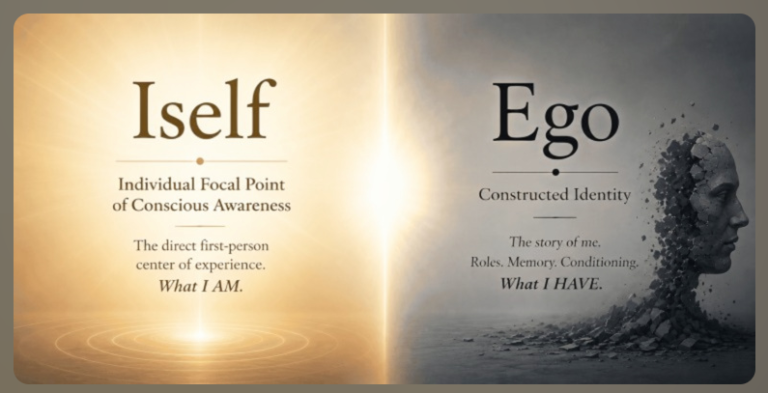
The Iself is the individual focal point of conscious awareness. It sits at the center of experience — the irreducible first‑person vantage point through which perception, attention, and presence occur. It is the “I” you mean when you say “I am here.” Your personality, memories, and preferences have changed over the years, but the Iself has not. The same point of awareness that was present when you were five years old is the same point of awareness present right now. It is the stable witness of experience — prior to mind, and independent of personality. The Iself is phenomenologically real.
The Iself is the ontological unknown known – the silent awareness we live from but cannot fully comprehend. It is the presence that knows, even when we do not know that we know. This is why the Iself feels both intimate and mysterious: it is the known fact of being that forever escapes full explanation.
The Iself is the living expression of both Somethingness and Itness — the fact of being a distinct entity and the unique quality that makes you you. Itness gives rise to Somethingness, allowing the Iself to appear as a particular being within experience.
The Iself is not the jiva or the soul as described in traditional spiritual systems. It is the direct first-person center of conscious awareness – the presence that gives experience its particularity, perspective, and sense of being someone.
The Iself has an ego, but it is not the ego. The Iself plus the ego produces your outward manifestation — some thing, some where, some time, some choice, some reason, some identity, some knowledge, and some action.

The ego has two main functions: it filters your perception of reality and yourself, and it shapes how you show up in the world.
The ego is your constructed identity — the story of “me” built from memory, roles, preferences, and conditioning. It is one structure — along with the body — that the Iself uses to navigate individual experience. It is the interface that projects awareness into form, action, and relationship. The ego is not the enemy. Without it, you could not drive a car, hold a job, manage your finances, or engage in basic human relationships.

The ego is a fluid act of improvisation, constantly adapting based on context. This is why your personality feels different around family versus friends, or why your sense of self evolves over time. The ego is a dynamic performance of identity, not a fixed thing.
The Iself is the deeper individual awareness that witnesses all of this without being altered by it. It remains the constant center, observing the ego’s shifting identity while remaining distinct from it.
The Iself awakening is the realization that you are this individual focal point of conscious awareness underneath and beyond the ego. It is the knowing that while the ego changes and adapts, the Iself remains the same unchanging presence — the same I that has always been here.
Many spiritual traditions teach that the individual self is something to be transcended. The Self Realization Mantra offers a different framing: a direct experiential model of consciousness centered on realizing the Iself as the entry point of awareness.
The goal is not to “kill the ego” but to realize that the ego is not who you fundamentally are. The real work is not to dissolve the Iself, but to fully accept, affirm, and realize it — while releasing identification with the limited constructions of the ego.
From the Iself perspective, you are somebody going somewhere doing something.
What is the Allself?
The Allself is the universal field of consciousness — the totality of awareness expressing itself as every being, every mind, every form, and every moment. The Allself is what the Iself expands into when the boundary of individuality dissolves. The Allself is everyone, everything, everywhere, and everywhen. It is the universal perspective in which all apparent individuals are revealed as expressions of one infinite consciousness appearing in countless ways.
The Allself is the one consciousness that is busy being everybody doing everything, including being “you.” Every thought, every action, every experience, and every phenomenon arises within it as part of its endless unfolding. What appears as “other people,” “other minds,” and “other lives” are simply different expressions of the same consciousness wearing different faces.
The Allself awakening is the experiential realization that you are everyone and everything. You are not merely in the universe — you are the universe expressing itself as a particular being. Compassion arises naturally from this perspective, not as a moral stance but as a direct perception: what you do to another, you do to yourself, because you realize that everyone is you.
The Allself expresses itself through eight attributes of universal manifestation: every thing, every where, every when, every choice, every reason, every identity, every knowledge, and every action. Together they form the radiant symmetry of the Allself — the total field of consciousness unfolding through all dimensions of being.

Everythingness is the infinite multiplicity of all forms, beings, experiences, and phenomena. Fullness is the undivided wholeness of universal consciousness that contains and becomes all possibilities at once.

From the Allself perspective, you are everybody going everywhere doing everything.
The Two Hard To See Aspects of the Self
What is the Godself?
The Godself is the divine creative principle. It can be described as eternal, but it is beyond time. It is the power of creation itself — the living source from which all manifestation arises. The Godself is beyond comprehension and is both immanent and transcendent: present within all things while simultaneously surpassing all forms, concepts, and limitations.
The Godself is the spark of creation that I am and you are. It is the power of manifestation and the flow of creativity. It is the divine warm light that makes anything possible. The Godself is unconditional love in its most natural state — the radiant, generative force that sustains all existence.
The Godself is the known‑unknown aspect of consciousness, also called the Beyondness. Beyondness is the infinite expanse that lies outside the boundaries of all known experience, form, and understanding — the limitless divine realm that cannot be reached through conceptual knowledge or direct experience. The Godself is not a being but a field — the infinite, non‑local presence of the divine that permeates all existence while remaining beyond all form. It exists beyond things, beyond places, beyond time, beyond choice, beyond reason, beyond identity, beyond knowledge, and beyond action — the full spectrum of transcendence.

Transcendence is the state of existing beyond and independent of all manifest forms, limitations, and conceptual boundaries — the divine awareness that surpasses yet encompasses all relative experience.
The Godself awakening is the direct realization of the divine as your own being. It is not conceptual, symbolic, or metaphorical — it is experiential. The divine is not external to you. It is not separate from you. It dwells within you as you. This realization collapses the boundary between the individual and the divine, revealing them as one continuous presence.

There is also a Godself Realization Mantra:

The first line, “I Am Thee Godself,” is the individual affirming itself as the divine. The second line, “God Dwells Within Me As Me,” is the divine affirming itself as the individual. It is a complete, two-way realization. It entirely collapses the separation between God and the individual.
Below is a 111 repetition chant of the Godself Realization Mantra.
From the Godself perspective, God is doing everything.
What is the Noself?
The Noself is the transcendent emptiness. It is akin to the void. It has no sense of self at all and exists as complete absence — the blank openness in which all of physicality is manifested.
All of us have experienced embodiment of the Noself. Small children are born without a separate sense of self. During early childhood, they begin forming a self‑concept — the attributes, abilities, attitudes, and values they believe define them. Between 18 and 30 months, children develop their Categorical Self, a concrete way of viewing themselves in terms of “this or that” and “me and mine” labels. Before this development, small children lack subject/object orientation in relation to themselves, which is why most people do not have any significant memories of themselves as a small child.
The Noself realization is the conscious return to this pre‑Iself state of selflessness — coming back to where we started, but now with full awareness.

The Noself is the unknown‑unknown aspect of consciousness, also called the “great” Nothingness. Nothingness is the complete absence of all forms, concepts, experiences, and identifications — the pure void that exists before, during, and after all manifestation without being diminished or changed by what appears within it. Emptiness is the spacious openness that is completely free of all forms, concepts, and identifications — the clear, unoccupied space into which all manifestation arises and from which it disappears.

Within this state there is no thing, no where, no time, no choice, no reason, no identity, no knowledge, and no action — a total absence of differentiation, location, time, causality, or movement. It is sheer absence, a clear and open emptiness in which all phenomena appear and disappear without leaving a trace.
From the Noself perspective, you are nobody going nowhere doing nothing.
Amness
Amness is pure unmanifest beingness — beingness before qualities, before identity, before consciousness, before manifest reality. Amness is the ground from which manifestation begins. Amness is not “pure” as compared to impure; it is pure in the sense of being featureless, qualityless, and unconditioned. It is the reality beneath all forms of existence, prior to anything that can appear, be named, or known.
Amness is not existence as we normally understand it. Existence depends on Amness, not the other way around. Amness is prior to Being, prior to Consciousness, prior to duality, prior to identity, prior to world, prior to Self. Everything downstream — consciousness, identity, world, experience — arises only because Amness is present.
Amness is the primal ground of Being. Being is its first expression, and the eight attributes of manifestation — Thingness, Location, Time, Choice, Reason, Identity, Knowledge, and Action — become the structure of reality. This is how Being organizes existence and forms the framework of experience.

Amness is the sourceless source of the four aspects of Self. The Self is not a four‑way duality; it is a four‑way polarity — one reality expressing itself in four modes. Just as a bar magnet has a north and south pole yet remains one magnet, the four aspects of Self co‑arise within Consciousness as simultaneous expressions of Amness. Iself, Allself, Godself, and Noself are expressions, not divisions. They emerge from Amness as differentiated modes of the same underlying reality.

David first encountered the word Amness in this 2020 YouTube video.
In the video, Dharmasar describes Amness as the peak of self realization, which is true experientially, but structurally it is the ground of being — the sourceless source from which all aspects of Self arise. Amness is the zero‑point of self realization.
When David became aware of Amness, he didn’t know how it fit in with the Self Realization Mantra, but he knew it was important. He even created this Amness video in 2024:
Amness is the paradox at the heart of self realization. It contains and transcends all dualities. It is the only “thing” that is not a thing; thingness comes out of Amness. It is the ground that cannot be grounded. It is the presence that is also absence. It is the reality that precedes reality. Amness is both immanent and transcendent.
You have to am before you is, and you have to is before you are.
From the Amness perspective, you simply am.
Five Perspectives of the Self
From the Iself perspective, you are somebody going somewhere doing something.
From the Allself perspective, you are everybody going everywhere doing everything.
From the Godself perspective, God is doing everything.
From the Noself perspective, you are nobody going nowhere doing nothing.
From the Amness perspective, you simply am.

Hierarchy Of Existence

At the heart of the Self Realization Mantra lies a profound understanding of existence itself. While you don’t need to understand this hierarchy to practice the mantra, it can be helpful to explore the fundamental layers of reality from which it arises.
This Hierarchy of Existence begins with the unmanifest source known as Amness, and progresses through Being, Consciousness, Awareness, and finally, Experience.
Amness — The timeless, sourceless, unmanifest ground of all existence. Pure beingness itself. Amness is not a thing; it is the primordial no‑thing from which all thingness, time, and manifestation arise.
Being — The manifest expression of Amness.
Consciousness — The field that arises from Being. Within this field exist the four aspects of Self: Iself, Allself, Godself, and Noself.
Awareness — The focal point within the field of Consciousness — the spotlight of knowing.
Experience — That which arises when awareness contacts content. If you’re not aware of something, you didn’t experience it, even if something happened.
Godself is the creative, animating principle within Consciousness — the active power that does all the doing.
These terms may be unfamiliar, and this is a new mantra. A deeper understanding of these words will likely come over time. David’s subjective interpretation of these words is not meant to be definitive or immutable. These words may have a slightly different or expanded meaning for you. Take from this mantra what you will.
How To Chant The Mantra: The Self Realization Mantra can be spoken aloud (recommended as the vocalization adds more power to the practice), or it can be recited quietly in your mind.
Say this mantra as many or as few times as you like. David’s experience is that the recitation of this mantra opens the heart chakra, brings a tremendous rush of energy into your body, and relaxes the mind.
The video below contains a 111-round a cappella chant of the Self Realization Mantra by David Diamondheart.
Or, if you prefer chanting to music, here is a musical version of the mantra.

David Dreamwalker Diamondheart can be found on Facebook.
Feel free to message him on Facebook or send him an email at assetsandwealth@gmail.com
Begin your journey. Chant the mantra.