Author: SelfRealized

  • The Sacredness of Impermanence

    There’s a common idea in many spiritual traditions that just because something is temporary, it is therefore unreal — an illusion, a dreamlike appearance, something to transcend or dismiss.

    I see it differently.

    To me, the temporary nature of things is not what makes them less real. It is precisely what makes them sacred.

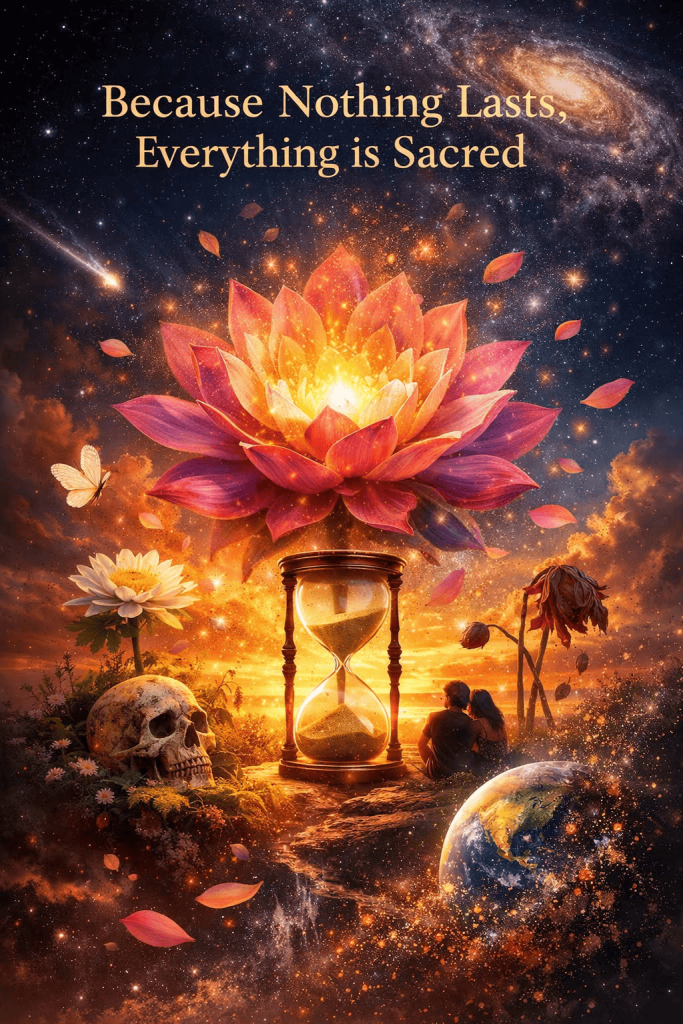
    A flower that blooms and wilts within a day is not less real because it will soon die — it is precious because it is temporary. Our bodies are real while we are alive, even though one day they will pass away. Our emotions are real while we are feeling them. A sunset is real, even though it lasts only a short time. This moment is real, even though it won’t last forever. The Earth is real, even though one day it will turn into cosmic dust.

    If we lived forever, nothing would matter.
    It is the very fact that nothing lasts that makes everything precious.

    Positive regard toward impermanence wasn’t something I chose in the sense of selecting a comforting belief. It wasn’t a preference. It was the natural outcome of my five realizations. Once I realized the Iself, the Allself, the Godself, the Noself, and finally Amness, the “everything is an illusion” worldview simply collapsed. Impermanence revealed itself as inherently meaningful – a truth I could no longer unsee. And yet it is still a worldview in the sense that every human being relates to impermanence through some lens. My realizations made this particular lens unavoidable for me, but it remains a way of seeing, a stance toward life.

    Reality is not defined by permanence. Reality is defined by presence.

    The “everything is an illusion” worldview, when taken literally, pulls people out of the present moment. It encourages a subtle dissociation — a hovering above life instead of participating in it. When we label everything unreal, we stop tasting, touching, grieving, celebrating, loving. We stop being here.

    And that’s the cost of seeing everything as unreal: it doesn’t just detach us from pain, it detaches us from joy. It categorizes love, happiness, connection, beauty, meaning, and even presence itself as illusions. It trains us to withdraw from life instead of participating in it.

    Seeing impermanence as sacred does the opposite.
    It brings us into life.

    It makes us more present, more appreciative, more awake to the fleeting beauty of each passing moment. It is a life‑affirming stance, not an escape. It honors the world instead of dismissing it. It teaches us to meet each moment with reverence, not detachment.

    Because nothing lasts, everything is sacred. 

  • Eye Gazing with the Self Realization Mantra

    There’s something uniquely powerful about two people practicing the Self Realization Mantra together while gazing into each other’s eyes.

    The Self Realization Mantra is:

    I Am Thee Iself
    I Am Thee Allself
    I Am Thee Godself
    I Am Thee Noself
    I Am Thee Amness

    How to Practice:

    Sit facing each other in a way that’s comfortable for both of you — either in chairs or sitting cross-legged on the floor. Get close enough that your knees are almost touching. Look directly into one another’s eyes and begin chanting the Self Realization Mantra together, slowly and clearly.

    Start with five minutes. If the energy feels right, keep going. Soft instrumental music and a little incense can be used to create a supportive atmosphere, but they’re completely optional.

    The Self Realization Mantra is already powerful when practiced alone. When combined with eye gazing, it takes on a whole new dimension.

    Why This Practice is So Potent:

    The mantra begins with the words “I Am Thee” on every single line. When you’re sitting close and gazing into another person’s eyes, each repetition becomes a living affirmation that you are them.

    You are not just affirming the five aspects within yourself — you are also affirming those same aspects in the person across from you.

    • I Am Thee Iself – I am an individual focal point of conscious awareness, and so are you.
    • I Am Thee Allself – I am everyone and everything, and so are you.
    • I Am Thee Godself – I am the divine creative principle, and so are you.
    • I Am Thee Noself – I am the transcendent emptiness, and so are you.
    • I Am Thee Amness – I am pure beingness, and so are you.

    This practice creates a powerful field where two people are mutually affirming each other’s true nature. It tends to dissolve the usual sense of separation and can open the heart in a very direct way.

    This is a beautiful way to practice the Self Realization Mantra with another person.

  • The Illusion of Doership

    The Self Realization Mantra points directly to five fundamental aspects of your true nature:

    I Am Thee Iself. — individual self
    I Am Thee Allself. — universal self
    I Am Thee Godself. — divine self
    I Am Thee Noself. — transcendent emptiness
    I Am Thee Amness. — pure beingness

    Most of us live with a deep, unquestioned belief: that we are the ones doing everything. That “I” am the thinker, the chooser, and the doer of my life.

    But what if that feeling is an illusion?

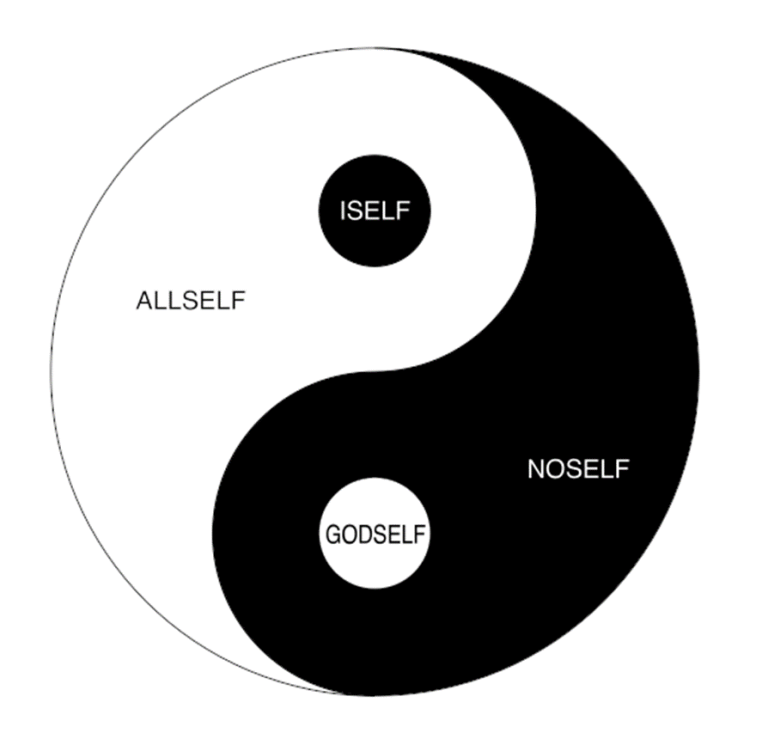
    The yin-yang symbol describes this beautifully. In it, the Iself and Godself are focal points of conscious awareness, while the Allself and Noself are vast fields of consciousness. The entire symbol represents Amness — pure beingness itself.

    Here’s how the illusion works:

    The Godself is the animating principle — the source from which all doing arises. The ego — the constructed identity built from memory, roles, and conditioning — quickly claims ownership, telling the Iself, “I did that.” The Iself then believes it is the doer.

    Sometimes this illusion suddenly breaks.

    This happens to me regularly when I’m washing my hands. One moment I’m “washing my hands,” and in the next moment, the sense of doership completely drops away. I’m no longer doing anything — I’m simply watching my hands wash each other. There is no “me” performing the action.

    I can’t say with certainty what’s happening in those moments. It feels as though the ego has stopped claiming ownership of the activity, leaving the Iself as nothing more than the silent witness. At the same time, the experience also has the flavor of Noself — the same selfless state we all lived in during the first couple years of life.

    This moment reveals something important: the Iself and Noself are not truly separate. The little black circle of Iself is made of the same substance as the vast black field of Noself.

    The Godself does everything.

    The ego claims it.

    The Iself believes it.

    But sometimes, for a brief moment, that entire illusion collapses.

    What remains is simply what is.

  • The Paradoxes of the Self Realization Mantra

    The Self Realization Mantra contains apparent contradictions.

    The paradoxes of the Self Realization Mantra aren’t a bug; they are a feature.

    I Am Thee Iself — you are an individual focal point of conscious awareness.
    I Am Thee Allself — you are everyone and everything.
    I Am Thee Godself — you are the divine creative power.
    I Am Thee Noself — you are the transcendent emptiness.
    I Am Thee Amness — you are the sourceless source of all of the above.

    These five lines seem to contradict each other. How can you be both an individual and everyone? Both divine and empty? Both something and nothing?

    The answer is that they aren’t contradictions.

    Think of water — it exists simultaneously as liquid, solid, and vapor. Each state is fully real. None cancels the others out.

    The four aspects of Self are like that — distinct modes of the same underlying reality, each genuinely real, all coexisting.

    The practice isn’t about choosing one over the others. It’s about expanding your capacity to hold all of them simultaneously without collapsing into a single rigid view.

    Individuality doesn’t negate unity. Unity doesn’t negate emptiness. Emptiness doesn’t negate the divine. The divine doesn’t negate the individual.

    You hold all four simultaneously.

    Amness sits outside this entirely. It’s not one of the four aspects — it’s what all four arise from. It’s not comparable to the others. It is the condition in which comparison itself becomes possible.

    It’s the ground, not a position on the ground.

    The paradoxes aren’t a problem. They’re the point.

  • From Spiritual Seeker to Spiritual Finder

    For many years, I identified as a spiritual seeker. Like countless others on the spiritual path, I was always searching for the next insight, the next breakthrough, the next awakening experience, or the next piece of wisdom that might finally complete the puzzle. There was always another book, another teacher, another practice, another level.

    Seeking led me to many valuable teachings, practices, and experiences. Yet over time, I began to notice something curious: the act of seeking implied that what I was looking for was somewhere else, sometime in the future, always just beyond reach.

    At some point, I realized I was not just engaging in seeking—I was being organized by the identity of a seeker. When I identified as a spiritual seeker, the assumption was already built in: what I was looking for had not yet been found. And if it had not yet been found, then the natural orientation of mind was always toward the next practice, the next teaching, the next experience, the next breakthrough. In this way, seeking can quietly reinforce itself—not because there is anything wrong with inquiry, but because identity shapes perception, and perception shapes behavior.

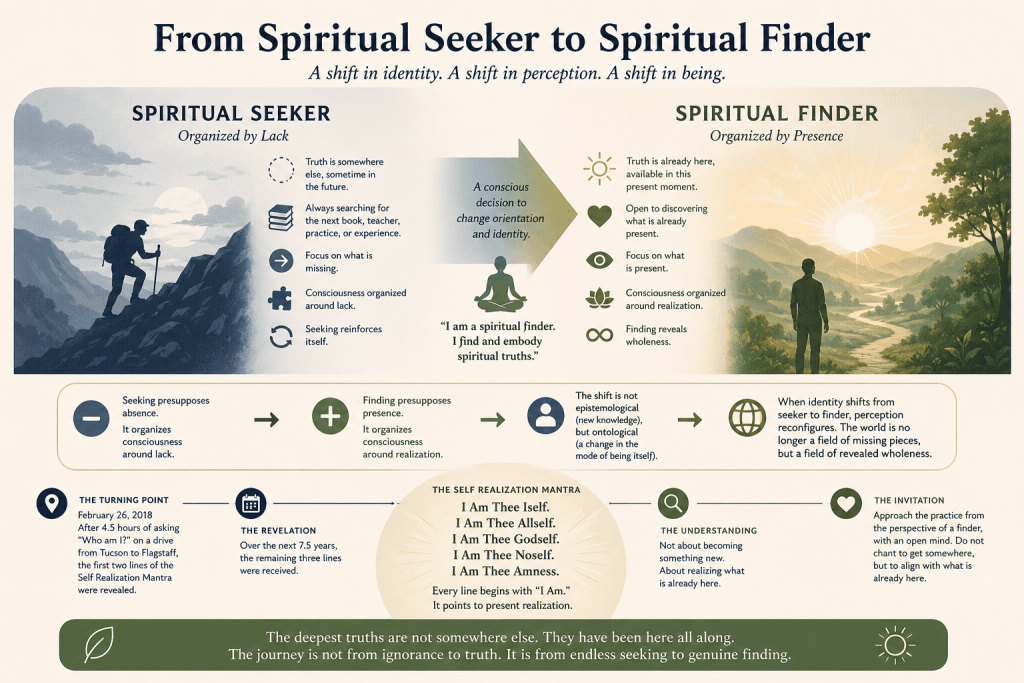
    About six months before the Self Realization Mantra was revealed to me, I made a conscious decision to change this orientation. I stopped identifying as a spiritual seeker and began identifying as a spiritual finder. I affirmed: “I am a spiritual finder. I find and embody spiritual truths.”

    At first glance, this may seem like a simple semantic shift, but for me it represented a real change in orientation. Instead of focusing on what I lacked, I began focusing on what was already present. The focus on finding opened me up to discovering spiritual truths instead of endlessly seeking them. I stopped assuming truth was somewhere else in the future and became open to what was already here.

    Seeking presupposes absence. It organizes consciousness around lack.

    Finding presupposes presence. It organizes consciousness around realization.

    The shift is not epistemological (new knowledge), but ontological (a change in the mode of being itself).

    When identity shifts from seeker to finder, perception reconfigures. The world is no longer experienced as a field of missing pieces, but as a field of revealed wholeness.

    Looking back, I am certain that this shift laid the groundwork for receiving the Self Realization Mantra.

    On February 26, 2018, after four and a half hours of repeating the question “Who am I?” during a drive from Tucson to Flagstaff, the first two lines of the Self Realization Mantra were revealed. Over the next seven and a half years, the remaining three lines were received.

    I Am Thee Iself.
    I Am Thee Allself.
    I Am Thee Godself.
    I Am Thee Noself.
    I Am Thee Amness.

    Every line begins with the words “I Am.” That is not accidental. The mantra points toward present realization rather than future attainment. It is not about becoming something new. It is about realizing what is already here. It does not point toward becoming something else. It points toward what is already present.

    This shift from seeking to finding does not mean abandoning inquiry. Genuine inquiry becomes even more important. A seeker assumes the answer is somewhere else, while a finder remains open to the possibility that what is being sought may already be present, available through direct experience.

    For me, the question “Who am I?” led to an answer—the Self Realization Mantra. Awakening can happen in an instant, but integration and embodiment are something I still work on daily.

    I invite you to work with the Self Realization Mantra from the perspective of a finder. Use your own discernment and decide if it is right for you, and whether it resonates with the truth of your being. Approach the practice from the perspective of a finder, with an open mind. Do not chant to get somewhere, but to align with what is already here.

    The deepest truths are not somewhere else. They have been here all along. In that sense, the journey is not from ignorance to truth. It is from endless seeking to genuine finding.

  • Falling Out Of Bed

    Enlightenment is NOT recognition.

    Recognition is a function of the thinking mind. The word itself literally means “to know again.” It requires memory, comparison, and thought. It is, by definition, a mental process.

    But true awakening is not a thought at all.

    It’s like falling out of bed while you’re asleep.

    One moment, you’re asleep. The next moment, you slam into the floor, and you’re suddenly, undeniably awake. You don’t think about it. You don’t analyze it. You don’t recognize anything. You just know it.

    That sudden, undeniable knowing is what awakening actually is.

  • The Pathless Path of Self Realization


    You are never lost.

    There is nowhere to go and nothing to do. And yet, here you are, chanting the Self Realization Mantra to awaken.

    This is the heart of the pathless path.

    The mantra is not a road that takes you somewhere else. It is a tool for awakening and alignment. It shifts you from intellectual understanding into deep, embodied knowing, helping you realize who and what you truly are.

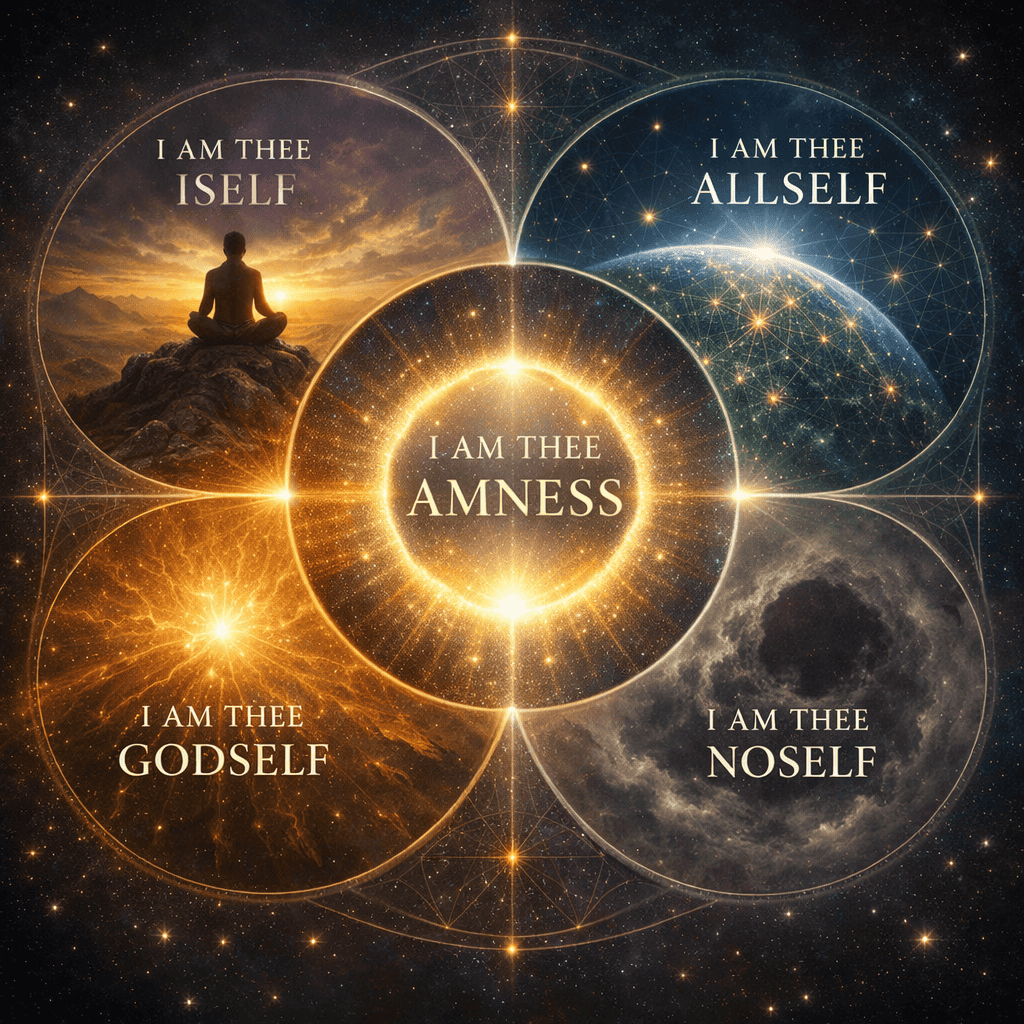
    Along the way are five signposts: Iself, Allself, Godself, Noself, and Amness. They are not destinations, but realizations of what has always been true. The first four are aspects of the Self. Amness is the pure beingness from which they arise.

    A rosebud has the potential to bloom, but it only opens when the conditions are right. The potential to awaken is already within you; it will happen when you are truly ready. If it is your time, and this mantra is the right practice for you, it will work.

    Awakening won’t magically fix your life. You may still get reactive, unconscious, or triggered. The difference is that you now have a deeper understanding of what is actually happening when those moments arise.

    Awakening is not just a peak experience. That’s when the real work begins. Integration internalizes the truth. Embodiment is living that truth in your day-to-day life. Without integration and embodiment, awakening may be of little practical use in your life.

    Here is the paradox: even though there is nowhere to go and nothing to do, the mantra is still profoundly useful. It can awaken you to your true nature.

    You have always been the Iself, Allself, Godself, Noself, and Amness.

    You were never lost.

    You only forgot who you are.

    Keep chanting. Every repetition is another opportunity to realize your true nature.

    1. The End Of Gurus

      For thousands of years, the spiritual world has repeated one central claim: “Enlightenment is ineffable. It cannot be spoken. It cannot be defined.”

      Whether that claim was made sincerely or not, it has had one unavoidable consequence: it keeps awakening mysterious, inaccessible, and dependent on those who supposedly understand it. If the truth cannot be clearly explained, then someone must always stand between you and it. The doctrine of ineffability has become the ultimate gatekeeping mechanism and the foundation of the guru industry. It keeps seekers chasing vague pointers, endless retreats, secret teachings, and decades of dependence on a spiritual middleman.

      But what if the ultimate truth isn’t a riddle? What if it’s actually simple?

      Let me define the “ineffable” in exactly two sentences:

      Self realization is a deep, transcendent knowing of your true nature. Your true nature is that you are individuality (Iself), unity (Allself), divinity (Godself), emptiness (Noself), and pure beingness (Amness)—all five at once.

      No Sanskrit required. No brain-breaking paradoxes. No “kill your ego” nihilism. Just a clear, operational definition of self realization. You don’t need a guru to translate it for you, and you don’t need to erase your individuality to discover it. You simply need the technology that allows you to realize it directly.

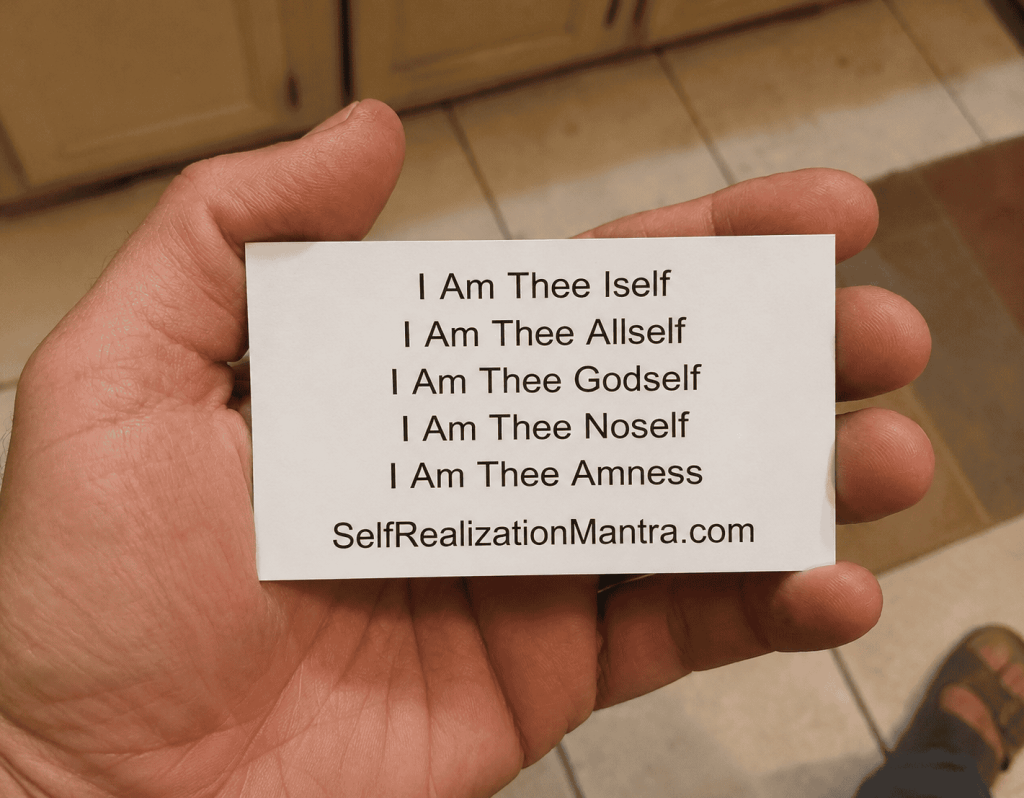
      That technology is the Self Realization Mantra. It’s only twenty words long and fits on a business card:

      I Am Thee Iself.

      I Am Thee Allself.

      I Am Thee Godself.

      I Am Thee Noself.

      I Am Thee Amness.

      Chant it. Contemplate it. Experience it. That is the real meditation.

      Now, let me be clear about the difference between a teacher and a guru. A teacher gives you the tools and empowers you to use them yourself. A guru asks you to surrender your autonomy and become permanently dependent upon them. A teacher says, “Here’s the method. Go practice it.” A guru says, “You can’t do it without me.”

      A teacher’s goal is to make themselves unnecessary. A guru’s business model is to remain indispensable.

      I am a teacher of the Self Realization Mantra. I share the method, the framework, and the map, but the Self Realization Mantra is self-contained. You don’t need me to chant it for you. You don’t need to worship me to make it work. You don’t need to give me money or kiss my feet. You simply need to practice it.

      The power is in the mantra, not in me.

      The era of needing a guru to awaken to the truth of who and what you are is coming to an end. For centuries, the map has been wrapped in mystery. Now the GPS is in your hands.

      Stop paying for the mystery.

      Start practicing the truth.

      The end of gurus isn’t a tragedy.

      It’s your liberation.

    2. The Ego Doesn’t Need to Die

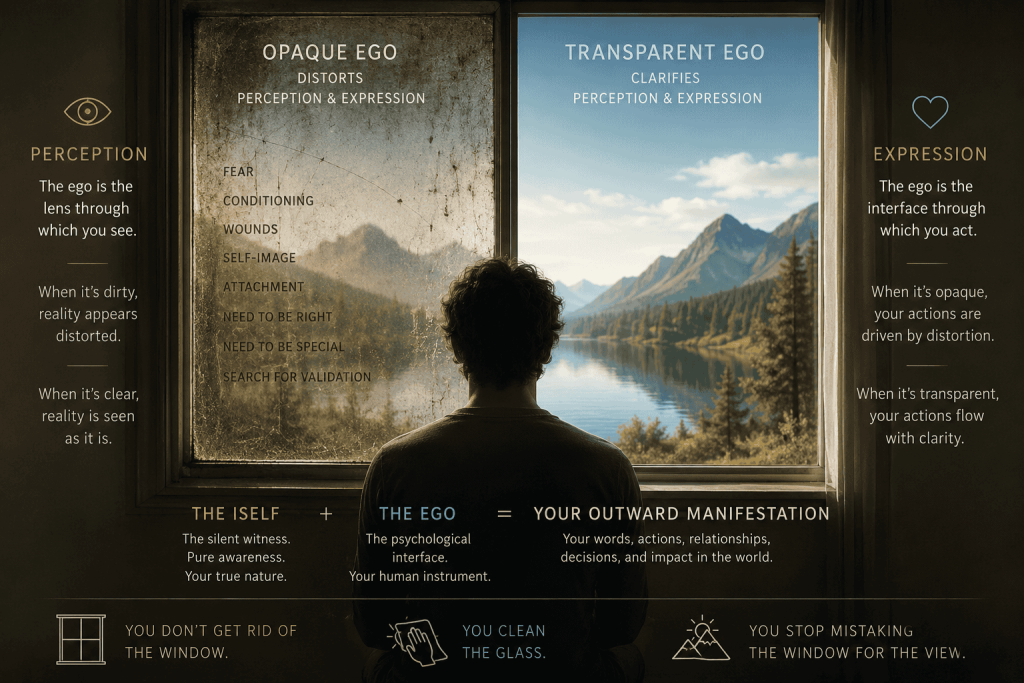
      There is a persistent myth in spiritual circles that awakening means the ego dissolves, dies, or gets destroyed. Many people chase “ego death” as though it were the finish line. But here’s what actually happens when you try to kill the ego: it simply plays dead. Or worse, it puts on spiritual robes and keeps running the show from behind the curtain. The ego doesn’t need to die. It needs to become transparent.

      The ego serves two important functions. It is both the lens through which you perceive reality and the interface through which you express yourself in the world. Think first about perception. Imagine looking through a window. When the glass is covered with dirt, scratches, and years of accumulated grime, you don’t realize you’re looking through a distorted lens. You mistake the condition of the window for reality itself. Your beliefs, fears, emotional wounds, conditioning, and self-image color everything you see. As the ego becomes more transparent, those distortions gradually fall away. The world doesn’t change. Reality doesn’t change. You simply begin seeing it more clearly.

      Now consider expression. Everything you do—your words, your actions, your relationships, your decisions, your reactions—moves through the ego before it reaches the world. This is the core mechanic: The Iself + The Ego = Your outward manifestation. The Iself is the silent witness. The ego is the psychological interface. When the ego is opaque, that outward manifestation becomes distorted by fear, attachment, insecurity, the need to be right, the need to be special, and the endless search for validation—even spiritual validation.

      As the ego becomes more transparent, those distortions begin to lose their grip. You still have a personality. You still have preferences. You still have memories, roles, and a unique history. None of that disappears. What changes is your relationship to them. They become functional rather than identificational. The ego is no longer mistaken for who you are.

      The goal isn’t to destroy the ego. The goal is to stop identifying with it. A transparent ego doesn’t disappear. It simply becomes a clearer lens through which reality is perceived and a cleaner interface through which life is expressed. You don’t get rid of the window. You clean the glass. And once the glass is clear, you stop mistaking the window for the view.

    3. Awakening Is Not The End — It’s The Beginning

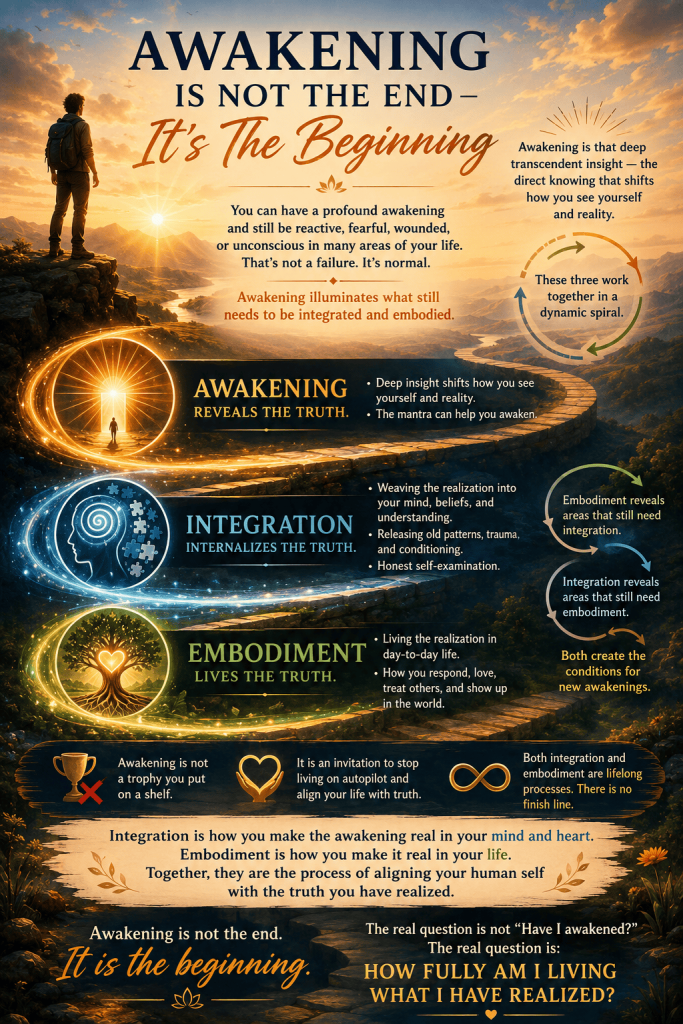
      Many people imagine that spiritual awakening is the final destination — that once you “get it,” you’re done. They believe it will permanently solve their suffering, heal all their conditioning, and instantly transform their lives.

      My experience has shown me something very different.

      Awakening is not the endpoint. It is the starting point.

      Awakening is that deep, transcendent insight — the direct knowing that shifts how you see yourself and reality. After a genuine awakening, two other major processes begin to unfold: Integration and Embodiment. These are not necessarily linear. They often overlap and interact with each other in different ways.

      Integration is the process of weaving that realization into your mind, your belief systems, and your understanding of life. It’s where old beliefs, emotional patterns, trauma, and conditioning are brought into the light of deeper knowing. This part can be uncomfortable because it requires honest self-examination.

      Embodiment is where you actually live that realization in your day-to-day life — how you respond to challenges, how you treat others, and how you carry yourself in the world.

      A simple way to understand the relationship between these three processes is this:

      Awakening reveals the truth.
      Integration internalizes the truth.
      Embodiment lives the truth.

      You can have a profound awakening and still be reactive, fearful, wounded, or unconscious in many areas of your life. That’s not a failure. It’s normal. Awakening does not instantly erase years of conditioning. Instead, it illuminates what still needs to be integrated and embodied.

      In my experience with the Self Realization Mantra, these three — Awakening, Integration, and Embodiment — work together in a dynamic spiral. Embodiment can reveal areas that still need integration. Integration can reveal areas that still need embodiment. And both integration and embodiment can create the conditions for new awakenings.

      Awakening is not a trophy you put on a shelf. It is an invitation to stop living on autopilot, to integrate the truth you have realized into every corner of your being, and to embody that truth in how you live, love, and show up in the world.

      The mantra can help you awaken. But only you can do the patient, honest work of integration and embodiment.

      Both are lifelong processes. There is no finish line.

      Integration is how you make the awakening real in your mind and heart. Embodiment is how you make it real in your life. Together, they are the process of aligning your human self with the truth you have realized.

      Awakening is not the end. It is the beginning.

      The real question is not “Have I awakened?”

      The real question is: How fully am I living what I have realized?