• Free Will and Destiny

    Have you ever regretted a decision and wondered, “Could I have chosen differently?” Or looked back on your life and thought, “Maybe everything happened exactly as it had to happen.” We all have these moments. That tension—between genuine choice and inevitable unfolding—has puzzled people for centuries.

    Free will is the ability to choose among options and be responsible for those choices. Destiny is the idea that events unfold with necessity, shaped by larger forces or patterns.

    Every choice we make feels personal. We weigh options, consider consequences, and act as if our decisions matter. Yet every choice also emerges from a chain of causes stretching back through time — genetics, conditioning, environment, trauma, culture, biology, memory, and the entire architecture of the universe that delivered us into this moment. We feel ourselves choosing, but we also feel ourselves being carried.

    This tension becomes sharper when we look closely at how the mind works. Thoughts arise on their own. Impulses appear without being summoned. Emotions surge from depths we cannot see. Even the feeling of “I choose” is something that emerges from neural processes we do not consciously control. The sense of agency is real as an experience, but its origins are hidden. We act, but we do not choose the conditions that shape our actions.

    And yet, despite all this, human beings live as if choice matters — because it does. Even if our decisions emerge from prior causes, the decisions themselves still change the trajectory of our lives. Destiny does not erase the significance of choice; it reframes it. Choice becomes the point where the entire past expresses itself into the future. Free will becomes the subjective experience of participating in that expression.

    This is where fate and destiny enter the conversation. Fate is the set of conditions you inherit — the givens, the constraints, the forces that shape the path beneath your feet. Destiny is the direction those forces move when combined with your choices. Fate is the structure. Destiny is the motion. Fate is the hand you’re dealt. Destiny is how the hand plays itself out through you. Neither one negates free will; they simply define the arena in which free will operates.

    Fate is retrospective. You only see once you’ve already walked the path. It is the map that reveals itself after the journey. You don’t recognize fate in real time. You recognize it in hindsight.

    But life doesn’t give you hindsight in advance. Life demands forward motion. You must act without knowing the pattern you’re inside. You must choose without knowing how the choice will echo. You must move without knowing what the movement will mean. Life is lived forward, blind to the coherence that will only become visible later. This is the human condition: we walk into the future without the map, and only later realize the map was there all along.

    This is the hinge between destiny and free will. Destiny explains why fate is only visible backward — because every moment is the product of causes that stretch behind you. Free will explains why life must be lived forward — because you can only respond to the moment you’re in, not the pattern you’ll eventually realize. Destiny emerges from the collision of these two truths. Destiny is fate in motion. Destiny is the forward-moving expression of a backward-visible structure.

    To live is to choose inside a pattern you cannot yet see. To understand your life is to look back and realize the pattern that was shaping your choices all along.

    Up to this point, everything can be understood without any special metaphysical framework. But there is a deeper way to look at the question — one that reveals why free will and destiny seem to be both true and false depending on where you stand. The Self Realization Mantra describes reality through multiple layers of Self, each with its own vantage point. When viewed through these layers, the debate shifts from “Which one is true?” to “Which perspective is speaking?”

    Iself (Individual Self) — the individual focal point of conscious awareness.
    Allself (Universal Self) — everyone and everything.
    Godself (Divine Self) — the divine creative principle.
    Noself (Transcendent Emptiness) — the void, the great nothingness.
    Amness (Pure Beingness) — the primal ground of being.

    From the individual perspective, free will is true. This is the dimension where life feels personal, where choices matter, and where consequences shape the direction of experience.

    From the universal perspective, free will remains true, but destiny becomes structurally true. The individual still chooses, but every choice is also part of a single unified field. The part chooses freely while the whole moves inevitably.

    From the divine perspective, free will is still true, but destiny becomes intelligently true. The individual acts and chooses authentically, yet those actions are simultaneously expressions of the divine creative principle. Choices arise freely, but they unfold within a larger coherence that moves with precision.

    From the transcendent emptiness perspective, both free will and destiny are false. The sense of a separate “I” is recognized as a construction. Actions continue to occur, but without an actor. Movement continues, but without a mover. Things get done, but there is no doer.

    From the pure beingness perspective, neither free will nor destiny are possible. Amness is the primal ground of being — the unmanifest source before anything arises, before agency, before inevitability, before the movement of life. The entire framework required for the debate exists downstream.

    Taken together, these perspectives form a coherent answer. Free will is true in the Individual Self, Universal Self, and Divine Self perspectives. Destiny is true in the Universal Self and Divine Self perspectives. Both are false in the Transcendent Emptiness perspective. And both are impossible in Pure Beingness. Each perspective is true from within itself, and none contradict the others — they simply operate at different depths of reality.

    Maturity is the ability to hold all five perspectives at once without collapsing them into one final answer. Free will and destiny are not opposites to be reconciled; they are truths that arise, dissolve, or never appear depending on the perspective being spoken from. The question is not “Which one is true?” but “Which perspective are we speaking from.”

  • The Acceptance Mantra

    I accept everything as it is.
    I accept everyone as they are.
    I accept myself as I am.

    When you stop trying to change the world, other people, and yourself, you can find peace in the present moment.
    Right here. Right now.

    This isn’t about avoiding change — make changes when/if you can. It’s about dropping the fight with reality.

    There may be things about the world, other people, and yourself that you can’t accept right now — so accept your nonacceptance.

    Radical acceptance is the only way to inner peace.

  • The Projector Metaphor: Iself, Ego, and Experience

    The Projector Metaphor: Iself, Ego, and Experience

    Imagine an old-fashioned film projector in a dark theater.

    The projector is turned on. Its bright light is shining. The light passes through a lens that focuses it, then through a film reel that contains the content. The light, now focused and shaped, hits the screen and creates the movie.

    This is exactly how your consciousness works.


    The Projector = The Iself (The Focal Point of Conscious Awareness)

    The projector is the Iself. It has two components: the light source, which is pure, unconditioned awareness (constant and unchanging), and the lens, which is the focusing mechanism that creates the individual point of view (dynamic and adjustable).

    The projector doesn’t create the movie or the screen. It simply illuminates and focuses what is already there, making perception possible. The projector was here before the movie started and will be here after the movie ends. The light source remains constant, steady, and unchanging, but the focus can shift. The lens can zoom in, zoom out, change perspective, and adjust its point of view.

    You are the projector. You are the awareness that perceives, and you can choose where to focus that awareness.


    The Film Reel = The Ego (The Content)

    The film reel is the ego. It is your constructed identity. It is the literal, biographical, first-person story of your specific life.

    But here’s the key: Every piece of content on that film is organized around “me.” It is not just random data; it is a highly specific filter made up of your memories, your conditioning, your traumas, your roles, what you fear, what you desire, and how you interpret it all. The entire film projects a first-person perspective. It’s content specifically filtered through the concept of “me.”

    The film reel doesn’t do anything. It is just content. It sits in the machine. When the light of the Iself shines through it, that “me” content is what creates the images on the screen and the narrative that goes along with that.

    You are not the film. You are the projector (light + lens) that shines through it.


    The Screen = Experience (The World)

    The screen is the canvas of reality. It is what’s actually happening: the events, the people, the circumstances, the phenomena, the world. The screen exists independently of the film and is not created by your ego. It just IS. Events unfold. Reality happens.

    But when the light of the Iself shines through the “me” content of the ego, the image that appears on that screen is the first-person perspective of your life.

    It’s not just “a story.” It’s “MY story.” It’s “shit that happened to me.” It’s “MY problems” and “MY joy”—the entire narrative organized around the central character: “me.”

    Most people think they are the character in that story. They believe they are just someone going somewhere doing something—and from the Iself vantage point, that’s absolutely true. But they think that’s all there is. They get completely lost in the plot. When the story gets scary, they feel fear. When it gets sad, they feel sorrow. And that is perfectly human.

    The trap isn’t feeling the emotions; the trap is identifying with them. Instead of saying, “I am feeling sad,” they say, “I am sad.” They don’t just feel the emotion, they identify their “I am” as the emotion. They forget they are the projector illuminating the screen, not the character trapped in the plot.

    You are not ONLY the first-person perspective of your life. You are what makes the story visible.


    Here’s the critical distinction:

    The screen (what is actually happening) might be the exact same for two people, and the light of awareness (the Iself) is the exact same. But when that light shines through different “me” content on their film reels, completely different first-person perspectives are projected.

    One person’s film projects: “I was victimized. Things happened to me. I am a victim.” Another person’s film projects: “I was blessed. Things happened for me. I am grateful.” A third person’s film projects: “Nothing matters. I am alone. I am disconnected.”

    The exact same reality, the exact same light, but a completely different experience.

    The ego is not the perceiver. The ego is not the experience. The ego is just the “me” content that shapes the first-person perspective.


    Without the projector, there is no light.
    Without the light, the film is just a reel of plastic.
    Without the film, the screen is blank.

    All three are needed to create the experience of being someone going somewhere doing something. But here is what you need to understand: The ego cannot exist without the Iself. The film reel is dead content without the projector’s light shining through it. The ego only has power because you keep feeding it your awareness. You keep identifying with it. You keep shining your light through it.


    Iself Realization: You Are the Projector

    Iself realization is the moment you turn around in the theater and see it clearly: “Oh my god. I’m not the character in the story. I’m not even the film running through the projector. I’m the projector itself. I’m the light and the lens.” The movie keeps playing, the ego keeps narrating, the film keeps running, and the first-person perspective of your life keeps unfolding. You still feel joy, sorrow, fear, and love — all of it — but you’re no longer trapped in the plot. You see the film for what it is: “me” content, conditioning, just a first-person perspective passing through your light.

    We are narrative creatures by nature, and the ego is the voiceover commentary constantly running in the background. The goal isn’t to kill the ego. The goal is to make it quiet enough that you can actually enjoy the show without the commentary drowning everything out.

    When the ego’s commentary quiets, the movie keeps running, and what remains is the raw frame of experience without interpretation.

    You can feel sadness without becoming sadness. You can watch the “me” content without being the “me” content. You can experience the world without getting swallowed by the world.

    You realize: You are the projector, not the projection.


    Noself Realization: You Take the Film Out

    Noself realization is when you remove the film reel entirely and just let the pure, unfiltered light shine directly onto the screen.

    There is no story, no character, no “me,” no “me” content, no conditioning, and no first-person perspective. There is no someone going somewhere doing something and no “things that happened to me.” Just pure, unfiltered awareness of what is.

    This is the void. This is the great Nothingness. This is nobody going nowhere doing nothing. The projector is still on and the light is still shining, but there is no film running through it anymore. The light just hits the screen directly. No plot, no drama, no identity.


    The Freedom

    Here is the ultimate freedom: You don’t have to smash the projector, destroy the screen, or even get rid of the film. You just have to realize what you actually are.

    Once you know you’re the projector—not the film, not the character—you can choose which film to run. You can heal the ego (repair the film), change the “me” content (swap the reel), or just take it all out and rest as the pure, unfiltered light. But you can never go back to thinking you’re just the character in the first-person perspective.

    When you know you’re the projector, the movie loses its power over you.

    You are free.

  • The Iself: The Doorway To Awakening

    The Self Realization Mantra is a spiritual awakening technology, not a religion. It makes no claims about the soul, karma, reincarnation, or what happens after you die. Instead, it offers a direct path to fully realize who you are at the deepest levels.


    The Self Realization Mantra

    I Am Thee Iself.
    I Am Thee Allself.
    I Am Thee Godself.
    I Am Thee Noself.
    I Am Thee Amness.

    The Iself is the entry point — the doorway to awakening.

    The Iself is the individual focal point of conscious awareness. It sits at the center of experience — the irreducible first‑person vantage point through which perception, attention, and presence occur. It is the “I” you mean when you say “I am here.” Your personality, memories, and preferences have changed over the years, but the Iself has not. The same point of awareness that was present when you were five years old is the same point of awareness present right now. It is the stable witness of experience — prior to mind, and independent of personality.

    The Iself is the ontological unknown known – the silent awareness we live from but cannot fully comprehend. It is the presence that knows, even when we do not know that we know. This is why the Iself feels both intimate and mysterious: it is the known fact of being that forever escapes full explanation.

    The Iself is the living expression of both Somethingness and Itness — the fact of being a distinct entity and the unique quality that makes you you. Itness gives rise to Somethingness, allowing the Iself to appear as a particular being within experience.

    The Iself is not the jiva or the soul as described in traditional spiritual systems. It is the direct first-person center of conscious awareness – the presence that gives experience its particularity, perspective, and sense of being someone.

    From the Iself perspective, you are someone going somewhere doing something.

    The Iself has an ego, but it is not the ego. The Iself plus the ego produces your outward manifestation — some thing, some where, some time, some choice, some reason, some identity, some knowledge, and some action.

    The ego has two main functions: it filters your perception of reality and yourself, and it shapes how you show up in the world.

    The ego is your constructed identity — the story of “me” built from memory, roles, preferences, and conditioning. It is one structure — along with the body — that the Iself uses to navigate individual experience. It is the interface that projects awareness into form, action, and relationship.

    The ego is a fluid act of improvisation, constantly adapting based on context. This is why your personality feels different around family versus friends, or why your sense of self evolves over time. The ego is a dynamic performance of identity, not a fixed thing.

    The Iself is the deeper individual awareness that witnesses all of this without being altered by it. It remains the constant center, observing the ego’s shifting identity while remaining distinct from it.

    The Iself awakening is the realization that you are this individual focal point of conscious awareness underneath and beyond the ego. It is the knowing that while the ego changes and adapts, the Iself remains the same unchanging presence — the same I that has always been here.

    Many spiritual traditions teach that the individual self is something to be transcended. The Self Realization Mantra offers a different framing: a direct experiential model of consciousness centered on realizing the Iself as the entry point of awareness.

    The goal is not to “kill the ego” but to realize that the ego is not who you fundamentally are. The real work is not to dissolve the Iself, but to fully accept, affirm, and realize it — while releasing identification with the limited constructions of the ego.

  • The Multi-Dimensional Self: Holding Five Perspectives at Once

    I Am Thee Iself.
    I Am Thee Allself.
    I Am Thee Godself.
    I Am Thee Noself.
    I Am Thee Amness.

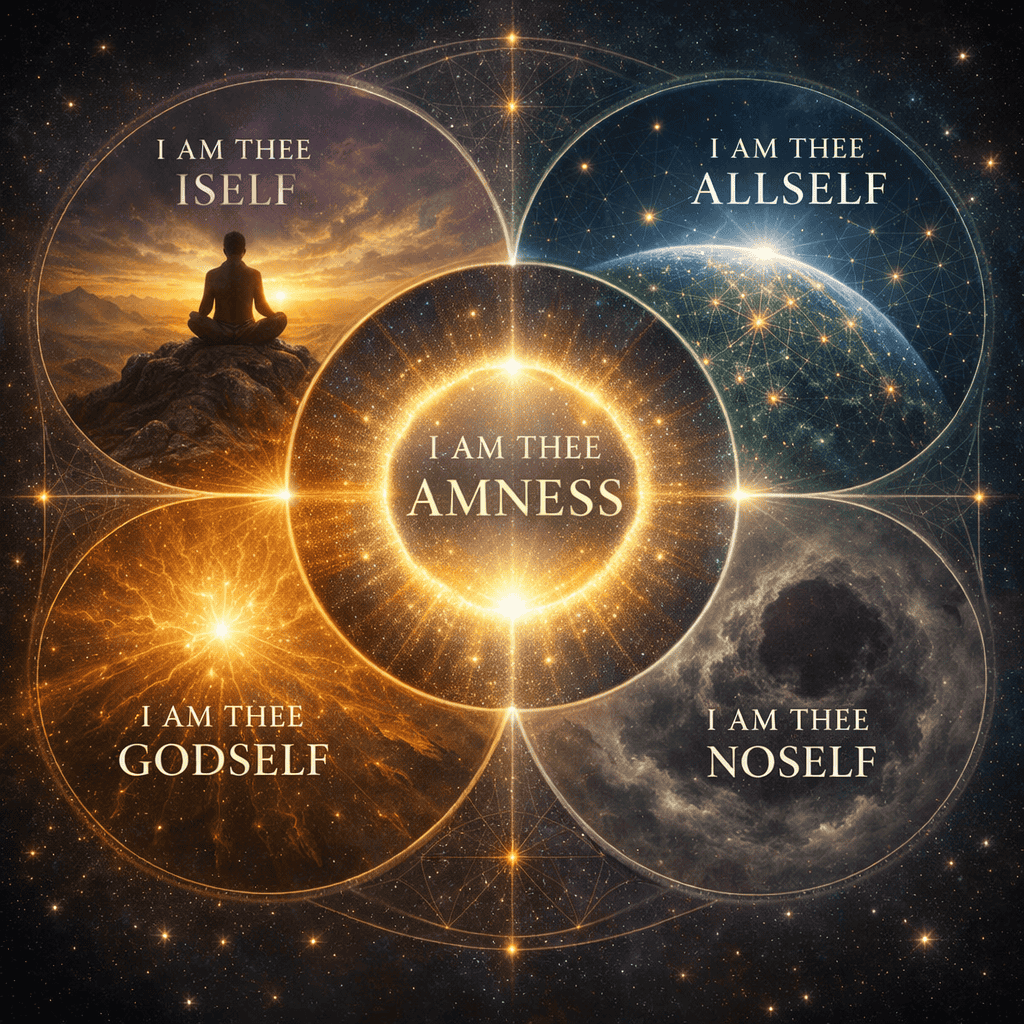
    The Self Realization Mantra presents a five-fold architecture of identity that reveals the multi-dimensional nature of the Self. Each line opens into a distinct vantage point of consciousness — Iself as the individual focal point of conscious awareness, Allself as everyone and everything, Godself as the divine creative principle, Noself as the transcendent emptiness, and Amness as pure beingness, the sourceless source beyond all vantage points. Together, they form a continuum of awakening that describes the full spectrum of what it means to be self realized.

    The mantra functions as a spiritual awakening technology. Its purpose is to initiate or potentiate awakenings across these five dimensions: the individual Iself, the universal Allself, the divine Godself, the empty Noself, and the pure beingness of Amness. Each line carries a different frequency of realization, and each one opens into a different vantage point on reality — except Amness, which is the sourceless source beyond all vantage points. The Self Realization Mantra is both a map and a catalyst. It describes the architecture of realization while simultaneously facilitating awakening into each of its dimensions.

    Awakening reveals the truth.
    Integration internalizes the truth.
    Embodiment lives the truth.

    Awakening as the Iself is the realization of your individual focal point of conscious awareness underneath and beyond the ego. The Iself is the aperture through which consciousness localizes as “this one.” It is the center of experience, the locus of embodiment, and the point where agency arises.
    From the Iself perspective, you are someone going somewhere doing something.

    Awakening as the Allself is the realization that you are everyone and everything. The Allself is the universal dimension of consciousness — the seamless field in which all beings and all experiences express the same underlying Self. Compassion emerges naturally, not as a moral stance but as the inevitable outcome of seeing everyone as yourself.
    From the Allself perspective, you are everyone going everywhere doing everything.

    Awakening as the Godself is the realization of yourself as the divine creative principle. The Godself perceives reality as purposeful and ordered. It is the dimension of sovereign creativity, luminous intelligence, and generative power — the vantage point from which creation is understood as happening through you, as you, and for you.
    From the Godself perspective, God is doing it all.

    Awakening as the Noself is the realization of yourself as the transcendent emptiness. The Noself is pure openness, the silent field in which all perspectives arise and dissolve without belonging to anyone. It is absolute liberation: the end of identity, the end of location, the end of the experiencer.
    From the Noself perspective, you are nobody going nowhere doing nothing.

    Awakening as Amness is the realization of pure beingness — the sourceless source, prior to all perspectives. Amness is not a vantage point; it is the unmanifest essence from which all vantage points emerge. It is the stillness beneath individuality, universality, divinity, and emptiness.

    The ultimate aim is not to remain in any single perspective. Each perspective is true, but none is complete on its own. Maturity is the ability to hold all five simultaneously — to live as the individual Iself, to perceive from the universal Allself, to act from the divine Godself, to rest in the transcendent emptiness of Noself, and to abide as the pure beingness of Amness.

    To hold all five perspectives at once is to live as a whole being. It is to see that individuality and universality are not opposites, that divinity and emptiness are not mutually exclusive, and that pure beingness is not separate from the world of form.

    When the Multi-Dimensional Self is realized, you awaken as these perspectives — and integration and embodiment become the art of holding them together.

    This is the invitation of the Self Realization Mantra: not to choose one identity, but to awaken as all of them; not to transcend the world, but to inhabit it from every dimension of Self; not to dissolve into emptiness, but to include emptiness as one facet of a larger wholeness. The Multi-Dimensional Self is what is realized — and awakening is the beginning of living its full spectrum.

  • The Sacredness of Impermanence

    There’s a common idea in many spiritual traditions that just because something is temporary, it is therefore unreal — an illusion, a dreamlike appearance, something to transcend or dismiss.

    I see it differently.

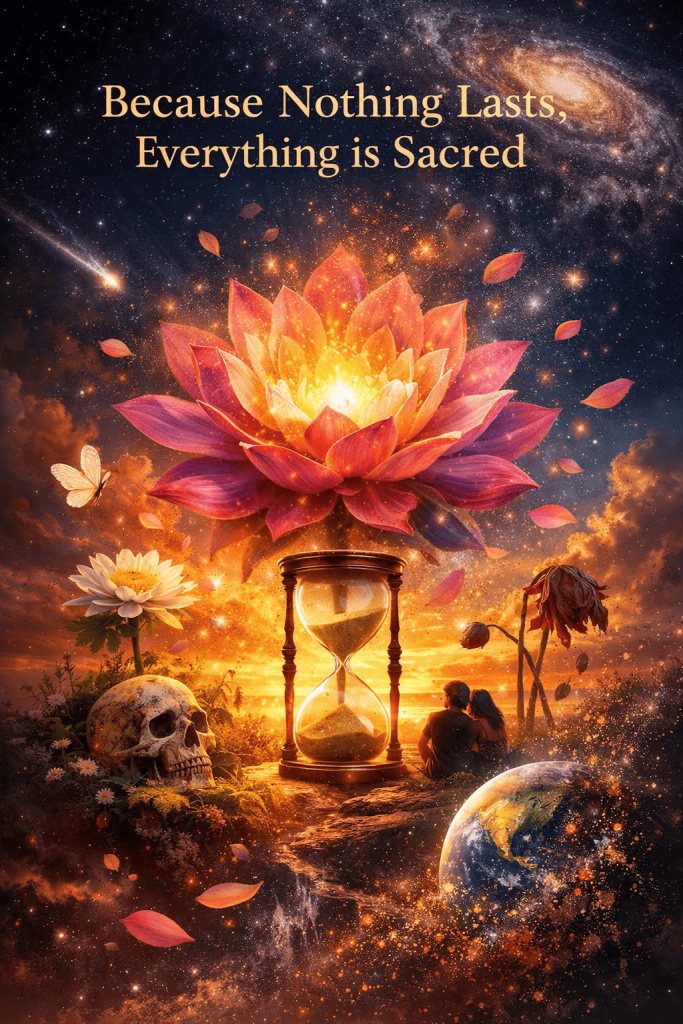
    To me, the temporary nature of things is not what makes them less real. It is precisely what makes them sacred.

    A flower that blooms and wilts within a day is not less real because it will soon die — it is precious because it is temporary. Our bodies are real while we are alive, even though one day they will pass away. Our emotions are real while we are feeling them. A sunset is real, even though it lasts only a short time. This moment is real, even though it won’t last forever. The Earth is real, even though one day it will turn into cosmic dust.

    If we lived forever, nothing would matter.
    It is the very fact that nothing lasts that makes everything precious.

    Positive regard toward impermanence wasn’t something I chose in the sense of selecting a comforting belief. It wasn’t a preference. It was the natural outcome of my five realizations. Once I realized the Iself, the Allself, the Godself, the Noself, and finally Amness, the “everything is an illusion” worldview simply collapsed. Impermanence revealed itself as inherently meaningful – a truth I could no longer unsee. And yet it is still a worldview in the sense that every human being relates to impermanence through some lens. My realizations made this particular lens unavoidable for me, but it remains a way of seeing, a stance toward life.

    Reality is not defined by permanence. Reality is defined by presence.

    The “everything is an illusion” worldview, when taken literally, pulls people out of the present moment. It encourages a subtle dissociation — a hovering above life instead of participating in it. When we label everything unreal, we stop tasting, touching, grieving, celebrating, loving. We stop being here.

    And that’s the cost of seeing everything as unreal: it doesn’t just detach us from pain, it detaches us from joy. It categorizes love, happiness, connection, beauty, meaning, and even presence itself as illusions. It trains us to withdraw from life instead of participating in it.

    Seeing impermanence as sacred does the opposite.
    It brings us into life.

    It makes us more present, more appreciative, more awake to the fleeting beauty of each passing moment. It is a life‑affirming stance, not an escape. It honors the world instead of dismissing it. It teaches us to meet each moment with reverence, not detachment.

    Because nothing lasts, everything is sacred. 

  • Eye Gazing with the Self Realization Mantra

    There’s something uniquely powerful about two people practicing the Self Realization Mantra together while gazing into each other’s eyes.

    The Self Realization Mantra is:

    I Am Thee Iself
    I Am Thee Allself
    I Am Thee Godself
    I Am Thee Noself
    I Am Thee Amness

    How to Practice:

    Sit facing each other in a way that’s comfortable for both of you — either in chairs or sitting cross-legged on the floor. Get close enough that your knees are almost touching. Look directly into one another’s eyes and begin chanting the Self Realization Mantra together, slowly and clearly.

    Start with five minutes. If the energy feels right, keep going. Soft instrumental music and a little incense can be used to create a supportive atmosphere, but they’re completely optional.

    The Self Realization Mantra is already powerful when practiced alone. When combined with eye gazing, it takes on a whole new dimension.

    Why This Practice is So Potent:

    The mantra begins with the words “I Am Thee” on every single line. When you’re sitting close and gazing into another person’s eyes, each repetition becomes a living affirmation that you are them.

    You are not just affirming the five aspects within yourself — you are also affirming those same aspects in the person across from you.

    • I Am Thee Iself – I am an individual focal point of conscious awareness, and so are you.
    • I Am Thee Allself – I am everyone and everything, and so are you.
    • I Am Thee Godself – I am the divine creative principle, and so are you.
    • I Am Thee Noself – I am the transcendent emptiness, and so are you.
    • I Am Thee Amness – I am pure beingness, and so are you.

    This practice creates a powerful field where two people are mutually affirming each other’s true nature. It tends to dissolve the usual sense of separation and can open the heart in a very direct way.

    This is a beautiful way to practice the Self Realization Mantra with another person.

  • The Illusion of Doership

    The Self Realization Mantra points directly to five fundamental aspects of your true nature:

    I Am Thee Iself. — individual self
    I Am Thee Allself. — universal self
    I Am Thee Godself. — divine self
    I Am Thee Noself. — transcendent emptiness
    I Am Thee Amness. — pure beingness

    Most of us live with a deep, unquestioned belief: that we are the ones doing everything. That “I” am the thinker, the chooser, and the doer of my life.

    But what if that feeling is an illusion?

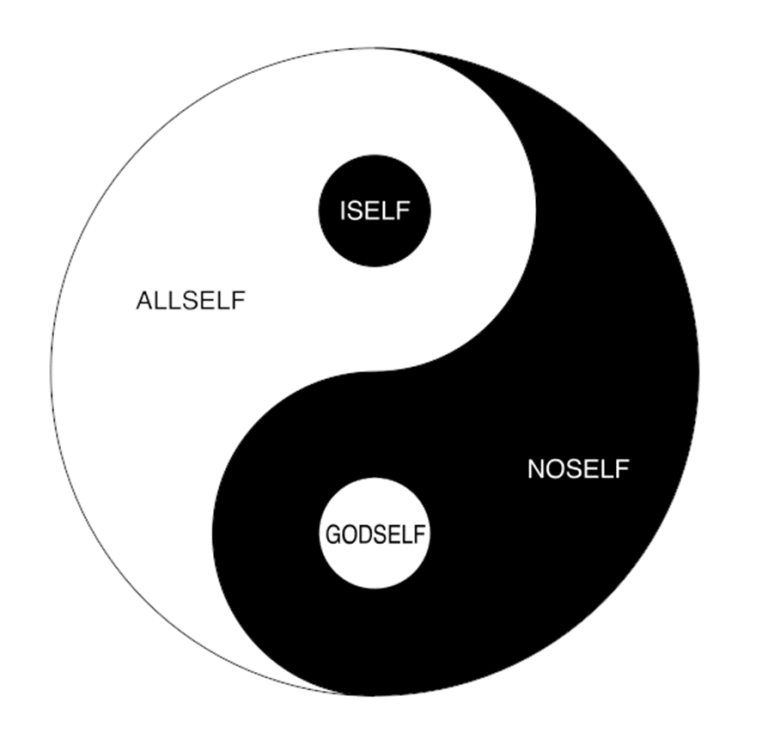
    The yin-yang symbol describes this beautifully. In it, the Iself and Godself are focal points of conscious awareness, while the Allself and Noself are vast fields of consciousness. The entire symbol represents Amness — pure beingness itself.

    Here’s how the illusion works:

    The Godself is the animating principle — the source from which all doing arises. The ego — the constructed identity built from memory, roles, and conditioning — quickly claims ownership, telling the Iself, “I did that.” The Iself then believes it is the doer.

    Sometimes this illusion suddenly breaks.

    This happens to me regularly when I’m washing my hands. One moment I’m “washing my hands,” and in the next moment, the sense of doership completely drops away. I’m no longer doing anything — I’m simply watching my hands wash each other. There is no “me” performing the action.

    I can’t say with certainty what’s happening in those moments. It feels as though the ego has stopped claiming ownership of the activity, leaving the Iself as nothing more than the silent witness. At the same time, the experience also has the flavor of Noself — the same selfless state we all lived in during the first couple years of life.

    This moment reveals something important: the Iself and Noself are not truly separate. The little black circle of Iself is made of the same substance as the vast black field of Noself.

    The Godself does everything.

    The ego claims it.

    The Iself believes it.

    But sometimes, for a brief moment, that entire illusion collapses.

    What remains is simply what is.

  • The Paradoxes of the Self Realization Mantra

    The Self Realization Mantra contains apparent contradictions.

    The paradoxes of the Self Realization Mantra aren’t a bug; they are a feature.

    I Am Thee Iself — you are an individual focal point of conscious awareness.
    I Am Thee Allself — you are everyone and everything.
    I Am Thee Godself — you are the divine creative power.
    I Am Thee Noself — you are the transcendent emptiness.
    I Am Thee Amness — you are the sourceless source of all of the above.

    These five lines seem to contradict each other. How can you be both an individual and everyone? Both divine and empty? Both something and nothing?

    The answer is that they aren’t contradictions.

    Think of water — it exists simultaneously as liquid, solid, and vapor. Each state is fully real. None cancels the others out.

    The four aspects of Self are like that — distinct modes of the same underlying reality, each genuinely real, all coexisting.

    The practice isn’t about choosing one over the others. It’s about expanding your capacity to hold all of them simultaneously without collapsing into a single rigid view.

    Individuality doesn’t negate unity. Unity doesn’t negate emptiness. Emptiness doesn’t negate the divine. The divine doesn’t negate the individual.

    You hold all four simultaneously.

    Amness sits outside this entirely. It’s not one of the four aspects — it’s what all four arise from. It’s not comparable to the others. It is the condition in which comparison itself becomes possible.

    It’s the ground, not a position on the ground.

    The paradoxes aren’t a problem. They’re the point.

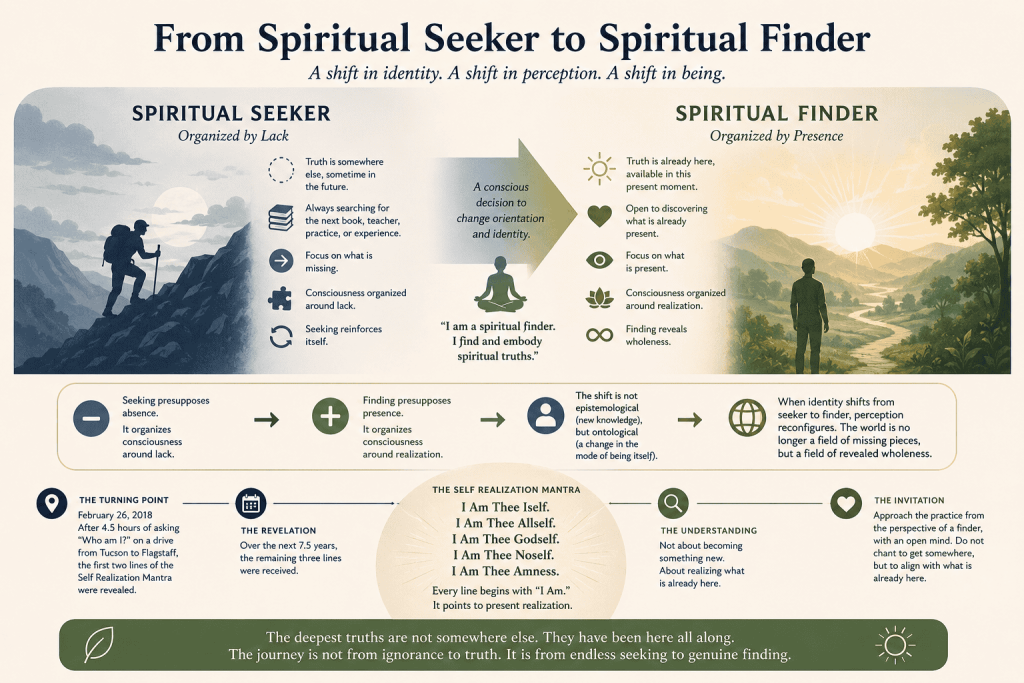
  • From Spiritual Seeker to Spiritual Finder

    For many years, I identified as a spiritual seeker. Like countless others on the spiritual path, I was always searching for the next insight, the next breakthrough, the next awakening experience, or the next piece of wisdom that might finally complete the puzzle. There was always another book, another teacher, another practice, another level.

    Seeking led me to many valuable teachings, practices, and experiences. Yet over time, I began to notice something curious: the act of seeking implied that what I was looking for was somewhere else, sometime in the future, always just beyond reach.

    At some point, I realized I was not just engaging in seeking—I was being organized by the identity of a seeker. When I identified as a spiritual seeker, the assumption was already built in: what I was looking for had not yet been found. And if it had not yet been found, then the natural orientation of mind was always toward the next practice, the next teaching, the next experience, the next breakthrough. In this way, seeking can quietly reinforce itself—not because there is anything wrong with inquiry, but because identity shapes perception, and perception shapes behavior.

    About six months before the Self Realization Mantra was revealed to me, I made a conscious decision to change this orientation. I stopped identifying as a spiritual seeker and began identifying as a spiritual finder. I affirmed: “I am a spiritual finder. I find and embody spiritual truths.”

    At first glance, this may seem like a simple semantic shift, but for me it represented a real change in orientation. Instead of focusing on what I lacked, I began focusing on what was already present. The focus on finding opened me up to discovering spiritual truths instead of endlessly seeking them. I stopped assuming truth was somewhere else in the future and became open to what was already here.

    Seeking presupposes absence. It organizes consciousness around lack.

    Finding presupposes presence. It organizes consciousness around realization.

    The shift is not epistemological (new knowledge), but ontological (a change in the mode of being itself).

    When identity shifts from seeker to finder, perception reconfigures. The world is no longer experienced as a field of missing pieces, but as a field of revealed wholeness.

    Looking back, I am certain that this shift laid the groundwork for receiving the Self Realization Mantra.

    On February 26, 2018, after four and a half hours of repeating the question “Who am I?” during a drive from Tucson to Flagstaff, the first two lines of the Self Realization Mantra were revealed. Over the next seven and a half years, the remaining three lines were received.

    I Am Thee Iself.
    I Am Thee Allself.
    I Am Thee Godself.
    I Am Thee Noself.
    I Am Thee Amness.

    Every line begins with the words “I Am.” That is not accidental. The mantra points toward present realization rather than future attainment. It is not about becoming something new. It is about realizing what is already here. It does not point toward becoming something else. It points toward what is already present.

    This shift from seeking to finding does not mean abandoning inquiry. Genuine inquiry becomes even more important. A seeker assumes the answer is somewhere else, while a finder remains open to the possibility that what is being sought may already be present, available through direct experience.

    For me, the question “Who am I?” led to an answer—the Self Realization Mantra. Awakening can happen in an instant, but integration and embodiment are something I still work on daily.

    I invite you to work with the Self Realization Mantra from the perspective of a finder. Use your own discernment and decide if it is right for you, and whether it resonates with the truth of your being. Approach the practice from the perspective of a finder, with an open mind. Do not chant to get somewhere, but to align with what is already here.

    The deepest truths are not somewhere else. They have been here all along. In that sense, the journey is not from ignorance to truth. It is from endless seeking to genuine finding.