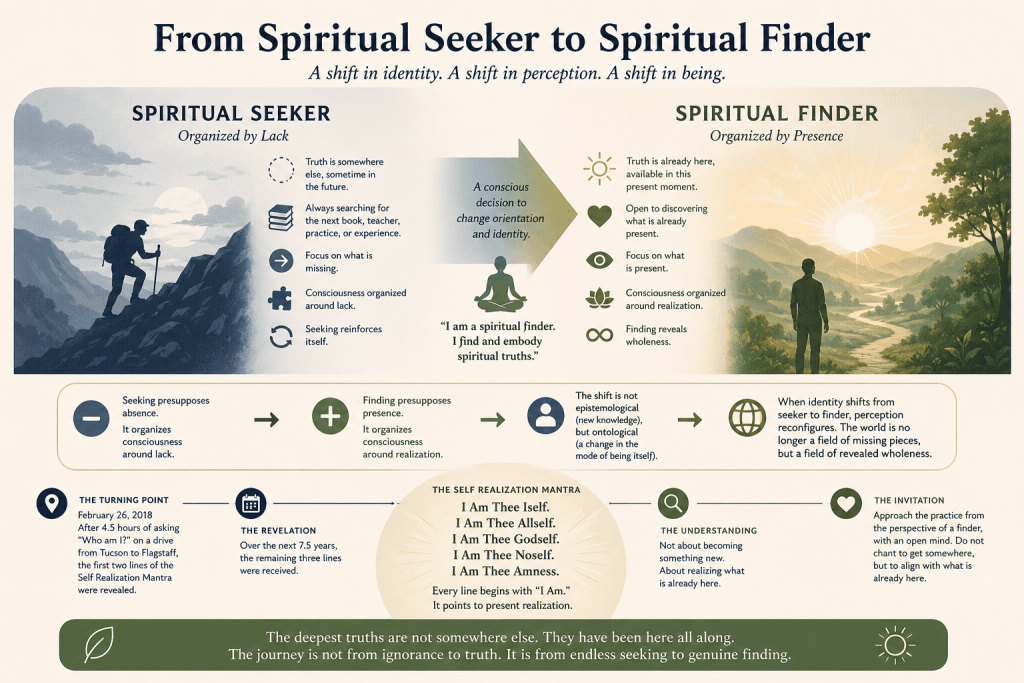
For many years, I identified as a spiritual seeker. Like countless others on the spiritual path, I was always searching for the next insight, the next breakthrough, the next awakening experience, or the next piece of wisdom that might finally complete the puzzle. There was always another book, another teacher, another practice, another level.
Seeking led me to many valuable teachings, practices, and experiences. Yet over time, I began to notice something curious: the act of seeking implied that what I was looking for was somewhere else, sometime in the future, always just beyond reach.
At some point, I realized I was not just engaging in seeking—I was being organized by the identity of a seeker. When I identified as a spiritual seeker, the assumption was already built in: what I was looking for had not yet been found. And if it had not yet been found, then the natural orientation of mind was always toward the next practice, the next teaching, the next experience, the next breakthrough. In this way, seeking can quietly reinforce itself—not because there is anything wrong with inquiry, but because identity shapes perception, and perception shapes behavior.
About six months before the Self Realization Mantra was revealed to me, I made a conscious decision to change this orientation. I stopped identifying as a spiritual seeker and began identifying as a spiritual finder. I affirmed: “I am a spiritual finder. I find and embody spiritual truths.”
At first glance, this may seem like a simple semantic shift, but for me it represented a real change in orientation. Instead of focusing on what I lacked, I began focusing on what was already present. The focus on finding opened me up to discovering spiritual truths instead of endlessly seeking them. I stopped assuming truth was somewhere else in the future and became open to what was already here.
Seeking presupposes absence. It organizes consciousness around lack.
Finding presupposes presence. It organizes consciousness around realization.
The shift is not epistemological (new knowledge), but ontological (a change in the mode of being itself).
When identity shifts from seeker to finder, perception reconfigures. The world is no longer experienced as a field of missing pieces, but as a field of revealed wholeness.
Looking back, I am certain that this shift laid the groundwork for receiving the Self Realization Mantra.
On February 26, 2018, after four and a half hours of repeating the question “Who am I?” during a drive from Tucson to Flagstaff, the first two lines of the Self Realization Mantra were revealed. Over the next seven and a half years, the remaining three lines were received.
I Am Thee Iself.
I Am Thee Allself.
I Am Thee Godself.
I Am Thee Noself.
I Am Thee Amness.
Every line begins with the words “I Am.” That is not accidental. The mantra points toward present realization rather than future attainment. It is not about becoming something new. It is about realizing what is already here. It does not point toward becoming something else. It points toward what is already present.
This shift from seeking to finding does not mean abandoning inquiry. Genuine inquiry becomes even more important. A seeker assumes the answer is somewhere else, while a finder remains open to the possibility that what is being sought may already be present, available through direct experience.
For me, the question “Who am I?” led to an answer—the Self Realization Mantra. Awakening can happen in an instant, but integration and embodiment are something I still work on daily.
I invite you to work with the Self Realization Mantra from the perspective of a finder. Use your own discernment and decide if it is right for you, and whether it resonates with the truth of your being. Approach the practice from the perspective of a finder, with an open mind. Do not chant to get somewhere, but to align with what is already here.
The deepest truths are not somewhere else. They have been here all along. In that sense, the journey is not from ignorance to truth. It is from endless seeking to genuine finding.
Leave a Reply