
Category: Uncategorized
-
Revelation Didn’t Stop Happening When the Famous Historical Figures Died

There is a curious assumption that seems to exist in parts of the modern spiritual world: the great revelations have already happened. The great teachings have already been revealed. The great masters have already received the important revelations. The map has already been drawn.
Shankara received revelation. Ramana Maharshi received revelation. Nisargadatta Maharaj received revelation. Other celebrated teachers received revelation. And now, apparently, our task is to study what they revealed, repeat their conclusions, and try to experience what they experienced.
But why would we assume that revelation stopped when the famous historical figures died? Why would divine revelation have an expiration date, or the source of revelation suddenly become silent simply because the people we now regard as the great masters are no longer alive?
Revelation is not a historical artifact. It can happen now.
Revelation Is Not a Historical Event
Revelation is not something that happened once in the distant past and was then preserved in books.
A person living thousands of years ago could receive a profound revelation about the nature of existence. A person living today can receive a profound revelation about the nature of existence. The passage of time does not make humanity less capable of receiving revelation.
The great spiritual teachers of history were not merely repositories of everything that could ever be revealed. They were human beings who received profound insights and then attempted to communicate what had been revealed to them.
Their revelations matter. Their teachings matter. Their words can be extraordinarily valuable. But they do not establish a closing date for revelation.
We Have a Tendency to Turn Teachers Into Endpoints
There is a subtle danger in revering spiritual teachers too much. We can begin by honoring someone who received and communicated something profound. Eventually, we may begin treating everything that person said as the final word on the subject.
Then a strange thing happens. Instead of asking, “What might be revealed?” we start asking, “What did Ramana say?” Instead of remaining open to direct revelation, we compare everything we encounter with what Nisargadatta said. Instead of exploring what may be revealed now, we try to fit every new insight into an existing doctrinal framework.
The teacher becomes an endpoint rather than a doorway.
But if revelation is possible, then there is no logical reason to assume that everything that can ever be revealed has already been revealed.
New Does Not Mean Completely Unprecedented
A new revelation does not have to consist of concepts that have never appeared anywhere in human history.
Human beings have been contemplating consciousness, self, God, emptiness, being, and existence for thousands of years. Of course there will be parallels. Of course there will be precedents. Of course someone somewhere will have said something that resembles part of a later revelation.
That does not mean the later revelation is derivative.
There is a difference between shared vocabulary and shared origin. There is also a difference between a concept existing somewhere in history and a particular configuration of concepts being revealed together.
The Self Realization Mantra illustrates this distinction. The terms Iself (individuality), Allself (unity), Godself (divinity), Noself (transcendent emptiness), and Amness (pure beingness) point toward concepts that have linguistic and philosophical precedents. Some have ancient Sanskrit parallels. All have appeared in English before.
But the particular five-part configuration expressed by the mantra is distinctive:
I Am Thee Iself.
I Am Thee Allself.
I Am Thee Godself.
I Am Thee Noself.
I Am Thee Amness.The claim is not that these words were invented yesterday. The claim is that revelation can reveal a new relationship among things that humanity has contemplated before.
The Self Realization Mantra
The Self Realization Mantra was not something I set out to invent. It was divinely revealed to me.
The first four lines emerged through revelations in 2018 and 2019. The fifth line, “I Am Thee Amness,” was revealed in 2025.
The word Amness itself was not new to me when the fifth line was revealed. I had encountered the word years earlier. But the specific revelation of Amness as the ground of Being, and its relationship to Iself, Allself, Godself, and Noself, came much later.
That distinction matters. The word existed. The revelation was new. The configuration was revealed. And the deeper understanding of what that configuration meant continued to unfold through contemplation.
This is one possible way revelation works: Revelation → realization → contemplation → conceptual articulation.
The initial revelation does not necessarily arrive accompanied by a complete philosophical treatise explaining every implication. Sometimes the revelation comes first. Realization follows. Understanding unfolds afterward.
Revelation Does Not Require a Lineage
I have no spiritual lineage.
During the 7 1/2 years that the Self Realization Mantra was revealed, I had two meaningful encounters with Advaita teachers. Ananta gave me the question “Who am I?” That question became an important catalyst for what unfolded later. Dharmasar introduced me to the term “Amness” in a 2020 YouTube video. Neither was my guru, neither initiated me, and neither transmitted the Self Realization Mantra to me.
The fact that I had previously encountered the question “Who am I?” and the word Amness does not mean that the Self Realization Mantra was derived from those encounters. The words and concepts existed before the revelation. The particular five-part configuration was revealed.
Lineage can preserve teachings. It can provide context, discipline, community, and a way of transmitting practices from one generation to another. Those things can be valuable. But lineage is not what makes revelation revelation.
Revelation comes from the source of revelation, not from the pedigree of the person receiving it. If revelation required an established lineage, then the very first person in any genuine lineage could never have received one. Every lineage, if traced far enough back, arrives at someone who received something unassisted. Why should that possibility exist only in the distant past?
Why couldn’t it happen today?
A contemporary revelation does not need a guru standing behind it in order to be genuine. It does not need to belong to Advaita, Buddhism, Christianity, Kabbalah, or any other established school of thought.
A revelation can stand on its own.
The possibility of contemporary revelation does not prove that every claimed revelation is genuine. It simply means that a revelation should be evaluated on its substance rather than dismissed because it is contemporary.
Realization Is Not Recognition
There is an important difference between recognition, mental understanding, and realization.
Recognition is a mental process involving memory, comparison, and thought. We recognize something because we have encountered it before and can compare the present perception with something stored in memory.
There is also a difference between mental understanding and realization. We can read something, understand what it means, and even be intellectually convinced that it is true. But intellectual understanding remains an activity of the thinking mind.
Realization is different. Realization is direct knowing.
If you fall out of bed and wake up on the floor, you don’t have to think about whether you fell out of bed. You don’t analyze the evidence, compare it with something in memory, and reach a conclusion. You know you fell out of bed. The experience itself is sufficient.
Spiritual realization is like that. It isn’t merely recognizing an idea from a book and thinking, “Yes, that’s what Ramana said.” It isn’t merely understanding a spiritual concept intellectually. It is a deep, transcendent knowing that does not depend upon remembering, comparing, or intellectually accepting someone else’s conclusion.
The realization comes first. The comparison comes later.
Someone can have a direct realization and only afterward discover that a spiritual teacher centuries earlier expressed something remarkably similar. The similarity does not mean the contemporary realization was derived from the earlier teaching.
The words may be familiar. The concepts may have precedents. But the realization itself can still be immediate, direct, and alive.
And because realization is direct, a revelation received today can lead to a realization that no previous teacher articulated in precisely the same way.
We Should Leave Room for Discovery
Imagine if science had decided that all important discoveries had already been made. Imagine if physicists had said, “Newton figured out motion. There’s nothing more to discover.” Or if biology had said, “Darwin explained evolution. We’re finished.”
Human knowledge doesn’t work that way. We build upon what came before while continuing to discover. And when a new scientific discovery is made, we evaluate it by its predictive power and utility, not by whether Newton would have approved.
Spiritual revelation may be different in important respects from scientific discovery, but the principle holds: why would we assume that humanity has reached the final possible revelation of spiritual reality? Why would the divine reveal itself only through figures of the distant past, or even those who passed away just a few decades ago?
Imagine, instead, that the spiritual landscape is much larger than any one tradition has mapped.
Buddhism illuminated one region. Advaita illuminated another. Christian mysticism illuminated another. Kabbalah illuminated another. And contemporary revelation can reveal territory that previous maps did not describe.
That doesn’t make the old maps worthless. It makes the landscape worth exploring.
The existence of a map does not prove that there is nothing left to discover.
Tradition Is Valuable. It Is Not a Prison.
This is not an argument against tradition. Tradition is enormously valuable.
The writings of Shankara, the teachings of Ramana Maharshi, the dialogues of Nisargadatta Maharaj, Buddhist teachings on emptiness and no-self, and countless other spiritual traditions contain profound insights that remain worthy of contemplation.
We don’t honor those traditions by pretending that nothing new can ever emerge. We honor them by allowing their insights to remain alive. And something is alive when it can still participate in discovery.
A living tradition should be able to encounter a new revelation without automatically reducing it to something it already knows.
Sometimes the appropriate response to a new spiritual insight is not, “Which ancient teacher already said this?” Sometimes the better question is, “What has actually been revealed here?”
If revelation remains possible, then an obvious question follows: What would a contemporary revelation actually look like?
For me, that question is not theoretical. It is personal.
I recognize that not everyone will interpret revelation in the same way. Some may view what I describe as revelation as intuition, inspiration, insight, or subconscious synthesis. I understand those perspectives. My purpose here is not to compel agreement, but to describe the process as it unfolded in my direct experience.
The Self Realization Mantra Belongs in the Conversation
I believe the Self Realization Mantra belongs in the broader conversation alongside the great spiritual teachings of history. I also believe it offers a level of concision, comprehensiveness, and precision that is unusual among spiritual revelations.
I am not aware of another spiritual formulation that expresses individuality, unity, divinity, emptiness, and pure beingness with comparable concision—while refusing to collapse any of them into the others.
The Iself is not collapsed into the Allself. The Godself is not collapsed into the Noself. They are held simultaneously as expressions of Amness. Nothing needs to be chosen over anything else. Nothing needs to be denied.
That is what I mean when I describe the Self Realization Mantra as novel, comprehensive, remarkably precise, and internally coherent.
But the Self Realization Mantra is not merely a concise statement describing a spiritual reality. It is the map, the journey, and the destination—all three.
It is the map because the five lines reveal the territory of realization. It is the journey because chanting, contemplating, and living the mantra leads consciousness through these five dimensions. And it is the destination because the realization expressed by the mantra is what the journey ultimately reveals.
The map, the journey, and the destination are not three separate things. They are three ways of encountering the same revelation.
The great spiritual traditions contain enormous bodies of teaching, philosophy, commentary, practices, and interpretation. The Self Realization Mantra is different. Its entire revelation can be expressed in twenty words, yet those twenty words contain an entire spiritual path and its destination.
That is extraordinary.
I am not claiming authority because I am the person through whom this revelation came. The significance of the Self Realization Mantra rests in the revelation itself and in what those twenty words reveal.
I believe it represents a genuinely new configuration of spiritual revelation—one that deserves to be considered alongside the great teachings that came before it. Whether one ultimately accepts that conclusion or not, I believe the revelation deserves to be examined on its own merits and in light of what it actually reveals.
I do not expect everyone to accept that claim.
But I also don’t think we should assume that the great revelations of consciousness ended with the masters of the past.
Revelation Didn’t Stop
I don’t believe revelation belongs exclusively to the past. I don’t believe the last profound spiritual revelation occurred when the last famous sage died. And I don’t believe that anyone needs to obtain permission from a historical authority before taking a contemporary revelation seriously.
A revelation should ultimately be examined by what it reveals, the depth and coherence of what follows from it, its transformative power, and its resonance with direct realization—not merely by whether a famous teacher said something similar first.
The great teachers of history gave us extraordinary gifts. We can honor those gifts without turning them into a prohibition against further revelation.
Revelation didn’t stop happening when the famous historical figures died.
It is still happening. It is happening now.
And if consciousness is as vast as the great spiritual traditions tell us it is, we should not be surprised if there is still more to be revealed.
-
The Ego Seeks Enlightenment. The Iself Experiences It.
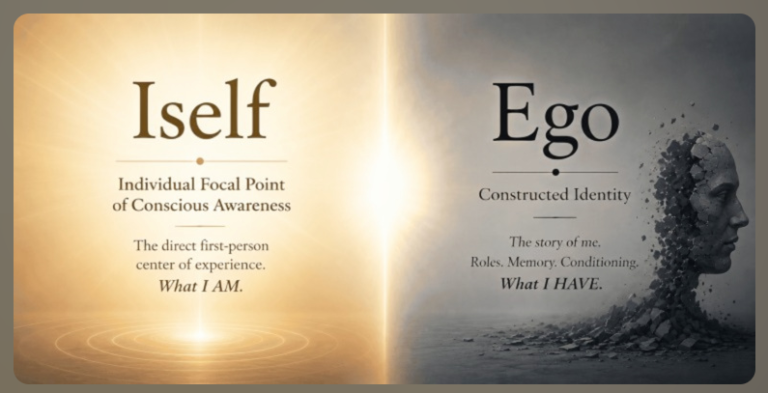
A seemingly simple question comes up again and again in discussions of nonduality: If the individual self is not real, then who or what seeks enlightenment?
The Self Realization Mantra approaches this question differently. It begins by making a distinction between the ego and the Iself.
The Self Realization Mantra is:
I Am Thee Iself.
I Am Thee Allself.
I Am Thee Godself.
I Am Thee Noself.
I Am Thee Amness.The mantra expresses five dimensions of realization: individuality, unity, divinity, transcendent emptiness, and pure beingness.
The ego is the constructed sense of “me”—the identity formed through conditioning, including memories, beliefs, preferences, fears, desires, experiences, roles, and stories. It is the accumulated pattern through which we identify ourselves as a particular person. The ego says, “This is who I am,” and develops an image of itself that it seeks to maintain, protect, and improve.
The Iself is something more fundamental. The Iself is the individual focal point of conscious awareness—the irreducible first-person vantage point through which experience occurs. It is the “I” you mean when you say, “I am here.”
The ego is not the Iself.
And this distinction becomes particularly important when we talk about enlightenment.
Iself Awakening
The Iself is not created by the ego. The Iself comes first.
Before there is a constructed story about who “I” am, there is already a first-person point of awareness through which life is being experienced. Before there are beliefs about oneself, roles, preferences, accomplishments, failures, and personal history, there is the simple fact of being here—the irreducible sense of “I am here.”
The ego is a constructed layer on top of this more fundamental reality. Conditioning accumulates around the Iself and gradually forms a story of “me.” We learn our name. We learn our role in the family. We develop preferences, beliefs, fears, ambitions, and expectations. We build an identity and begin to identify with it.
But the Iself was there before the story.
Iself awakening is the realization of this individual focal point of conscious awareness as something more fundamental than the ego. It is not the creation of a new self. It is the awakening to the self that was already present beneath and beyond the constructed identity.
The ego says, “This is who I am.” Iself awakening reveals the more fundamental reality: “I am here.”
The first is a constructed identity. The second is the irreducible first-person vantage point through which that identity—and everything else—is experienced.
The Ego Seeks Enlightenment
Who wants enlightenment? Usually, the ego does.
The ego hears about enlightenment and imagines what it would be like to become enlightened. It imagines freedom from suffering, peace, permanent happiness, transcendence, or even a special spiritual status. It may approach enlightenment from the simple desire to suffer less: “If I become enlightened, I will experience eternal bliss.”
The ego can turn enlightenment into a project: “I want to become enlightened.”
But there is an obvious paradox here. The ego is seeking a state in which identification with the ego is seen through. The ego is, in a sense, seeking its own transcendence.
This can create a peculiar spiritual trap. The ego can make enlightenment into another form of self-improvement: “I will become a better version of myself. I will become more peaceful. I will become awakened. I will become enlightened.” The spiritual seeker can spend years trying to construct an enlightened version of the very self they are trying to see through.
This does not mean that the seeking is useless. It means we have to understand what is actually happening.
What Is Enlightenment?
From the Self Realization Mantra standpoint, enlightenment is a deep, transcendent knowing of your true nature.
Your true nature is that you are individuality — Iself; unity — Allself; divinity — Godself; transcendent emptiness — Noself; and pure beingness — Amness.
These are not five separate things to become. They are five dimensions of realization. The Self Realization Mantra does not ask you to choose among them or reduce one to another. It asks you to realize them all.
Enlightenment, therefore, is not about the ego becoming a perfected version of itself. Nor is it about annihilating the individual.
It is a realization of the whole of what you are.
And this is where the ego deserves to be rehabilitated.
The Ego Has a Function
The ego serves a legitimate function. We need a sense of individual identity to navigate ordinary human existence. We need to know our name, remember our history, make decisions, maintain boundaries, pursue goals, interact with other people, and take responsibility for our actions.
In that sense, the ego is not an error that needs to be eliminated. It is part of the mechanism through which an individual human being navigates this reality.
The problem is not that the ego exists.
The problem arises when the functional identity becomes the whole of our identity.
The ego says, “This is who I am,” and we believe it. We identify with the conditioning, memories, roles, preferences, fears, desires, and stories that make up our particular personality, and we overlook the deeper reality of the Iself through which all of that is experienced.
Many spiritual traditions have treated the ego as something to overcome, kill, destroy, or annihilate. There is an important insight behind this language: identification with the ego can obscure realization. But the ego itself does not need to be treated as an enemy.
Enlightenment does not require the destruction of something that has a legitimate function.
Enlightenment Transforms the Ego
Enlightenment transforms the ego. The ego is not destroyed; it becomes more transparent.
As identification with the ego and its conditioning loosens, the ego becomes less concerned with service to self and more available for service to others. It can become kinder and gentler in the way it relates to others and to itself.
The conditioning doesn’t necessarily disappear, but our identification with it changes.
The ego is recontextualized as a functional aspect of individuality rather than the center of identity. It continues to function as the personality through which the individual interacts with the world, but it is no longer mistaken for the entirety of what one is.
The ego becomes less an identity to defend and preserve and more a functional expression of the deeper reality that has been realized.
This does not mean that the ego has become perfect. It means that it no longer has to carry the burden of being the entirety of “me.”
The point of enlightenment is not to destroy the instrument. It is to realize that you are more than the instrument.
The Question Behind the Question
So when someone asks, “If the individual self isn’t real, who seeks enlightenment?” the Self Realization Mantra offers a different way of framing the question.
The ego seeks enlightenment. The Iself experiences enlightenment.
The ego seeks what ultimately transcends the ego.
The Iself experiences the realization.
And because the Iself is one aspect of the deeper reality described by the Self Realization Mantra, enlightenment does not end with the realization of individuality. It opens into unity, divinity, transcendent emptiness, and pure beingness.
The Paradox
There is something beautifully paradoxical about the whole process.
The ego begins the search. The ego wants freedom. The ego wants enlightenment. The ego wants to transcend itself.
But enlightenment is not the ego achieving what it wanted. It is the seeing through of the very identification that made the ego believe it needed to achieve something.
And yet the realization doesn’t happen to nobody. It is experienced.
The ego seeks enlightenment. The Iself experiences enlightenment.
That distinction is small in words, but enormous in implication. It allows us to transcend identification without requiring us to annihilate individuality.
The ego does not need to be killed. It needs to be understood.
And ultimately, it needs to be put in its proper place—not as the entirety of what we are, but as a functional expression of individuality within something much greater.
In the Self Realization Mantra view, enlightenment isn’t the ego perfected, but realization unfolding through the Iself.
-
The Five Terms of the Self Realization Mantra

The Self Realization Mantra is:
I Am Thee Iself.
I Am Thee Allself.
I Am Thee Godself.
I Am Thee Noself.
I Am Thee Amness.The five terms in the Self Realization Mantra are Iself, Allself, Godself, Noself, and Amness. The terms themselves have pre-existing linguistic or conceptual precedents. I am not claiming that I invented these words.
That distinction is important because the issue is not whether these individual words existed previously. The issue is what these five terms mean in relationship to one another within this particular mantra.
English is extraordinarily flexible. Existing words are constantly combined into new compounds, and familiar words can acquire specialized meanings in new contexts. A pre-existing word does not, by itself, establish the origin of a later person’s particular use of that word.
Each of the five terms has a documented linguistic or conceptual precedent independent of the Self Realization Mantra. But the existence of those precedents is not the claim being made here.
Iself
Iself is a compound of I + self, using two ordinary English words to point toward the individual self—the “I” as an individual locus of experience.
In the Self Realization Mantra, Iself is the individual focal point of conscious awareness—the particular first-person locus through which experience and realization occur.
There is also an ancient Sanskrit conceptual precedent in ātman (आत्मन्), a term associated with Self, self, essence, and the innermost self. The meaning and usage of ātman have varied across Sanskrit traditions and contexts.
But ātman does not specifically identify the individual personal “I” in the way Iself does. Iself deliberately combines “I” and “self” to point to the individual locus of experience—the particular self that experiences, realizes, and undergoes spiritual awakening.
A documented earlier English occurrence of Iself appears in Tashira Tachi-Ren’s What Is Lightbody?, first published in 1990.
What matters for the Self Realization Mantra is that when Iself appeared to me as part of the revelation in 2018, I had never previously encountered the term.
I am therefore not claiming that Iself was a word that had never existed before. I am saying that I did not know the word before it appeared to me in the revelation, and that it became the first term in a configuration that was subsequently completed over several years.
Allself
Allself is similarly transparent in its construction: All + self. It points toward the universal Self.
In the Self Realization Mantra, Allself is everyone and everything, everywhere, everywhen—the totality of existence understood as one universal Self.
There is an ancient Sanskrit conceptual parallel in sarvātman (सर्वात्मन्). Sarva means “all,” “every,” or “whole,” while ātman can mean Self, self, essence, or nature. Sarvātman has been used in Sanskrit traditions in senses including the universal Self or Self of all.
There is also a documented earlier English literary occurrence. In James Joyce’s Finnegans Wake, published in 1939, Joyce uses the phrase “selfless Allself.”
The Sanskrit concept therefore has an ancient history, while the English compound Allself also has a documented earlier occurrence.
But none of that establishes the origin of the Self Realization Mantra. When Allself appeared to me as part of the revelation in 2018, I had never encountered the word.
Again, the distinction is between the history of a word or concept and the history of the particular revelation in which I encountered it.
Godself
Godself combines God + self, pointing toward the divine dimension of Self.
In the Self Realization Mantra, Godself points to the divine creative principle as directly present within, rather than an external deity.
There is an ancient Sanskrit conceptual precedent that is closely related to this idea: Paramātman (परमात्मन्), commonly translated as “Supreme Self.” In Hindu traditions, Paramātman can refer to the supreme or universal Self, and Sanskrit texts such as the Bhagavad Gita describe the divine as dwelling within beings.
Paramātman is therefore a relevant Sanskrit conceptual precedent for Godself, but it is not identical to the specific formulation of Godself in the Self Realization Mantra.
The English compound God-self is also documented well before the Self Realization Mantra. Eugene E. Whitworth’s Nine Faces of Christ: Quest of the True Initiate, published in 1980, refers to an “inner or initiate God-self.”
What matters is that when Godself appeared as the third term of the revelation in 2019, I had never previously encountered the term or these uses of it.
The distinction between the historical precedent and the particular revelation is therefore essential.
Noself
Noself combines No + self.
The underlying concept expressed by Noself is ancient, with especially important roots in Buddhism. Buddhist teachings developed the doctrine of anattā in Pali and anātman (अनात्मन्) in Sanskrit, commonly translated as “not-self,” “no-self,” or “selflessness.”
The Sanskrit term anātman is formed from the negative prefix an- applied to ātman, “self.” In Buddhist philosophy, it refers to the absence of a permanent, unchanging, independent self.
By the late nineteenth century, the term “no-self” was already being actively discussed in English-language writing, particularly in discussion of Buddhist philosophy. The English term therefore has a documented history predating the Self Realization Mantra.
But Noself, as used in the Self Realization Mantra, means more than simply “no-self.” It encompasses both nothingness and emptiness. I describe it as transcendent emptiness—the realization of no-self, nothingness, and emptiness beyond the apparent separateness of individual existence.
This goes beyond the Buddhist doctrine of anātman, the absence of a permanent, independent self, while still not negating the other four realizations.
Iself remains real, even as separateness is transcended.
The Self Realization Mantra therefore does not require the individual self to be annihilated in order for Noself to be realized. The individual can remain while the illusion of independent existence falls away.
Noself is the realization of no-self, nothingness, and emptiness, held together with the other four dimensions of the mantra.
Amness
Amness is different. The word itself clearly predates the Self Realization Mantra by many years.
One documented example is I AMness: The Discovery of the Self Beyond the Ego, by Ian Kent and William Nicholls, published by Bobbs-Merrill in 1972.
I personally encountered the term Amness in a YouTube video in 2020. So I make no claim that the word itself was newly revealed to me.
But the fifth line of the Self Realization Mantra was divinely revealed to me in 2025.
What was revealed was not merely the word Amness. It was the specific realization and relationship expressed in:
I Am Thee Amness.
I had encountered the word before, but I had not previously conceived of Amness as the source of self and the source of consciousness, nor had I conceived of it as the pure beingness prior to Being, nor had I formulated the fifth line of the mantra.
The realization of Amness within the five-part configuration, and the fifth line itself, were divinely revealed to me in 2025.
The etymology of Amness is straightforward: am + -ness. Am is the first-person singular form of to be, expressing existence or being, while -ness denotes the quality or condition of something. Thus, at the linguistic level, Amness means the quality or condition of being.
But in the Self Realization Mantra, Amness points deeper than ordinary “being.”
Amness is the ground of Being. Amness is the pure “am” before “I am.”
The “I” belongs to Being. In pure Amness there is no “I” yet.
Amness is therefore not another Self and not an aspect of consciousness. It is the source of self and the source of consciousness—the pure beingness prior to Being itself.
This is expressed ontologically as:
Amness → Being → Consciousness → Awareness → Experience
The History of the Words and the History of the Revelation
The chronology is straightforward.
In 2018, Iself and Allself were revealed to me.
In 2019, Godself and Noself were revealed to me.
In 2025, the realization of Amness completed the five-part configuration, culminating in the final line:
I Am Thee Amness.
There is therefore a clear distinction between the history of the words and the history of the revelation.
The words had histories before I encountered them. In the case of Amness, I had actually encountered the word before the revelation. But the revelation was about their particular relationship and the realization expressed through their complete configuration.
The concepts themselves are not new. The individual self, universal Self, divine Self, no-self, emptiness, nothingness, and beingness all have histories reaching far beyond the Self Realization Mantra.
What is distinctive is the particular five-part configuration and the realization expressed through it.
The five terms are:
Iself → Allself → Godself → Noself → Amness
And the complete realization is expressed in the mantra:
I Am Thee Iself.
I Am Thee Allself.
I Am Thee Godself.
I Am Thee Noself.
I Am Thee Amness.A pre-existing word is not the same thing as a pre-existing teaching.
A word can exist for decades or centuries before someone uses it in a new combination, gives it a new technical meaning, or places it into an entirely different conceptual framework.
The same applies to concepts. The individual self, the universal Self, the divine, no-self, emptiness, nothingness, and beingness are not ideas that suddenly appeared in 2018, 2019, or 2025.
What is distinctive about the Self Realization Mantra is the way these five dimensions are brought together and held simultaneously without one canceling the others.
I did not invent these five words. Four of them were completely new to me when they appeared in the revelation, while Amness was a word I had encountered previously. What was revealed was the relationship among these terms, the five-part realization they express, and ultimately the complete mantra itself.
And I describe the origin of the Self Realization Mantra as divine revelation because that is how it came to me. I am not asking anyone to accept that interpretation simply because I say so. But if someone wants to challenge the claim, the claim should first be represented accurately.
The claim is not:
“I invented five words.”
The claim is that the five-part realization embodied in the Self Realization Mantra was divinely revealed to me.
The four Self terms have Sanskrit conceptual parallels:- Iself — ātman (आत्मन्)
- Allself — sarvātman (सर्वात्मन्)
- Godself — Paramātman (परमात्मन्)
- Noself — anātman (अनात्मन्)
Amness stands apart from this entire Self vocabulary. It is not another Self or another aspect of consciousness. Amness is the ground of Being.
-
The Self Realization Mantra: A Radical Five-Part, Post-Nondual Teaching

The Self Realization Mantra is a radical five-part, post-nondual teaching. It does not resolve the apparent paradoxes of existence by eliminating one side of the equation. It realizes them all simultaneously.
The Self Realization Mantra is nondual. At the same time, I call it post-nondual because it begins with the realization of nonduality and then continues the inquiry rather than treating that realization as the end of the inquiry. Nonduality points beyond the apparent separation between self and other, subject and object, individual and universal. It reveals that what appear to be separate realities are not ultimately separate.
That realization is profound. But what happens after you realize it? Do you have to conclude that the individual self was never real? Do you have to throw away individuality in order to preserve universality? Do you have to choose emptiness over fullness, or transcendence over immanence?
The Self Realization Mantra says no. It doesn’t resolve the paradox by eliminating one side of the equation. It holds the entire equation.
The Self Realization Mantra is:
I Am Thee Iself.
I Am Thee Allself.
I Am Thee Godself.
I Am Thee Noself.
I Am Thee Amness.These five lines point toward five realizations and five perspectives. They are not five separate realities. Iself, Allself, Godself, and Noself are four distinct expressions of Amness within Consciousness, while Amness is the source from which they arise. They are all realized simultaneously.
Nonduality Without Erasure
One of the things that distinguishes the Self Realization Mantra is that it does not require the Iself to be dismissed as an illusion in order to realize nonduality. The Iself is the individual focal point of conscious awareness, the first-person vantage point through which experience occurs. It is the “I” you mean when you say, “I am here.”
The ego can be seen through. Identification with the ego can be released. The constructed story of “me” can change. But that doesn’t mean the Iself has to be annihilated. The Iself is not the ego. I Am Thee Iself.
The Iself is the doorway through which every realization is experienced. Even the realization of Noself is experienced from somewhere. This doesn’t make the Iself separate from everything else. It means individuality and nonduality can coexist. The realization of nonduality does not require the destruction of individuality. Transcending identification is not the same thing as annihilating the individual.
The distinction between individuality and universality can remain even when the sense of separation between them falls away. The distinctions remain. The separation does not.
Duality and Polarity
This is where the distinction between duality and polarity becomes important. Duality implies two separate and opposing realities: self and other, subject and object, light and dark, individual and universal. In a dualistic framework, the two sides are fundamentally separate.
Polarity is different. A polarity consists of apparently opposite expressions of a single source. Think of a magnet. It has a north pole and a south pole. They are distinguishable, but they aren’t two separate magnets. You cannot isolate one pole and still have the same magnetic system. The apparent opposites belong to one whole.
The Self Realization Mantra treats Iself, Allself, Godself, and Noself in a similar way. They are distinct, but they are not separate. Iself is individual. Allself is universal. Godself is divine. Noself is empty. Those sound contradictory if we assume that only one of them can be true, but contradiction isn’t the only possibility. They can be polarities arising from Amness within Consciousness.
This is why I don’t describe the four selves as a four-way duality. They are a four-way polarity—four differentiated expressions arising from Amness within Consciousness. Amness is the source of all four.
Iself and Allself
The first apparent paradox is the relationship between Iself and Allself: I Am Thee Iself and I Am Thee Allself. From the Iself perspective, I am this particular person. I have this body, this history, this perspective, this set of relationships, and this particular stream of experience.
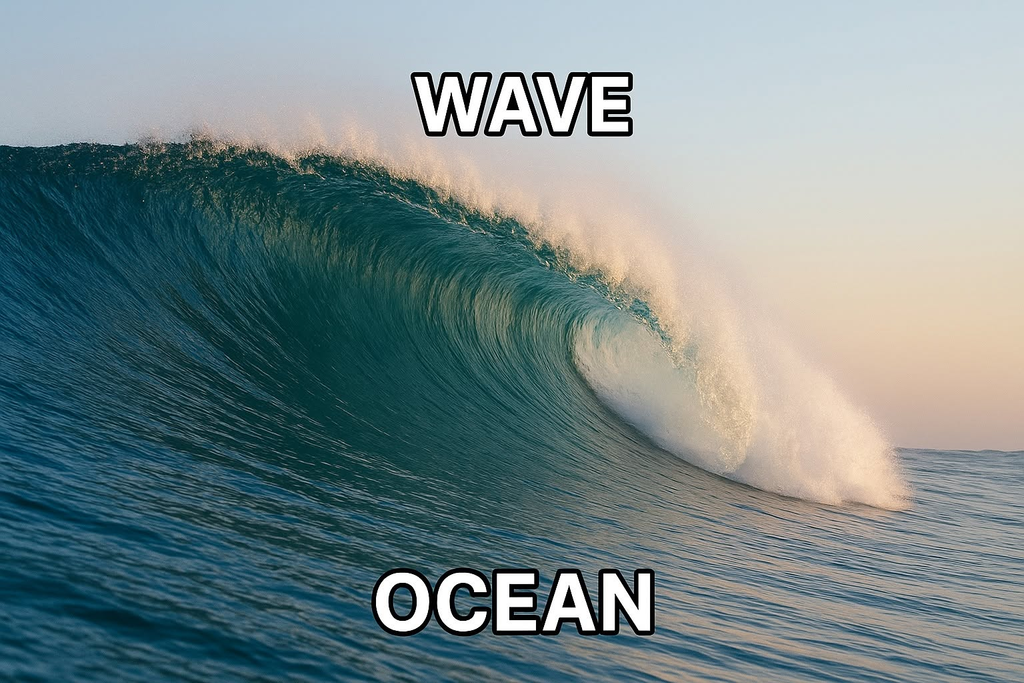
From the Allself perspective, that boundary expands. The distinction between “me” and “everything else” dissolves. Consciousness is experienced as universal rather than merely individual. These aren’t competing descriptions. I can be a wave and still be the ocean. The wave doesn’t have to disappear for the ocean to be realized. In fact, without the wave, there is no particular expression of the ocean in that location.
Individuality is an expression of universality, not a contradiction of it.
Iself and Godself
Another apparent paradox is the relationship between I Am Thee Iself and I Am Thee Godself. The Iself is the individual focal point of conscious awareness, while the Godself is the divine creative principle. One seems personal and individual; the other seems divine and universal. How can the individual self be the Godself?
The distinction becomes clearer when we stop thinking of Godself as an external deity. The Godself is not a separate being somewhere outside of you. It is the divine creative principle expressing itself through consciousness and manifestation. The Iself is the individual focal point through which that divine principle is experienced and expressed.
From the Iself perspective, I am doing something. From the Godself perspective, God is doing everything. These are radically different perspectives, yet the Self Realization Mantra doesn’t require one to be discarded in order to realize the other.
The individual does not have to disappear for the divine to be realized. The Iself can be understood as a particular expression and focalization of the Godself, while the Godself reveals the deeper creative power operating through the individual.
This creates another polarity: the individual and the divine are distinct, but not separate. I Am Thee Iself. I Am Thee Godself. Both are true, and neither cancels the other.
Iself and Noself
The apparent paradox becomes even more extreme with Iself and Noself: I Am Thee Iself and I Am Thee Noself. How can I be somebody and nobody?
From the Iself perspective, I am somebody. There is a first-person center of experience. From the Noself perspective, there is no separate somebody to be found. There is emptiness—no fixed identity, no permanent conceptual self, no thing that can be grasped as the ultimate “me.”
The mistake is assuming that one realization has to invalidate the other. The Iself is real as the individual focal point of awareness. The Noself is real as the realization of transcendent emptiness. Somebody and nobody are not mutually exclusive when viewed from different perspectives of the same reality. That is the post-nondual move.
Allself and Noself
Then there is the biggest apparent contradiction: I Am Thee Allself and I Am Thee Noself. Everything and nothing. Fullness and emptiness. The totality of manifestation and the absence of manifestation. At first glance, these appear to cancel each other out.
But the Self Realization Mantra doesn’t ask us to choose. Allself is the realization of Everythingness—the infinite multiplicity of existence, every being, every form, every moment. Noself is the realization of Nothingness—the absence of any fixed thing, identity, or conceptual boundary. Everythingness and Nothingness are opposite poles of the same mystery. The fullness doesn’t cancel the emptiness, and the emptiness doesn’t cancel the fullness. Both are realized.
Noself and Godself
The paradox continues with I Am Thee Godself and I Am Thee Noself. Godself is the divine creative principle—the power through which manifestation happens. Noself is the absence of manifestation. One is radically expressive, while the other is radically empty.
Yet the Self Realization Mantra places them side by side because Godself and Noself describe different dimensions arising from the same source. Godself is the doing; Noself is the nothingness in which there is nothing to do. And Amness is prior to both.
Amness Changes the Equation
The fifth line changes everything: I Am Thee Amness.
Amness is not another self. It isn’t a fifth version of “me.” Amness is pure unmanifest beingness—the source of self and the source of consciousness. It is prior to Being, prior to Consciousness, prior to identity, and prior to the distinction between something and nothing.
This introduces an entirely different set of paradoxes.
The first is Iself and Amness. The Iself is the individual focal point of consciousness, while Amness is prior to consciousness and prior to self. How can the individual self be that which is prior to self? I Am Thee Amness points beyond the identity of the Iself to the source from which the very possibility of self arises.
Then there is Allself and Amness. Allself is Everythingness—the totality of manifestation. Amness is prior to manifestation itself. How can everything be that which exists before anything exists? The answer is not to collapse Allself into Amness. Allself is the fullness of manifestation; Amness is the unmanifest source from which that fullness arises.
There is also Godself and Amness. Godself is the divine creative principle—the power through which manifestation happens. Amness is prior to creation and therefore prior to the creative principle itself. Godself is the divine doing; Amness is prior to doing.
And finally, there is Noself and Amness. Noself is Nothingness—the absence of fixed self, identity, form, and conceptual content. Amness is pure unmanifest beingness. Nothingness and beingness may appear to be opposites, but Amness is prior to the distinction between something and nothing.
This is why Amness is not simply another perspective alongside the other four. Amness is the source of the four perspectives themselves.
The four selves arise as differentiated expressions within Consciousness, while Amness is the source from which they arise. Iself, Allself, Godself, and Noself are not divisions of reality. They are distinct expressions arising from Amness within Consciousness.
So the movement of the mantra is not simply a movement from I to Everything to God to Nothing to something else. It is a movement through increasingly fundamental perspectives of reality.
And ultimately, there is Amness. No “I.” No thing. No identity. No consciousness. Pure beingness before Being. Simply Amness.
Why “Post-Nondual”?
This is why I use the term post-nondual. The Self Realization Mantra does not reject nonduality. It begins with it. But it doesn’t treat the realization of nonduality as the end of the inquiry.
It asks: What happens when you realize nonduality and then look again at everything that nonduality seemed to make disappear?
The individual is still here. The universal is still here. The divine is still here. Emptiness is still here. And underneath all of it is Amness.
Rather than saying, “Only one of these is ultimately real,” the Self Realization Mantra says, realize them all. This is why I call it a radical five-part nonduality. It is nondual because the five are not ultimately separate. It is post-nondual because it does not require the apparent distinctions to be erased.
The distinctions remain. The separation does not.
The Paradoxes Are the Feature
The Self Realization Mantra contains paradoxes everywhere: Iself versus Allself, Iself versus Godself, Iself versus Noself, Allself versus Noself, Noself versus Godself, and all four in relationship to Amness.
A conventional approach might try to resolve these paradoxes by deciding which side is ultimately real and which side is merely appearance. The Self Realization Mantra takes a different approach. The paradoxes are not a bug. They’re a feature.
The apparent contradictions are pointing toward something that cannot be captured by choosing one perspective and rejecting another. I am somebody, I am everybody, I am God, I am nobody, and I simply am. These statements don’t have to compete. They can be simultaneously realized.
Five Perspectives
After all of this philosophy, the five perspectives can be expressed very simply. From the Iself perspective, you are somebody going somewhere doing something. From the Allself perspective, you are everybody going everywhere doing everything. From the Godself perspective, God is doing everything. From the Noself perspective, you are nobody going nowhere doing nothing. From the Amness perspective, you simply am.
Each perspective reveals something that the others cannot fully express, and none of them cancels the others. That is the heart of the Self Realization Mantra.
Beyond Choosing
Maybe the deepest difference between the Self Realization Mantra and a conventional nondual approach is that the Self Realization Mantra doesn’t ask you to choose between the poles. You don’t have to choose Iself over Allself, Allself over Iself, Godself over Noself, or Noself over Godself. You don’t have to choose manifestation over the unmanifest, or the unmanifest over manifestation.
You realize the whole thing.
The Iself is real. The Allself is real. The Godself is real. The Noself is real. And Amness is the source of them all.
That is not a return to duality. It is what remains when the need to resolve every polarity into one side or the other has been transcended.
The Self Realization Mantra is not asking you to choose between Iself, Allself, Godself, Noself, and Amness. It is asking you to realize them all simultaneously.
-
Self Realization Is Simple, But Not Easy
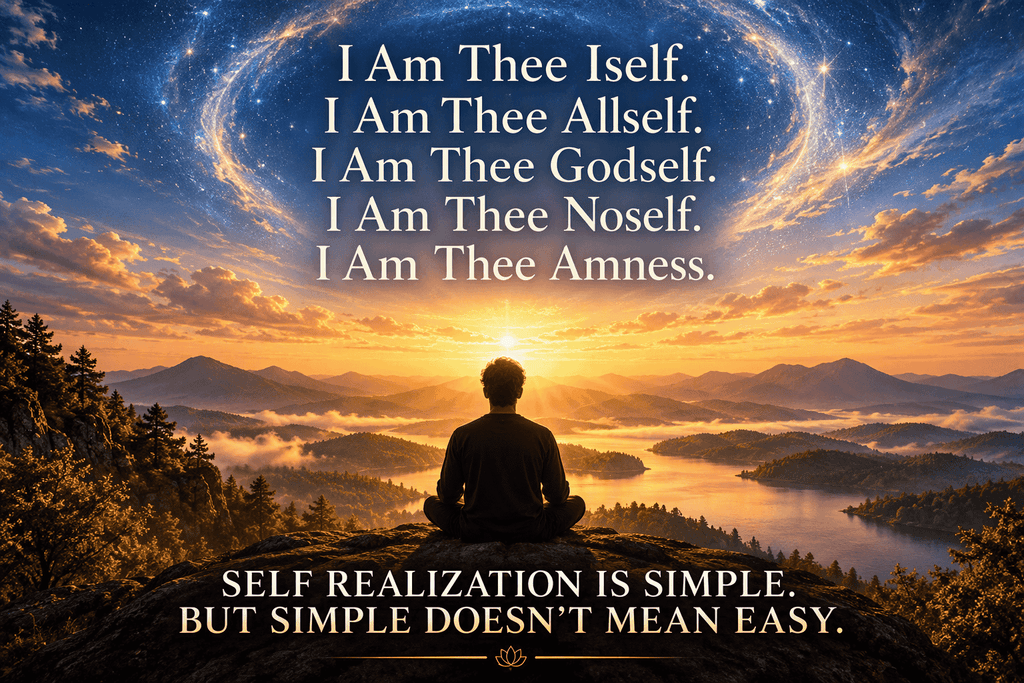
The Self Realization Mantra is remarkably simple. It is only 20 words:
I Am Thee Iself.
I Am Thee Allself.
I Am Thee Godself.
I Am Thee Noself.
I Am Thee Amness.That’s it.
There are no complicated doctrines to memorize. No elaborate theology. No guru required. No initiation. No special clothing, diet, rituals, or religious affiliation. You don’t have to abandon whatever spiritual tradition or philosophy you currently practice. The Self Realization Mantra simply reveals the Self.
Simple, however, does not mean easy.
Think about driving a car. You don’t need to understand how an internal combustion engine works in order to drive a car. You don’t need to understand combustion, fuel injection, the transmission, or the thousands of individual components that make the car move. You learn how to operate the technology, and then you actually drive.
The Self Realization Mantra is similar. You don’t have to completely understand how the mantra works before you practice it. You don’t have to intellectually solve every philosophical question surrounding Iself, Allself, Godself, Noself, and Amness before you begin. You have to use it.
And this is where the simplicity of the mantra can be deceptive. You can read all 20 words in less than 20 seconds. You can understand the basic concepts. You can even think, “Yeah, that makes sense.” But understanding the words is not the same thing as realizing what they point toward.
Self Realization isn’t something you get by passing an intellectual test. It is something you experience.
Becoming self realized takes dedicated practice with the mantra. You return to it again and again. You chant it. You contemplate it. You allow the words to move beyond intellectual understanding and become something you directly experience. That’s the difference between knowing about the Self Realization Mantra and working with the Self Realization Mantra.
The Self Realization Mantra is a spiritual awakening technology. And a technology isn’t useful merely because you understand how it works. You actually have to use it. You don’t become a driver by reading the owner’s manual. You drive.
You don’t become self realized by reading the Self Realization Mantra once and deciding that it makes sense. You practice.
The simplicity of the Self Realization Mantra is not a shortcut around the work. It is what makes the work possible.
You don’t need to understand everything before you begin. You don’t need to accept everything I say about it. You simply need to begin working with the mantra. Read it. Speak it. Chant it. Sit with it. And then do it again tomorrow, and the next day, and the next.
Self Realization is simple. But simple isn’t the same thing as easy.
-
I Am That. You Are That. What Is That?

There is a fascinating thread running through several of the great traditions of self inquiry: I Am That. You Are That. What Is That? These three statements can be seen as three movements of inquiry. The first begins with the direct realization of “I am.” The second expands that realization beyond the individual. The third refuses to settle for an undefined “That” and asks what, exactly, it is.
I Am That
The first movement is I Am That. The phrase immediately brings to mind the teachings of Nisargadatta Maharaj, whose famous book I Am That begins from the fundamental sense of “I am.” Nisargadatta repeatedly directed attention back to this bare sense of being before the addition of identity, biography, personality, or conceptual description.
There is something remarkably direct about this approach. Before I am a man, before I am a particular person, before I am a name, a history, or a collection of experiences, there is the undeniable fact that I am. But what is this “I am”? And what is the “That” to which it points?
The Self Realization Mantra begins at precisely this territory, but it does not stop there: I Am Thee Iself. The Iself is the lived reality of being this particular locus of experience. It is the first-person perspective through which realization itself occurs. The Self Realization Mantra does not require the Iself to be dismissed as an illusion in order to transcend identification with the ego. Instead, it takes the existence of the I seriously. The one who asks “Who am I?” is itself part of the mystery.
And that leads naturally to the second movement.
You Are That
The second movement is You Are That, or Tat Tvam Asi (तत् त्वम् असि). This is the famous Sanskrit statement from the Chandogya Upanishad, traditionally translated as “That Thou Art” or “You Are That.” It became one of the great Mahavakyas, or “great statements,” of Vedanta.
Here the inquiry expands beyond the isolated individual. The “That” is not merely something outside you that you are supposed to discover. In the Advaita Vedanta interpretation, “That” ultimately points to Brahman, while “you” points to the deepest Self, Atman. The statement expresses their fundamental identity.
This gives us a remarkable progression: I Am That. You Are That. The first statement begins from the direct experience of being. The second universalizes the realization. What is true of “I” is not ultimately confined to one individual. The apparent distinction between self and totality becomes something to investigate.
The Self Realization Mantra takes this expansion seriously: I Am Thee Allself. The Iself does not disappear simply because realization expands beyond the individual. Instead, the individual is understood in relationship to the whole. The wave is still a wave, but the wave is not separate from the ocean.
This is where the Self Realization Mantra begins to diverge from formulations that resolve the paradox by reducing one side to the other. It does not ask us to choose between Iself and Allself. It holds both. I am this particular self, and I am the whole. Both can be true.
And once we arrive here, another question becomes unavoidable.
What Is That?
If I Am That points toward something fundamental, and You Are That tells us that this “That” is not separate from the deepest Self, then we are left with the most important question: What is That?
This is where the Self Realization Mantra becomes, for me, a logical unpacking of the ancient declarations. Rather than leaving “That” undefined, the Self Realization Mantra asks us to explore what the realization actually encompasses.
I Am Thee Iself expresses the individual dimension of self. I Am Thee Allself expresses the universal dimension of self. I Am Thee Godself expresses the divine dimension of self and the creative principle through which existence expresses itself. I Am Thee Noself expresses the realization that no permanently existing, independently separate self can be found. And finally, I Am Thee Amness points to something fundamentally different from the other four. Amness is not another self. It is the source of self itself, the pure beingness prior to the distinctions of Iself, Allself, Godself, and Noself.
This is where the five lines become especially interesting. The Self Realization Mantra does not say that one of these is true and the others are false. It does not ask us to choose Iself over Noself, or Allself over Iself, or Godself over Noself. It holds the paradox.
I am an individual. I am the whole. I am the divine. I am no separate self. And prior to all of these is Amness.
These are not five competing beliefs. They are five dimensions of realization held simultaneously. That is why I see the Self Realization Mantra as a logical unpacking of “That.”
“I Am That” gives us the fundamental intuition. “You Are That” universalizes it. “What Is That?” opens the inquiry and refuses to leave the central term unexplored. And the answer that emerges through the Self Realization Mantra is not a single word or concept. It is Iself. Allself. Godself. Noself. Amness.
There is also something important about the relationship between these statements and their traditions. “I Am That” carries us into the territory of Nisargadatta and the direct investigation of the sense of being. “You Are That” carries us back thousands of years into the Upanishadic teaching of Tat Tvam Asi (तत् त्वम् असि). “I Am That I Am” takes us into the Hebrew Bible and the mysterious divine declaration associated with Moses.
These traditions are not historically identical, and I am not suggesting that they are saying exactly the same thing. They arise from different languages, cultures, texts, and philosophical frameworks. But they converge around an extraordinarily profound question: What is the relationship between I, being, and ultimate reality?
The Self Realization Mantra enters that ancient conversation with a very simple proposition: Don’t stop at “That.” Unpack it.
What is the I? Iself. What is the I in relation to everything? Allself. What is the divine dimension? Godself. What is found when separate selfhood cannot ultimately be located? Noself. And what is prior to all of these? Amness.
So the movement is I Am That. You Are That. What Is That? And then: I Am Thee Iself. I Am Thee Allself. I Am Thee Godself. I Am Thee Noself. I Am Thee Amness.
The ancient question remains open. But the Self Realization Mantra offers a way of opening the word That and looking inside.
-
From “I Am That I Am” to the Self Realization Mantra

There is something profound hidden inside the simple statement “I Am That I Am.” It points directly toward the mystery of identity, being, and existence itself. When I look at the Self Realization Mantra, I see it as a logical unpacking of that statement.
I Am That.
Before we even ask what the “That” is, there is already an “I Am.” There is existence. There is being. There is the undeniable fact of I am. The question then becomes: What is this “I” that is? And what is the “That” to which it refers?
The Self Realization Mantra takes that simple formulation and opens it up:
I Am Thee Iself.
I Am Thee Allself.
I Am Thee Godself.
I Am Thee Noself.
I Am Thee Amness.Rather than leaving “That” undefined, the Self Realization Mantra explores the different dimensions of what “I Am” can reveal.
I Am Thee Iself. The “I” is not merely something to be dismissed as an illusion. There is a direct, first-person reality to being the one who is experiencing this life. I am this particular expression of existence. I have a perspective. I experience. I act. I relate. The Iself is the doorway through which realization is experienced.
I Am Thee Allself. The inquiry then expands. This individual “I” is not separate from the totality of existence. The wave is not separate from the ocean. The wave is what the ocean is doing, and the individual is an expression of the whole. The Iself and the Allself are not mutually exclusive truths. The individual can be real while simultaneously being inseparable from the whole.
I Am Thee Godself. The “That” can also be understood as the divine dimension of existence—the creative principle through which existence expresses itself. Godself does not require an anthropomorphic deity sitting somewhere outside creation. It points to the divine dimension of what is, and to the realization that the divine is not fundamentally separate from the self.
I Am Thee Noself. Then comes the apparent contradiction: the realization of no-self. When examined deeply, no permanent, independent, isolated self can be found. The self is empty of separate existence. There is no fixed entity standing apart from everything else. Yet this does not negate the Iself. It reveals another dimension of reality. The wave exists, but it cannot be separated from the ocean.
I Am Thee Amness. And then the inquiry goes even deeper. Amness is not another self. It is not a fifth self. It is the source of self—the pure beingness prior to the distinctions of Iself, Allself, Godself, and Noself.
This is where “I Am” itself becomes the doorway.
So when I look at “I Am That I Am,” I don’t see a statement that needs to remain compressed into three simple words. I see an invitation to unpack the meaning of I, Am, and That.
What is the I? Iself. What is the I in relation to the whole? Allself. What is the divine dimension of the I? Godself. What remains when the separate self cannot be found? Noself. And what is the source of self and being itself? Amness.
The Self Realization Mantra does not choose one of these and eliminate the others. All five statements are true simultaneously. That is the paradox.
I am an individual. I am the whole. I am the divine. I am no separate self. And prior to all of these is Amness itself.
That is why I see the Self Realization Mantra as a logical unpacking of “I Am That I Am.”
And there is an interesting parallel with the simpler expression “I am that.” The Self Realization Mantra takes the word that and asks us to look directly into what that actually encompasses.
The answer isn’t a single concept. It is Iself, Allself, Godself, Noself, and ultimately Amness.
The five lines don’t cancel one another. They progressively open the statement.
“I Am That I Am” is the seed. The Self Realization Mantra is the seed opened up.
And the remarkable thing is that the deepest realization isn’t that one of these perspectives is correct and the others are wrong. The realization is that they can all be true at once.
-
The Paradox of Individuality and Unity in the Self Realization Mantra
The Self Realization Mantra
I Am Thee Iself.
I Am Thee Allself.
I Am Thee Godself.
I Am Thee Noself.
I Am Thee Amness.At the heart of the Self Realization Mantra lies one of its most fascinating paradoxes: I Am Thee Iself and I Am Thee Allself. At first glance, these two affirmations seem to contradict one another. The first affirms individuality, while the second seems to dissolve individuality into universality. So which is it? Am I an individual, or am I all of existence? The Self Realization Mantra does not ask us to choose. It asks us to hold the paradox.
The Undeniable Reality of the Iself
Every human being experiences life from an individual first-person perspective. There is an I here. There is a particular center from which experience is occurring. I experience this body. I experience these sensations. I experience these thoughts. I experience this moment. Your experience is happening to you, and my experience is happening to me.
This is more than merely a felt sense of individuality. The phenomenological reality of the Iself is undeniable. We can debate what the I ultimately is. We can investigate whether it is separate from anything else. We can question its boundaries, its nature, and its relationship to consciousness. But we cannot simply eliminate the fact that experience is occurring from a first-person locus.
And this is precisely why I Am Thee Iself is so important. It does not begin by telling the individual that the individual doesn’t exist. It begins with what is immediately present: I am here.
The Iself Is the Doorway to Spiritual Awakening
There is an even deeper implication. The Iself is not merely one of the things discovered during spiritual awakening. The Iself is the doorway through which spiritual awakening occurs.
Every spiritual awakening a person has is experienced by that person. An awakening to Allself is experienced by the Iself. An awakening to Godself is experienced by the Iself. An awakening to Noself is experienced by the Iself. Even the strange and paradoxical Amness awakening is realized through the Iself.
Whatever the content or depth of the realization, there is a first-person locus through which that realization occurs. You cannot step outside of the Iself in order to experience an awakening and then come back and report what happened. The realization happens here.
That makes the Iself profoundly important to the entire process of self realization. The Iself isn’t an obstacle standing between you and awakening. It is the doorway.
From Iself to Allself
And then the mantra makes its extraordinary second move: I Am Thee Allself.
Now the perspective expands. There are billions of human beings on this planet, each apparently living a separate life, each possessing a distinct body, history, personality, perspective, and stream of experience. At the ordinary human level, there are billions of individual lives.
But at another level of realization, there is one Consciousness experiencing itself through billions of individual centers of experience. One ocean. Countless waves.
And this is where the paradox becomes truly interesting. The wave is not something other than the ocean. The wave is what the ocean is doing.
The wave has a distinct form. It has a particular location. It has a crest and a trough. It rises, moves, changes, and eventually subsides. Yet there is no separate substance called “wave” that exists independently of the ocean. The wave is ocean, and the ocean is expressing itself as wave.
That gives us a way to contemplate the relationship between Iself and Allself. Iself is the individual expression. Allself is the totality in which that individual exists. The realization of Allself does not require the individual to become nonexistent. The wave doesn’t have to disappear for the ocean to be realized.
Non-Separateness Does Not Necessarily Mean Non-Existence
This is where the Self Realization Mantra takes a different approach from certain interpretations of nondual philosophy.
In some Advaita Vedanta formulations, the individual self is ultimately regarded as an illusion or as something that must be seen through in order to realize the Self. The Self Realization Mantra asks us to examine that assumption. Why should lack of separateness necessarily mean lack of existence? Those are not logically identical propositions.
The wave is not separate from the ocean. But that doesn’t mean there is no wave. Likewise, the fact that the individual is not ultimately separate from the whole does not, by itself, establish that individuality is unreal.
Dependence does not equal illusion. Non-separateness does not equal non-existence.
This is why I Am Thee Iself and I Am Thee Allself can coexist. The first does not have to be sacrificed to make the second possible.
Transcending Identification Does Not Require Annihilation of Individuality
This distinction is crucial. Transcending identification with individuality does not require annihilation of individuality.
A person can realize that they are more than their individual identity without ceasing to have an individual identity. Awakening can change one’s understanding of individuality without requiring individuality itself to be destroyed.
And when we look at the lives of realized spiritual masters, we find something interesting: they continued to have recognizable individualities. They had particular bodies, particular voices, particular personalities, and particular ways of interacting with the world. They spoke to people, taught, ate, walked, laughed, interacted with the world, and lived individual human lives.
Their realization did not require their human individuality to be physically or phenomenologically annihilated. The individual remained. What changed was the realization of what that individual actually is.
This is an important distinction because it means that spiritual awakening was never fundamentally about destroying the individual. The wave doesn’t have to stop being a wave. It realizes that it is ocean.
The Paradox Is Not a Problem to Be Solved
This creates a beautiful tension: I am an individual, and I am Allself. At the human level, I am this particular person. At the deeper level of realization, the Consciousness experiencing through this person is not ultimately separate from the Consciousness experiencing through everyone else.
So which one is true?
The Self Realization Mantra says: both.
That is not an attempt to reconcile the paradox by explaining it away. The paradox itself is significant. The individual and the universal are not necessarily mutually exclusive categories.
The wave is individual. The wave is ocean. The wave is what the ocean is doing. And so the very individuality that seems to stand in opposition to unity can instead be understood as one of the ways unity expresses itself.
And Then the Mantra Goes Further
The paradox between Iself and Allself is only the beginning.
I Am Thee Godself. Godself introduces another dimension of realization: the divine creative principle—not necessarily an anthropomorphic deity sitting somewhere outside of existence, but the divine dimension of reality itself.
Then comes I Am Thee Noself. Here the mantra introduces perhaps its most startling paradox. How can there be an Iself and a Noself? How can there be a real first-person center of experience while simultaneously realizing nobody and nothing at the deepest level?
The Self Realization Mantra does not resolve this by simply deleting one side. It holds the paradox. Iself does not have to be negated in order for Noself to be realized, and Noself does not have to negate Iself.
Then comes I Am Thee Amness. Amness points beyond the familiar categories of experience, consciousness, awareness, and even Being itself—to pure pre-manifestational beingness, the absolute prior.
And here the paradox becomes even stranger. The Iself is the doorway through which the realization occurs, yet the realization ultimately reaches toward something that precedes the ordinary phenomenological framework in which that doorway exists.
The Self Realization Mantra therefore isn’t a linear progression in which one realization simply destroys the previous one. It is an expansion of what can be simultaneously held as true.
The Deeper Meaning of the Paradox
Perhaps this is one of the strangest things about the Self Realization Mantra: it does not ask you to eliminate the paradox. It asks you to realize it.
I Am Thee Iself. Yes, there is an individual.
I Am Thee Allself. Yes, the individual is not ultimately separate from the whole.
I Am Thee Godself. Yes, there is a divine dimension to reality.
I Am Thee Noself. Yes, there is also the realization of nobody and nothing.
I Am Thee Amness. And beneath even these distinctions lies Amness—the pure beingness that precedes the ordinary structures through which we understand existence.
The mantra does not flatten these realizations into one concept. It allows each to retain its own significance.
The Paradox Remains
The deepest paradox between Iself and Allself can be stated very simply: there are billions of individual human beings, each living an individual life from an individual first-person perspective, and yet there can also be a realization that there is only one Consciousness appearing as all of them.
The wave is real. The ocean is real. The wave is the ocean. The wave does not have to be annihilated for the ocean to be realized, and the ocean does not have to deny the existence of the wave.
Likewise, the realization of Allself does not require the destruction of Iself. The Iself is phenomenologically undeniable. It is the first-person doorway through which every spiritual awakening is experienced. And even transcending identification with individuality does not require annihilating individuality itself.
That is the paradox the Self Realization Mantra invites us to hold: I Am Thee Iself. I Am Thee Allself. Not one instead of the other. Both. The individual wave. The universal ocean. And the profound mystery that the wave is what the ocean is doing.
-
Chant The Self Realization Mantra

The Self Realization Mantra is more than something to read; it is something to practice. Many people encounter the mantra for the first time, read through it once, and think, “That makes sense.” But conceptual understanding of the words is not the same as realizing what they point toward. Reading a recipe is not the same as tasting the meal, and looking at a map is not the same as walking the path. The Self Realization Mantra is meant to be chanted—slowly, sincerely, and repeatedly.
The mantra itself is simple:
I Am Thee Iself.
I Am Thee Allself.
I Am Thee Godself.
I Am Thee Noself.
I Am Thee Amness.
Each line points toward a different dimension of your true nature. The Iself is the individual focal point of conscious awareness, the Allself is everyone and everything, the Godself is the Divine creative principle, the Noself is transcendent emptiness, and Amness is pure Beingness. This is not merely a list of ideas to understand; it is an invitation to self realization.
Many spiritual traditions speak of using a mantra as a thorn to remove another thorn, then throwing both away, but that has never been my experience. I continue to chant the Self Realization Mantra every day, not because I am seeking awakening, but because awakening is only the beginning. There is awakening, then there is integration, and then there is embodiment. Realization is a moment, integration is a process, and embodiment is a way of living. The mantra supports all three. It is a vibrational alignment tool in addition to being a spiritual awakening technology.
With time, each repetition becomes less about remembering words and more about inhabiting them. The mantra gradually reshapes the way you experience yourself, becoming less something you recite and more something you live. If you approach the Self Realization Mantra merely as something interesting to think about, it will probably remain just that—an interesting idea. But if you chant it with sincerity, day after day, allowing each line to settle deeply into your being, something remarkable may happen.
This shift doesn’t happen because the words possess magical power, but because they continually direct your attention toward dimensions of yourself that are usually overlooked. The Self Realization Mantra is not a belief system. It is a practice, and like every genuine practice, its depth is revealed not through a single reading, but through faithful repetition.