The Self Realization Mantra
I Am Thee Iself.
I Am Thee Allself.
I Am Thee Godself.
I Am Thee Noself.
I Am Thee Amness.
At the heart of the Self Realization Mantra lies one of its most fascinating paradoxes: I Am Thee Iself and I Am Thee Allself. At first glance, these two affirmations seem to contradict one another. The first affirms individuality, while the second seems to dissolve individuality into universality. So which is it? Am I an individual, or am I all of existence? The Self Realization Mantra does not ask us to choose. It asks us to hold the paradox.
The Undeniable Reality of the Iself
Every human being experiences life from an individual first-person perspective. There is an I here. There is a particular center from which experience is occurring. I experience this body. I experience these sensations. I experience these thoughts. I experience this moment. Your experience is happening to you, and my experience is happening to me.
This is more than merely a felt sense of individuality. The phenomenological reality of the Iself is undeniable. We can debate what the I ultimately is. We can investigate whether it is separate from anything else. We can question its boundaries, its nature, and its relationship to consciousness. But we cannot simply eliminate the fact that experience is occurring from a first-person locus.
And this is precisely why I Am Thee Iself is so important. It does not begin by telling the individual that the individual doesn’t exist. It begins with what is immediately present: I am here.
The Iself Is the Doorway to Spiritual Awakening
There is an even deeper implication. The Iself is not merely one of the things discovered during spiritual awakening. The Iself is the doorway through which spiritual awakening occurs.
Every spiritual awakening a person has is experienced by that person. An awakening to Allself is experienced by the Iself. An awakening to Godself is experienced by the Iself. An awakening to Noself is experienced by the Iself. Even the strange and paradoxical Amness awakening is realized through the Iself.
Whatever the content or depth of the realization, there is a first-person locus through which that realization occurs. You cannot step outside of the Iself in order to experience an awakening and then come back and report what happened. The realization happens here.
That makes the Iself profoundly important to the entire process of self realization. The Iself isn’t an obstacle standing between you and awakening. It is the doorway.
From Iself to Allself
And then the mantra makes its extraordinary second move: I Am Thee Allself.
Now the perspective expands. There are billions of human beings on this planet, each apparently living a separate life, each possessing a distinct body, history, personality, perspective, and stream of experience. At the ordinary human level, there are billions of individual lives.
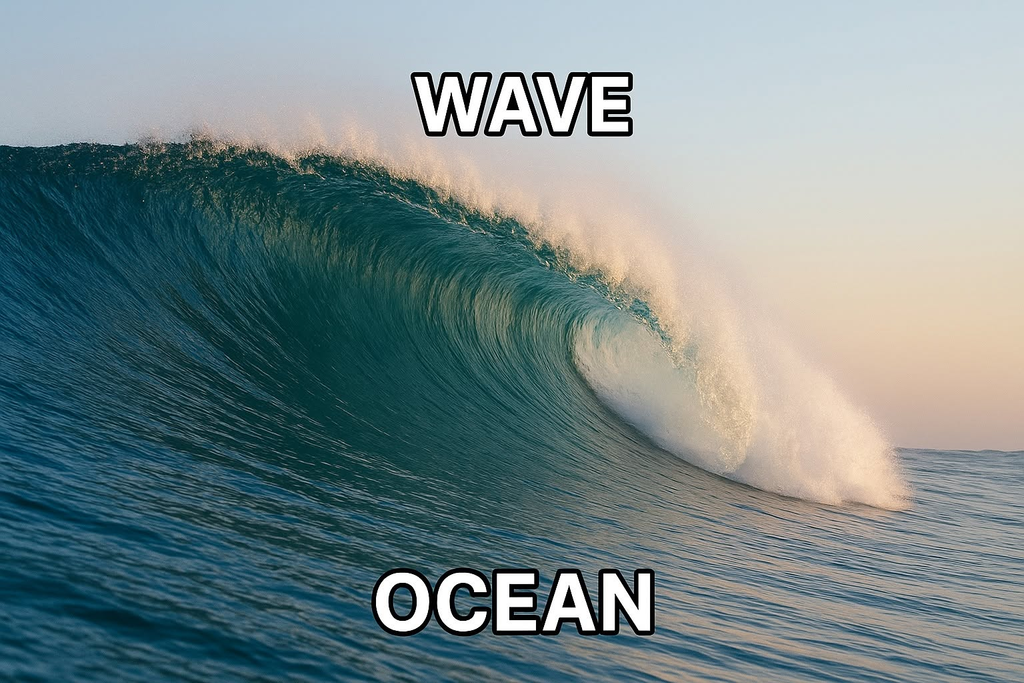
But at another level of realization, there is one Consciousness experiencing itself through billions of individual centers of experience. One ocean. Countless waves.
And this is where the paradox becomes truly interesting. The wave is not something other than the ocean. The wave is what the ocean is doing.
The wave has a distinct form. It has a particular location. It has a crest and a trough. It rises, moves, changes, and eventually subsides. Yet there is no separate substance called “wave” that exists independently of the ocean. The wave is ocean, and the ocean is expressing itself as wave.
That gives us a way to contemplate the relationship between Iself and Allself. Iself is the individual expression. Allself is the totality in which that individual exists. The realization of Allself does not require the individual to become nonexistent. The wave doesn’t have to disappear for the ocean to be realized.
Non-Separateness Does Not Necessarily Mean Non-Existence
This is where the Self Realization Mantra takes a different approach from certain interpretations of nondual philosophy.
In some Advaita Vedanta formulations, the individual self is ultimately regarded as an illusion or as something that must be seen through in order to realize the Self. The Self Realization Mantra asks us to examine that assumption. Why should lack of separateness necessarily mean lack of existence? Those are not logically identical propositions.
The wave is not separate from the ocean. But that doesn’t mean there is no wave. Likewise, the fact that the individual is not ultimately separate from the whole does not, by itself, establish that individuality is unreal.
Dependence does not equal illusion. Non-separateness does not equal non-existence.
This is why I Am Thee Iself and I Am Thee Allself can coexist. The first does not have to be sacrificed to make the second possible.
Transcending Identification Does Not Require Annihilation of Individuality
This distinction is crucial. Transcending identification with individuality does not require annihilation of individuality.
A person can realize that they are more than their individual identity without ceasing to have an individual identity. Awakening can change one’s understanding of individuality without requiring individuality itself to be destroyed.
And when we look at the lives of realized spiritual masters, we find something interesting: they continued to have recognizable individualities. They had particular bodies, particular voices, particular personalities, and particular ways of interacting with the world. They spoke to people, taught, ate, walked, laughed, interacted with the world, and lived individual human lives.
Their realization did not require their human individuality to be physically or phenomenologically annihilated. The individual remained. What changed was the realization of what that individual actually is.
This is an important distinction because it means that spiritual awakening was never fundamentally about destroying the individual. The wave doesn’t have to stop being a wave. It realizes that it is ocean.
The Paradox Is Not a Problem to Be Solved
This creates a beautiful tension: I am an individual, and I am Allself. At the human level, I am this particular person. At the deeper level of realization, the Consciousness experiencing through this person is not ultimately separate from the Consciousness experiencing through everyone else.
So which one is true?
The Self Realization Mantra says: both.
That is not an attempt to reconcile the paradox by explaining it away. The paradox itself is significant. The individual and the universal are not necessarily mutually exclusive categories.
The wave is individual. The wave is ocean. The wave is what the ocean is doing. And so the very individuality that seems to stand in opposition to unity can instead be understood as one of the ways unity expresses itself.
And Then the Mantra Goes Further
The paradox between Iself and Allself is only the beginning.
I Am Thee Godself. Godself introduces another dimension of realization: the divine creative principle—not necessarily an anthropomorphic deity sitting somewhere outside of existence, but the divine dimension of reality itself.
Then comes I Am Thee Noself. Here the mantra introduces perhaps its most startling paradox. How can there be an Iself and a Noself? How can there be a real first-person center of experience while simultaneously realizing nobody and nothing at the deepest level?
The Self Realization Mantra does not resolve this by simply deleting one side. It holds the paradox. Iself does not have to be negated in order for Noself to be realized, and Noself does not have to negate Iself.
Then comes I Am Thee Amness. Amness points beyond the familiar categories of experience, consciousness, awareness, and even Being itself—to pure pre-manifestational beingness, the absolute prior.
And here the paradox becomes even stranger. The Iself is the doorway through which the realization occurs, yet the realization ultimately reaches toward something that precedes the ordinary phenomenological framework in which that doorway exists.
The Self Realization Mantra therefore isn’t a linear progression in which one realization simply destroys the previous one. It is an expansion of what can be simultaneously held as true.
The Deeper Meaning of the Paradox
Perhaps this is one of the strangest things about the Self Realization Mantra: it does not ask you to eliminate the paradox. It asks you to realize it.
I Am Thee Iself. Yes, there is an individual.
I Am Thee Allself. Yes, the individual is not ultimately separate from the whole.
I Am Thee Godself. Yes, there is a divine dimension to reality.
I Am Thee Noself. Yes, there is also the realization of nobody and nothing.
I Am Thee Amness. And beneath even these distinctions lies Amness—the pure beingness that precedes the ordinary structures through which we understand existence.
The mantra does not flatten these realizations into one concept. It allows each to retain its own significance.
The Paradox Remains
The deepest paradox between Iself and Allself can be stated very simply: there are billions of individual human beings, each living an individual life from an individual first-person perspective, and yet there can also be a realization that there is only one Consciousness appearing as all of them.
The wave is real. The ocean is real. The wave is the ocean. The wave does not have to be annihilated for the ocean to be realized, and the ocean does not have to deny the existence of the wave.
Likewise, the realization of Allself does not require the destruction of Iself. The Iself is phenomenologically undeniable. It is the first-person doorway through which every spiritual awakening is experienced. And even transcending identification with individuality does not require annihilating individuality itself.
That is the paradox the Self Realization Mantra invites us to hold: I Am Thee Iself. I Am Thee Allself. Not one instead of the other. Both. The individual wave. The universal ocean. And the profound mystery that the wave is what the ocean is doing.
Leave a Reply