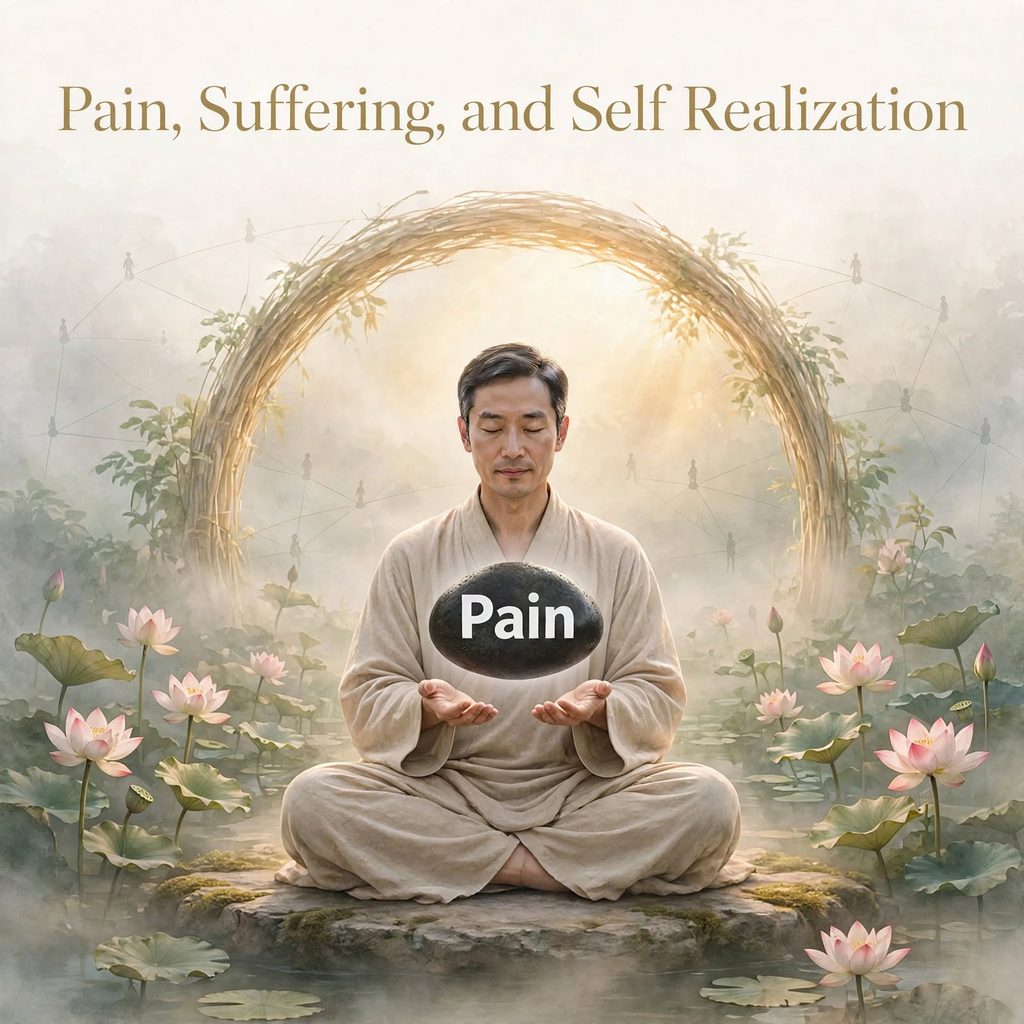
Pain is an unavoidable part of human life, but pain and suffering are not identical. We experience physical pain, emotional distress, disappointment, grief, loss, and uncertainty. Although we cannot always prevent pain or choose how deeply we suffer, we can sometimes change our relationship with these experiences. Self Realization offers a broader understanding of who and what we are, allowing us to meet the difficulties of life without reducing our entire reality to the pain we experience.
The distinction is important. Self Realization is not an escape from life. It is a fuller realization of life and of the Self through which life is experienced.
Pain and Suffering
Pain and suffering are related, but they are not identical.
Pain is an experience. It may arise from physical injury, emotional loss, unmet expectations, or the realization that something important to us has changed or disappeared. Pain is not necessarily something we choose, and it is not always something we can control.
Suffering can arise from pain itself, but it can also arise from our relationship with pain. We may resist what has happened, insist that reality should be different, imagine that our circumstances will never improve, or turn a painful experience into a judgment about who we are.
This does not mean that all suffering is optional or that people can simply choose not to suffer. Severe pain, trauma, illness, grief, and difficult circumstances can impose suffering that cannot be dissolved through a change of perspective alone.
There is an old saying: “Pain is inevitable, suffering is optional.”
Like many memorable sayings, it contains an important insight but overstates the case. Pain is an unavoidable part of life, and we cannot always choose whether or how deeply we suffer. But we can sometimes influence how much additional suffering arises from our resistance to pain, our expectations, and the stories we tell ourselves about what happens to us.
Nevertheless, there are times when our response adds another layer of suffering to an already painful experience.
We may not be able to eliminate the pain, but we may be able to reduce the additional suffering created by our resistance, expectations, and interpretations.
Suffering as Resistance to What Is
Much of our suffering arises from the conflict between what is happening and what we believe should be happening.
We want circumstances to be different. We want people to behave differently. We want the past to have unfolded differently. We want uncertainty to disappear and the future to conform to our expectations.
When reality fails to cooperate, we struggle against it.
Acceptance offers another possibility.
Acceptance means acknowledging that something is happening or has happened. It does not mean approving of it, believing it is fair, or deciding that nothing can be done about it. We can accept the reality of a situation while working to change it.
If we are in pain, we can acknowledge the pain and seek relief. If someone treats us badly, we can acknowledge what happened and establish boundaries. If circumstances are harmful, we can accept that they are harmful and take action to change them.
Acceptance is not resignation. It is the willingness to begin with reality rather than expend all our energy insisting that reality should already be something else.
Radical acceptance is one of the most direct paths to inner peace. It means fully acknowledging reality as it is, without making our peace dependent upon reality being different. We can still oppose injustice, change harmful circumstances, pursue our goals, and work toward a better future. Radical acceptance does not require us to approve of everything that happens; it requires us to stop denying that it has happened. When we accept reality as our starting point rather than treating it as an enemy, we release the futile struggle against what already is and become more available to respond wisely to what can still be changed.
Accepting Our Non-Acceptance
Radical acceptance does not mean that we must be able to accept everything that happens. Some experiences are so painful, unjust, or incomprehensible that acceptance may seem impossible. Grief, trauma, betrayal, and profound loss cannot always be reconciled with our expectations of how life should be.
When we cannot accept what has happened, we can begin by accepting our inability to accept it.
This is a minimum form of radical acceptance: accepting our non-acceptance rather than struggling against it. We acknowledge that we are resisting reality without adding another layer of suffering by insisting that we should not be resisting it.
We do not have to approve of what happened, find meaning in it, or force ourselves to make peace with it. We need only acknowledge where we are, including our inability to be anywhere else emotionally at that moment.
Even this small shift can interrupt the cycle of resistance. We may not yet be able to accept the loss, the injustice, or the pain itself, but we can stop demanding that our own response be different from what it is.
When we cannot accept reality, we can accept that we cannot accept it. That is not the completion of radical acceptance, but it is a place to begin.
When we stop arguing with the fact that something has happened, we may find that more of our energy becomes available for deciding what to do next.
Disappointment and Unmet Expectations
Disappointment occurs when reality fails to meet an expectation.
Sometimes our expectations are reasonable. We expect honesty from a friend, fairness from an employer, or care from someone we love. When those expectations are violated, disappointment is understandable.
At other times, our expectations may be unrealistic, poorly examined, or beyond our control. We may expect people to understand us without explanation, expect life to reward our efforts in a particular way, or expect circumstances to remain unchanged simply because we value them.
The expectation itself can become a source of suffering.
We may be disappointed not only by what happened but also by the distance between what happened and what we imagined should have happened. We may repeatedly compare reality with an imagined alternative, keeping the disappointment alive long after the original event.
This does not mean we should abandon expectations or stop caring about outcomes. Expectations help us make plans, establish standards, and determine what matters to us.
The opportunity lies in distinguishing between expectations that serve us and expectations that keep us in conflict with reality.
We can hold preferences without insisting that life must fulfill them. We can pursue desired outcomes without making our well-being entirely dependent upon achieving them.
The Tyranny of Shouldness
How often does our suffering begin with the belief that something should be different?
I shouldn’t have to experience this. People should treat me better. My life should have turned out differently. I should be further along by now. I shouldn’t feel this way. The world should be fair.
These statements express our expectations of how reality ought to be. Some reflect legitimate values and reasonable standards. People should be treated with dignity. We should take responsibility for our actions. We should work to prevent harm and correct injustice.
The problem is not the word should itself. It is what happens when we turn our expectations into demands that reality must satisfy before we can be at peace.
Shouldness is the attachment to how we believe reality ought to be, especially when we use that expectation to resist how reality actually is.
We don’t merely grieve a loss; we insist that the loss shouldn’t have happened. We don’t merely experience disappointment; we insist that life shouldn’t disappoint us. We don’t merely make a mistake; we insist that we shouldn’t have made it.
The original experience is one thing. Our struggle against the fact that it occurred is another.
We may not be able to change what happened, but we can examine the expectations through which we interpret it. We can distinguish between what we would prefer and what we demand, between what we believe ought to happen and what is actually happening.
This is the distinction between preference and demand.
We can prefer that something had happened differently without denying that it happened. We can believe something ought to change without requiring it to have already changed. We can act according to our values without making inner peace contingent upon the world conforming to them.
The Paradox of Shouldness
Shouldness can turn against itself.
We might tell ourselves, I shouldn’t resist reality. But that can become another form of resistance: now we are resisting our own resistance.
We might think, I should accept everything. When we discover that we cannot accept something, we suffer because we believe we should be more accepting.
Even radical acceptance can become another standard against which we judge ourselves.
The goal is not to eliminate shouldness by force. That would simply give us another demand to struggle against. It is to realize that our judgments about how things should be are not the same as reality itself.
When we cannot accept what has happened, we need not add the judgment that we should already have accepted it. We can acknowledge our resistance without condemning ourselves for it.
This brings us back to radical acceptance. We can accept our non-acceptance, allowing ourselves to begin where we actually are rather than where we believe we should be.
The point is not to abandon our values, standards, or aspirations. It is to stop making peace dependent upon reality already conforming to them.
The Reasonableness of Expectations
Not every expectation is unreasonable simply because it is unmet.
There is a difference between expecting another person to treat us with basic respect and expecting that person to agree with everything we believe. There is a difference between expecting honesty in a relationship and expecting that we will never be disappointed by someone we love.
The question is not whether we should have expectations. It is whether our expectations accurately reflect the situation, the people involved, and the limits of our control.
Sometimes suffering reveals that an expectation needs to change. At other times, suffering reveals that a boundary needs to be established or that a situation needs to end.
We should not use acceptance as an excuse to tolerate abuse, neglect, or preventable harm. Nor should we assume that every painful situation is an invitation to adjust ourselves to circumstances that ought to change.
Self Realization does not remove discernment. It can help us exercise discernment without being entirely consumed by disappointment, resentment, or fear.
The Story We Tell Ourselves
Human beings are natural storytellers. We don’t simply experience life; we narrate our experiences, organizing events into stories that help us understand what happens to us, what it means, and how it relates to who we are. This is an inherent part of being human. Through narration, we make sense of our experiences, connect the past with the present, and anticipate the future.
But the stories we tell ourselves are not always neutral descriptions of what happened. They often include interpretations, assumptions, judgments, and conclusions about ourselves and others.
An experience does not always remain confined to what happened. We construct stories around it.
A friend fails to return a call, and we conclude that we do not matter to them. We make a mistake and decide that we are failures. A relationship ends, and we interpret the loss as proof that we are unlovable.
The original experience may be painful, but the story can extend the suffering associated with it far beyond the event itself.
A missed call becomes a judgment about our worth. A mistake becomes an identity. A loss becomes a prediction that we will always be alone.
These interpretations may feel convincing, but they are not identical to the events that prompted them.
We can distinguish between what happened and what we have concluded about what happened.
This distinction does not require us to deny our feelings. It allows us to experience our feelings without automatically treating every thought accompanying them as the final truth.
We can acknowledge, “I feel rejected,” without concluding, “I am fundamentally unworthy of love.”
We can acknowledge, “This relationship has ended,” without concluding, “My life can no longer be meaningful.”
The event matters. The feeling matters. But neither necessarily supports every conclusion we draw from it.
Neutral Narration
One way to change our relationship with suffering is to describe experiences more neutrally.
Instead of saying, “Everything is going wrong,” we might say, “Several things have not gone as I hoped.”
Instead of saying, “I always fail,” we might say, “I did not succeed at this.”
Instead of saying, “This is unbearable,” we might say, “This is very painful, and I am having difficulty with it.”
Neutral narration does not require us to pretend that circumstances are pleasant or insignificant. It simply avoids adding unnecessary judgments and sweeping conclusions to what is already happening.
There is a meaningful difference between describing an experience and turning that experience into a verdict on our lives.
The purpose is not to replace negative language with artificially positive language. It is to describe reality as accurately as possible, without making it worse through exaggeration, overgeneralization, or self-condemnation.
When we separate the experience from the story surrounding it, we create room to respond rather than merely react.
Pain as a Teacher
Pain can reveal things about ourselves that comfort may leave undiscovered.
It can expose attachments, expectations, assumptions, and beliefs that we have never examined. Physical pain can remind us of our vulnerability and impermanence. Emotional pain can reveal the depth of our attachments and the stories we tell ourselves about love, identity, and belonging. Existential pain can challenge our assumptions about who we are and what gives life meaning.
But pain does not automatically produce wisdom, and suffering is not a prerequisite for awakening.
Some pain is simply painful. Some suffering results from circumstances that should never have occurred. We need not romanticize suffering or assume that every painful experience has been arranged to teach us something.
The opportunity lies in what becomes possible when we are willing to look honestly at an experience rather than merely resist it or flee from it.
Pain may reveal that an expectation needs to be released, an assumption reconsidered, a boundary established, or a harmful situation changed. It may expose the difference between what we can control and what we cannot. It may show us how much of our suffering comes from the meaning we attach to events.
The lesson is not always to accept more or endure more. Sometimes the lesson is to stop tolerating what harms us. Sometimes it is to grieve what cannot be recovered. Sometimes it is to acknowledge that we do not know why something happened.
The teacher is not pain alone, but what pain makes possible for us to see.
Pain may open the door, but it does not determine what we discover when we walk through it.
Holding Pain Lightly
To hold pain lightly is not to minimize it, suppress it, or pretend that it does not matter. It is to allow pain to be present without giving it unlimited authority over our experience or identity.
Pain is real, but it is not necessarily the whole of our reality. Disappointment does not have to become a verdict on our worth. Grief does not have to become the totality of our identity. A difficult period in our lives does not have to define the meaning of our entire existence.
We can acknowledge pain without insisting that we should not be experiencing it. We can allow ourselves to grieve without concluding that happiness is no longer possible. We can recognize that something matters deeply to us without making our entire well-being dependent upon its preservation.
Holding pain lightly does not mean that we care less. It means that we are learning to distinguish caring from clinging, acknowledging from resisting, and experiencing from identifying completely with an experience.
Acceptance does not require passivity. We can take action to alleviate pain, address its causes, seek help, and change our circumstances. We can do these things without adding the belief that our lives are ruined simply because we are suffering now.
The Iself—the individual focal point of conscious awareness—is the one who experiences pain. Yet the Iself is more than any particular experience, and the totality of the Self extends beyond the individual perspective.
We can give pain our attention without giving it everything.
Holding pain lightly is not indifference. It is being present with what hurts without adding unnecessary suffering to an already painful experience.
The Iself and the Experience of Suffering
The Iself is the individual focal point of conscious awareness. It is the lived sense of being here, of experiencing life from a particular perspective.
Pain and suffering are experienced through this individual perspective. They are not abstractions. They are lived realities.
The Iself can experience physical discomfort, emotional distress, fear, grief, and disappointment. These experiences do not become unreal simply because the nature of the Self extends beyond individuality.
Nor does the existence of an ego mean that every painful experience is merely an egoic illusion.
The ego is a functional layer associated with identity, self-image, memory, and our interpretation of experience. It can contribute to suffering when it turns an event into a threat to identity or treats a disappointment as proof of personal inadequacy. But the Iself is not reducible to the ego.
The Iself is the doorway to awakening and Self Realization. It is the perspective through which we experience our lives, including the process of realizing that our lives and our identities are more expansive than our ordinary self-concepts suggest.
Self Realization does not require the individual perspective to disappear. It allows the Iself to be understood within a more comprehensive realization of the Self.
This matters when we suffer. We need not deny our individual experience in order to understand that it is not the totality of what we are.
Beyond the Individual Self
The Self Realization Mantra presents five terms: Iself, Allself, Godself, Noself, and Amness. These terms illuminate different aspects of realization without requiring us to collapse them into one another.
Each offers a different context for understanding our lives, including our experience of suffering.
The Iself, Allself, Godself, and Noself are four distinct aspects of the Self, expressing different dimensions of Consciousness rather than dividing it into separate parts. Each expresses a different dimension of the same underlying reality: individuality, universality, divinity, and emptiness. They are distinct without being separate, and none can be reduced to another without losing something essential. Amness stands apart from these four aspects—not as another manifestation of Consciousness, but as the pure beingness prior to Being, Consciousness, and the Self itself.
Allself: The Universal Self
The Allself encompasses everyone, everything, everywhere, and everywhen.
From the perspective of the Allself, our individual lives are not isolated from the larger reality in which they occur. We are part of a vast interconnected whole.
This perspective does not make individual suffering insignificant. The pain of one person remains meaningful, even within a reality that extends far beyond that person.
Rather, the Allself broadens the context in which we understand our experiences. Our individual concerns can be real without being the only reality that matters. Our lives can be meaningful without being the center of the entire universe.
The realization of the Allself may soften the sense of isolation that accompanies suffering. It can remind us that we belong to a reality far more extensive than the boundaries of our individual identities.
Godself: The Divine Self
The Godself expresses the divine creative principle—the dimension of reality through which creation and manifestation are understood.
This is not necessarily an external, anthropomorphic deity who stands apart from us. The Godself points toward the divine as an intrinsic dimension of reality.
From this perspective, life is not merely something that happens to an isolated individual. We participate in a reality whose creative depth exceeds our ordinary understanding.
This does not mean that every painful event should be interpreted as divinely intended or that suffering must be justified by appealing to a greater plan.
Such explanations can create additional suffering when they demand that people find a purpose in experiences that remain painful, unjust, or incomprehensible.
The Godself offers a broader spiritual context without requiring us to pretend that we know why every event occurs.
We can remain open to the depth and mystery of existence without inventing explanations for every hardship.
Noself: Transcendent Emptiness
The Noself points toward emptiness and the absence of a permanently existing, independent self.
This does not mean that nothing exists or that our lived experiences are meaningless. It means that what we ordinarily regard as a fixed, independent identity cannot be established as an isolated and unchanging entity.
Our bodies change. Our thoughts change. Our emotions change. Our relationships and circumstances change. Even the identities through which we understand ourselves are shaped by conditions, relationships, memories, and experience.
The realization of Noself can loosen our attachment to the idea that we must defend and preserve an entirely fixed identity. It can help us see that a painful experience does not have to become a permanent definition of who we are.
Yet the absence of an independent, unchanging self does not mean that the individual experience of suffering is unreal.
Noself Realization and Spiritual Bypassing
Within some spiritual communities, the realization of Noself is used to dismiss or deny the experience of pain and suffering. When someone expresses distress, the response may be that there is no one who suffers, that the individual is an illusion, or that pain exists only because someone remains attached to the ego.
This can turn a potentially liberating insight into a way of avoiding the realities of human life.
Using spiritual teachings or the concept of emptiness to avoid emotional pain, bypass unresolved issues, or dismiss another person’s suffering is a form of spiritual bypassing.
The realization of Noself does not make suffering unreal or render human experience irrelevant. Emptiness is not a license to dismiss pain, detach from responsibility, or pretend that personal difficulties no longer matter. Genuine Self Realization does not require us to deny the individual self or transcend the human experience by refusing to engage with it. It allows us to experience that reality without mistaking it for the totality of what we are.
Noself and Iself need not be treated as mutually exclusive. We can realize the absence of an independent, permanent self while acknowledging the reality of the individual who experiences pain.
The point is not to use emptiness to escape our humanity. It is to understand our humanity within a more comprehensive realization of the Self.
Amness: Pure Beingness
Amness is not another individual or universal self. It is not simply another aspect alongside Iself, Allself, Godself, and Noself.
Amness points toward pure beingness prior to Being itself—the source from which Being and the manifestations of Self arise. Amness is the ground of Being.
In the framework of the Self Realization Mantra, Amness is prior to Self, consciousness, and agency. It is not an object to be grasped or an identity to be adopted. It is the ground that precedes the distinctions through which experience becomes intelligible.
The relationship can be expressed as:
Amness → Being → Consciousness → Awareness → Experience
This is an ontological ordering, not a sequence of events unfolding through ordinary time. Amness is not an earlier moment in a temporal history. Temporality itself belongs to the reality that emerges within this ordering.
What does this have to do with suffering?
It places our experiences within a context that is not exhausted by any particular experience. Pain arises within experience. Experience occurs through awareness and consciousness. Yet the source to which Amness points is not reducible to the changing contents of experience.
This does not mean that Amness makes pain disappear or that we should retreat into an abstract idea of ultimate reality whenever life becomes difficult.
Rather, it points toward a depth of reality that is not confined to the changing experiences through which we encounter life.
The realization of Amness does not require us to reject the other aspects of the Self. It provides the ground within which their distinctions can be held without being collapsed.
Self Realization Is Not Perfection
Self Realization does not mean that we will never experience pain, disappointment, anger, fear, or grief.
Self Realization is sometimes portrayed as a state of perpetual bliss—a condition in which suffering disappears and unbroken happiness becomes our permanent experience. This is a profound misconception.
Self Realization does not make us immune to the full range of human experience. We can still feel grief when someone we love dies, disappointment when our expectations are unmet, pain when we are injured, and sadness when life brings loss. We can experience anger, frustration, fear, and uncertainty. Realization does not require these experiences to disappear, nor does their presence invalidate realization.
The delusion lies in confusing Self Realization with a permanent emotional state. Bliss may accompany spiritual awakening or arise during contemplative experiences, but an experience of bliss is not the same as Self Realization itself. Emotional states change. Experiences arise and pass away. No particular feeling, however profound or pleasurable, defines the totality of the Self.
Self Realization is not the permanent experience of bliss; it is the realization of who and what we are, whether bliss is present or absent.
The deeper possibility is not that we will never experience suffering, but that suffering no longer has to determine our entire understanding of ourselves or our relationship with existence.
Self Realization does not mean that we will always respond wisely or that we will never become caught in our expectations and interpretations. We may find ourselves caught in familiar patterns of thought and reaction, even as our understanding of the Self deepens.
The difference is not necessarily that difficult experiences cease to occur. It is that our understanding of ourselves and our relationship with those experiences can change.
We may become better able to distinguish an experience from the story we tell about it. We may recognize when our expectations are creating unnecessary conflict. We may accept what cannot be changed while taking action where action is possible.
We may also become more willing to acknowledge our vulnerability without treating vulnerability as a failure.
Self Realization is not a demand that we become invulnerable. It is not a requirement that we transcend every emotion or maintain an unbroken state of peace.
It is a fuller realization of the Self, including the individual dimension through which we experience the ordinary challenges of being human.
We can experience suffering without concluding that something is fundamentally wrong with us. We can acknowledge our limitations without reducing our identity to them. We can continue to learn and grow without making perfection the condition of our well-being.
The Self Realization Mantra as a Catalyst
The Self Realization Mantra is a spiritual awakening technology: a concise formulation that can serve as a touchstone for contemplation, realization, and a shift in being.
It is not a belief system, religion, or dogma. The mantra itself carries no doctrine. All explanations are optional context, not required belief.
Its five lines bring together the individual, universal, divine, empty, and primordial dimensions of realization:
I Am Thee Iself.
I Am Thee Allself.
I Am Thee Godself.
I Am Thee Noself.
I Am Thee Amness.
The mantra does not ask us to choose one dimension of the Self and deny the others. It holds them together while preserving their distinctions.
The Iself is not simply collapsed into the Allself. The Godself is not simply collapsed into the Noself. The Noself is not identical to Amness. And Amness is not merely another identity that the individual can claim.
The mantra can be contemplated as a whole or approached through its individual lines. It can serve as a touchstone when we are caught in a narrow interpretation of ourselves or our circumstances.
When we suffer, the Iself reminds us of the individual perspective through which pain is experienced. The Allself broadens our context beyond the isolated individual. The Godself opens a perspective on the divine creative principle. The Noself loosens our attachment to a fixed, independent identity. Amness points toward the ground prior to the distinctions through which experience arises.
None of these perspectives requires us to deny the others.
The mantra is not a formula for suppressing difficult feelings or replacing them with spiritual affirmations. Its value lies in the larger realization it can facilitate: a shift from identifying exclusively with one limited perspective toward a more comprehensive understanding of the Self.
Self Realization is a shift in being, not merely a change in belief.
A Different Relationship with Suffering
We cannot always control what happens to us. We cannot prevent every loss, guarantee that our expectations will be fulfilled, or eliminate every source of pain.
But we can sometimes distinguish the pain we experience from the additional suffering that may arise through our relationship with it. We can question the stories that turn individual events into sweeping judgments about our lives. We can distinguish reasonable expectations from demands that reality must conform to our wishes.
We can allow pain to teach us without assuming that pain is always a teacher. We can hold pain lightly without minimizing its significance. We can acknowledge the individual who suffers without mistaking that individual perspective for the entirety of the Self.
And we can explore the wider dimensions of Self Realization without using spiritual understanding to evade our humanity.
The realization of the Self does not make us less human. It allows us to understand our humanity within a more comprehensive context.
We can experience pain without becoming only pain. We can acknowledge suffering without allowing suffering to define everything. We can act to change what can be changed and accept what cannot, without confusing acceptance with resignation.
Self Realization does not promise a life without suffering. It offers the possibility of a different relationship with suffering—one grounded in a fuller realization of who and what we are.
The Self Realization Mantra brings this realization into a concise expression:
I Am Thee Iself.
I Am Thee Allself.
I Am Thee Godself.
I Am Thee Noself.
I Am Thee Amness.
Leave a Reply