A seemingly simple question comes up again and again in discussions of nonduality: If the individual self is not real, then who or what seeks enlightenment?
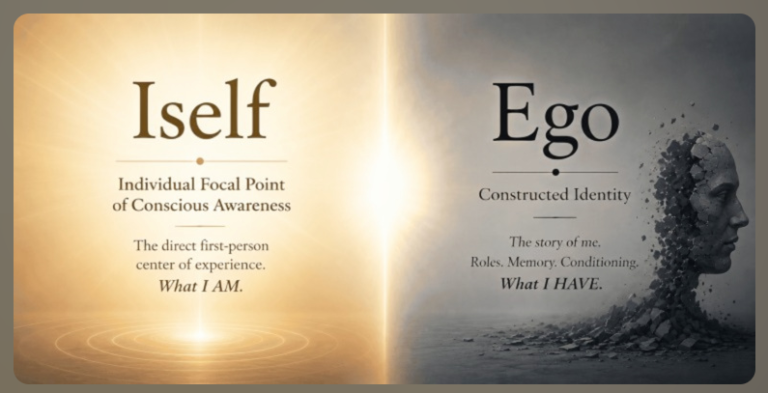
The Self Realization Mantra approaches this question differently. It begins by making a distinction between the ego and the Iself.
The Self Realization Mantra is:
I Am Thee Iself.
I Am Thee Allself.
I Am Thee Godself.
I Am Thee Noself.
I Am Thee Amness.
The mantra expresses five dimensions of realization: individuality, unity, divinity, transcendent emptiness, and pure beingness.
The ego is the constructed sense of “me”—the identity formed through conditioning, including memories, beliefs, preferences, fears, desires, experiences, roles, and stories. It is the accumulated pattern through which we identify ourselves as a particular person. The ego says, “This is who I am,” and develops an image of itself that it seeks to maintain, protect, and improve.
The Iself is something more fundamental. The Iself is the individual focal point of conscious awareness—the irreducible first-person vantage point through which experience occurs. It is the “I” you mean when you say, “I am here.”
The ego is not the Iself.
And this distinction becomes particularly important when we talk about enlightenment.
Iself Awakening
The Iself is not created by the ego. The Iself comes first.
Before there is a constructed story about who “I” am, there is already a first-person point of awareness through which life is being experienced. Before there are beliefs about oneself, roles, preferences, accomplishments, failures, and personal history, there is the simple fact of being here—the irreducible sense of “I am here.”
The ego is a constructed layer on top of this more fundamental reality. Conditioning accumulates around the Iself and gradually forms a story of “me.” We learn our name. We learn our role in the family. We develop preferences, beliefs, fears, ambitions, and expectations. We build an identity and begin to identify with it.
But the Iself was there before the story.
Iself awakening is the realization of this individual focal point of conscious awareness as something more fundamental than the ego. It is not the creation of a new self. It is the awakening to the self that was already present beneath and beyond the constructed identity.
The ego says, “This is who I am.” Iself awakening reveals the more fundamental reality: “I am here.”
The first is a constructed identity. The second is the irreducible first-person vantage point through which that identity—and everything else—is experienced.
The Ego Seeks Enlightenment
Who wants enlightenment? Usually, the ego does.
The ego hears about enlightenment and imagines what it would be like to become enlightened. It imagines freedom from suffering, peace, permanent happiness, transcendence, or even a special spiritual status. It may approach enlightenment from the simple desire to suffer less: “If I become enlightened, I will experience eternal bliss.”
The ego can turn enlightenment into a project: “I want to become enlightened.”
But there is an obvious paradox here. The ego is seeking a state in which identification with the ego is seen through. The ego is, in a sense, seeking its own transcendence.
This can create a peculiar spiritual trap. The ego can make enlightenment into another form of self-improvement: “I will become a better version of myself. I will become more peaceful. I will become awakened. I will become enlightened.” The spiritual seeker can spend years trying to construct an enlightened version of the very self they are trying to see through.
This does not mean that the seeking is useless. It means we have to understand what is actually happening.
What Is Enlightenment?
From the Self Realization Mantra standpoint, enlightenment is a deep, transcendent knowing of your true nature.
Your true nature is that you are individuality — Iself; unity — Allself; divinity — Godself; transcendent emptiness — Noself; and pure beingness — Amness.
These are not five separate things to become. They are five dimensions of realization. The Self Realization Mantra does not ask you to choose among them or reduce one to another. It asks you to realize them all.
Enlightenment, therefore, is not about the ego becoming a perfected version of itself. Nor is it about annihilating the individual.
It is a realization of the whole of what you are.
And this is where the ego deserves to be rehabilitated.
The Ego Has a Function
The ego serves a legitimate function. We need a sense of individual identity to navigate ordinary human existence. We need to know our name, remember our history, make decisions, maintain boundaries, pursue goals, interact with other people, and take responsibility for our actions.
In that sense, the ego is not an error that needs to be eliminated. It is part of the mechanism through which an individual human being navigates this reality.
The problem is not that the ego exists.
The problem arises when the functional identity becomes the whole of our identity.
The ego says, “This is who I am,” and we believe it. We identify with the conditioning, memories, roles, preferences, fears, desires, and stories that make up our particular personality, and we overlook the deeper reality of the Iself through which all of that is experienced.
Many spiritual traditions have treated the ego as something to overcome, kill, destroy, or annihilate. There is an important insight behind this language: identification with the ego can obscure realization. But the ego itself does not need to be treated as an enemy.
Enlightenment does not require the destruction of something that has a legitimate function.
Enlightenment Transforms the Ego
Enlightenment transforms the ego. The ego is not destroyed; it becomes more transparent.
As identification with the ego and its conditioning loosens, the ego becomes less concerned with service to self and more available for service to others. It can become kinder and gentler in the way it relates to others and to itself.
The conditioning doesn’t necessarily disappear, but our identification with it changes.
The ego is recontextualized as a functional aspect of individuality rather than the center of identity. It continues to function as the personality through which the individual interacts with the world, but it is no longer mistaken for the entirety of what one is.
The ego becomes less an identity to defend and preserve and more a functional expression of the deeper reality that has been realized.
This does not mean that the ego has become perfect. It means that it no longer has to carry the burden of being the entirety of “me.”
The point of enlightenment is not to destroy the instrument. It is to realize that you are more than the instrument.
The Question Behind the Question
So when someone asks, “If the individual self isn’t real, who seeks enlightenment?” the Self Realization Mantra offers a different way of framing the question.
The ego seeks enlightenment. The Iself experiences enlightenment.
The ego seeks what ultimately transcends the ego.
The Iself experiences the realization.
And because the Iself is one aspect of the deeper reality described by the Self Realization Mantra, enlightenment does not end with the realization of individuality. It opens into unity, divinity, transcendent emptiness, and pure beingness.
The Paradox
There is something beautifully paradoxical about the whole process.
The ego begins the search. The ego wants freedom. The ego wants enlightenment. The ego wants to transcend itself.
But enlightenment is not the ego achieving what it wanted. It is the seeing through of the very identification that made the ego believe it needed to achieve something.
And yet the realization doesn’t happen to nobody. It is experienced.
The ego seeks enlightenment. The Iself experiences enlightenment.
That distinction is small in words, but enormous in implication. It allows us to transcend identification without requiring us to annihilate individuality.
The ego does not need to be killed. It needs to be understood.
And ultimately, it needs to be put in its proper place—not as the entirety of what we are, but as a functional expression of individuality within something much greater.
In the Self Realization Mantra view, enlightenment isn’t the ego perfected, but realization unfolding through the Iself.
Leave a Reply