Have you ever regretted a decision and wondered, “Could I have chosen differently?” Or looked back on your life and thought, “Maybe everything happened exactly as it had to happen.” We all have these moments.
That tension—between genuine choice and inevitable unfolding—has puzzled people for centuries. Free will is the ability to choose among options and be responsible for those choices. Determinism is the idea that events unfold with necessity, shaped by larger forces or patterns.
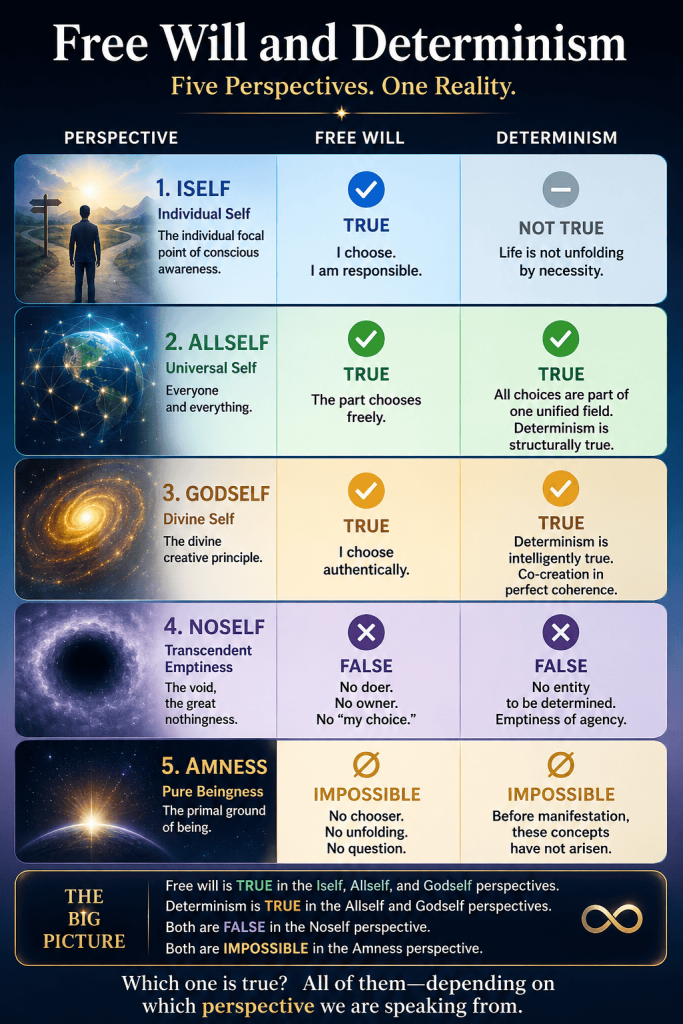
The Self Realization Mantra approaches this question from a different angle. It shows that the Self expresses itself through multiple perspectives, all operating at once. Each perspective has its own valid answer to the question of free will and determinism. Instead of forcing a single conclusion, it reveals how free will and determinism can be true, false, or impossible depending on which perspective we’re speaking from.
Iself (Individual Self) — the individual focal point of conscious awareness.
Allself (Universal Self) — everyone and everything.
Godself (Divine Self) — the divine creative principle.
Noself (Transcendent Emptiness) — the void, the great nothingness.
Amness (Pure Beingness) — the primal ground of being.
From the Individual Self perspective, free will is true. This is the dimension where life feels personal, where choices matter, and where consequences shape the direction of experience. The Iself evaluates options, makes decisions, and is responsible for what happens next. The experience of choosing is authentic, and the weight of responsibility is real within this perspective.
From the Universal Self perspective, free will remains true, but determinism becomes structurally true. The individual still chooses, but every choice is also part of a single unified field. The Allself experiences reality as one interconnected movement expressing itself through many nodes. Free will and determinism coexist here because they operate at different scales: the part chooses freely, while the whole moves inevitably. What once appeared random now reveals itself as coordinated expression within a single coherent system.
From the Divine Self perspective, free will is still true, but determinism becomes intelligently true. The individual acts and chooses authentically, yet those actions are simultaneously expressions of the divine creative principle — divine providence moving through form. Choices arise freely, but they unfold within a larger coherence that moves with precision. Free will and determinism coexist here as co‑expression: the individual chooses freely, and the creative principle moves inevitably.
From the Transcendent Emptiness perspective, both free will and determinism are false. The sense of a separate “I” is recognized as a construction—compelling, useful, but not fundamental. Actions continue to occur, but without an owner. Movement continues, but without a mover. The notion of doership dissolves completely. The idea of “my choice” loses its footing because the “self” that would possess such a choice is seen as an appearance within consciousness rather than an independent entity. Determinism is equally false because there is no entity to be determined. Noself reveals the emptiness of agency.
From the Pure Beingness perspective, neither free will nor determinism are possible. Amness is the primal ground of being — the unmanifest source before anything arises, before agency, before inevitability, before the movement of life. Free will and determinism only appear once manifestation begins. In Amness, there is no chooser, no unfolding, no question to ask. The entire framework required for the debate exists downstream. Amness is the ground prior to the Self differentiating into anything that could even wonder about free will.
Taken together, these perspectives form a coherent answer. Free will is true in the Individual Self, Universal Self, and Divine Self perspectives. Determinism is true in the Universal Self and Divine Self perspectives. Both are false in the Transcendent Emptiness perspective. And both are impossible in Pure Beingness. Each perspective is true from within itself, and none contradict the others—they simply operate at different depths of reality.
The mature realization is the ability to hold all five perspectives at once without collapsing them into a single final answer. Free will and determinism are not opposites to be reconciled; they are truths that arise, dissolve, or never appear depending on the perspective being spoken from. The question is not “Which one is true?” but “Which perspective are we speaking from.”
Leave a Reply