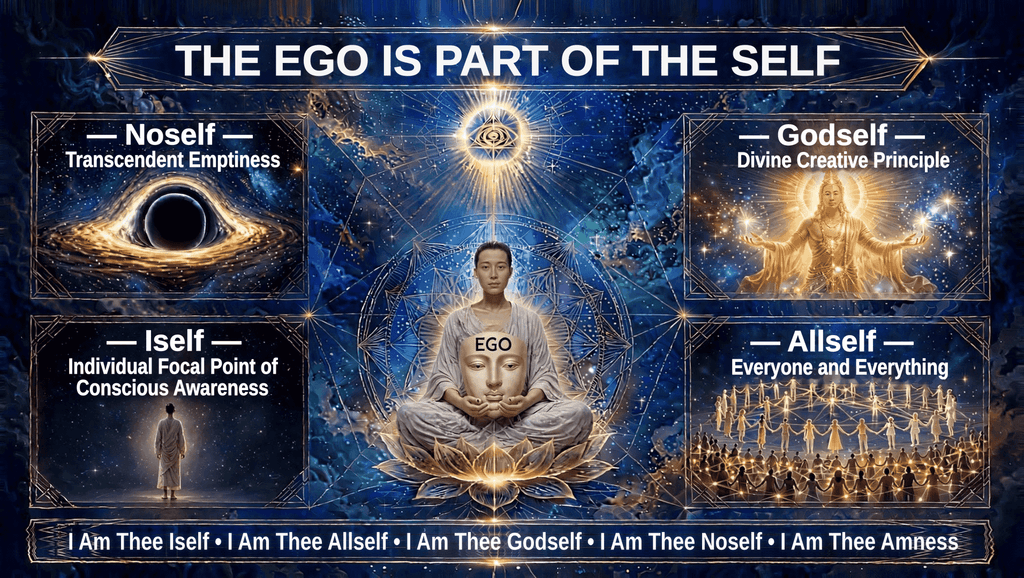
One of the persistent misconceptions in spirituality is that the ego is separate from the Self, or that transcending the ego means eliminating it from our understanding of who and what we are.
This misconception arises from confusing the Iself with the ego and failing to consider the broader implications of the four dimensions of the Self.
The ego is not the Iself. However, that does not mean the ego is separate from the Self.
To understand this distinction, we need to consider the relationship between the Iself, the ego, and the Allself, Godself, and Noself.
The Self Realization Mantra is:
I Am Thee Iself.
I Am Thee Allself.
I Am Thee Godself.
I Am Thee Noself.
I Am Thee Amness.
The mantra expresses five affirmations, but they do not represent five equivalent dimensions. Iself, Allself, Godself, and Noself are four dimensions of the Self. Amness is the premanifest source from which they arise.
This article examines the ego through the four dimensions of the Self.
The Iself Has an Ego
The Iself is the individual focal point of conscious awareness. It is the first-person sense of being here, of being an individual with a unique perspective, experience, agency, and intentionality.
The ego is a functional psychological structure associated with the Iself. It encompasses our self-image, personal history, memories, preferences, attachments, roles, beliefs, and narratives about ourselves.
The ego helps organize our experience as individuals. It provides continuity and helps us navigate the world and our relationships with others.
The Iself is not the ego. The Iself has an ego.
If we equate the Iself with the ego, we reduce the individual dimension of the Self to its psychological structures. If we regard the ego as entirely separate from the Iself, we fail to acknowledge its legitimate role in individual experience.
At the Iself level, we may seek to transcend the ego, or we may not. Ego transcendence is neither equivalent to Self Realization nor a prerequisite for it. It is a possible direction of individual development, not a requirement for realizing the Self. The Iself remains the Iself regardless of whether an individual transcends identification with the ego.
We can understand that we are more than our ego without pretending that we have no ego.
At the Allself Level, We Are the Ego
Consider the relationship from the perspective of Allself.
Allself encompasses everyone, everything, everywhere, and everywhen.
There are no special exceptions.
If Allself includes everyone, it includes every individual and every individual ego. If it includes everything, it includes the psychological structures, thoughts, desires, identities, and behaviors that constitute human experience.
At the individual level, we have an ego.
At the Allself level, we are the ego.
This is not a contradiction. It is a difference in perspective. What is experienced as an individual psychological structure at the Iself level is included within the totality of existence at the Allself level.
At the Iself level, we may choose to transcend our individual ego. At the Allself level, however, we cannot exclude the ego or any individual ego from the totality of what we are.
Ego transcendence is optional at the individual level. Ego inclusion is inherent at the universal level.
The ego does not cease to belong to the Self simply because we have transcended identification with it. Nor does it become something outside the Self because we have come to understand its limitations.
Allself does not selectively exclude aspects of existence because we consider them spiritually undesirable.
That includes the ego.
The Ego as a Manifestation of Godself
From the Godself perspective, our individual ego is a manifestation of the Godself.
Godself is the divine creative principle. The individual expressions of consciousness, identity, personality, and agency are among its manifestations.
The ego is not separate from the divine creative principle that gives rise to its existence. It is one expression of that principle.
This does not mean that every egoic thought, impulse, or behavior represents the highest expression of the Godself, or that every expression of the ego is beneficial or desirable.
It means that the ego itself is not inherently outside, opposed to, or separate from the divine. Its existence is part of the creative expression of the Godself.
The Ego from the Noself Perspective
From the Noself perspective, the ego is empty of inherent, independent existence. It has no permanent, self-sustaining essence that exists independently of the conditions and relationships that give rise to it.
The ego is neither an independently existing entity nor an absolute nothingness. It exists, functions, and participates in experience, but it does not possess an independent essence.
Realizing Noself does not require denying the existence of the ego. It means understanding the nature of its existence.
Noself does not negate the ego’s existence any more than it negates the Iself. It reveals the absence of inherent, independent existence.
The ego is real as an expression, but empty of independent essence.
This is entirely consistent with recognizing the ego as part of our individual experience at the Iself level, including every ego within the totality of Allself, and understanding the ego as a manifestation of Godself.
Why Amness Is Not an Ego Perspective
Amness is pure beingness. It is the premanifest source from which Being, Consciousness, Awareness, and Experience arise.
The ego, by contrast, is a functional psychological structure associated with the individual Iself. It exists within the manifested domain of experience.
Amness is prior to the conditions in which an ego can arise, function, or be experienced. Consequently, the ego has no meaningful relationship to Amness as a distinct perspective.
This is not an exclusion of Amness from the Self Realization Mantra. It is an acknowledgment that Amness occupies a fundamentally different place in the framework. The question of the ego applies to the four dimensions of the Self, each of which offers a distinct perspective on its existence and nature.
Transcending the Ego Does Not Mean Rejecting It
There is an important distinction between transcending the ego and rejecting it.
Transcendence means going beyond the limitations of identifying exclusively with the ego. It means understanding that our identity and nature extend beyond our personal history, self-image, attachments, and psychological narratives.
Rejection, on the other hand, treats the ego as something that must be eliminated, denied, or excluded from the Self.
These are not the same thing.
We can make peace with having an ego. We do not have to regard its existence as a spiritual shortcoming, an obstacle to awakening, or evidence that we have somehow failed to realize the Self. The ego is part of our individual human experience, and its presence is not something we need to apologize for or continually struggle against.
Making peace with the ego means accepting that we have one, understanding its functions, and developing a healthy relationship with it. We can appreciate its role in organizing our experience, maintaining personal continuity, and navigating everyday life without assuming that it defines the entirety of who we are.
Ego perfection is not the goal. Having a healthy, functional ego that plays well with other people’s egos is. We don’t need to eliminate our insecurities, resolve every internal conflict, or become completely free of self-interest. We need an ego that allows us to maintain a healthy sense of ourselves while respecting the individuality, needs, and boundaries of others. We can develop greater self-awareness, emotional maturity, and interpersonal skills without turning ego improvement into another spiritual requirement. A healthy ego is not an obstacle to Self Realization. It is part of living well as an individual.
Awakening belongs to the Iself, not the ego. The Iself is the individual focal point of conscious awareness that awakens to its own nature. The ego is a functional psychological structure associated with the Iself. It can develop, mature, and change through experience, reflection, and intentional effort. We can improve how our ego functions, develop healthier relationships, and become more emotionally mature without confusing those processes with Self Realization. Ego development and Self Realization are related possibilities in human experience, but neither requires the other.
The process of awakening is likely to bring about some degree of transformation in the ego, although this is not guaranteed. The nature and extent of that transformation will vary from person to person. Some people may experience significant changes in their self-image, attachments, attitudes, or behavior, while others may experience little noticeable change in their psychological identity. Neither outcome determines whether Self Realization has occurred. Self Realization does not require the ego to change, mature, or become transformed. Ego transformation is a possible consequence of awakening, not a condition for it.
We can allow the ego to develop and change naturally without making its transformation or transcendence another spiritual objective.
Identity, Attachment, and Choice
Not all aspects of our identity have the same relationship to the ego. Some are preferences, opinions, affiliations, and positions that we consciously adopt and may change over time. Others are deeply rooted in our personal history, family, ancestry, culture, and sense of belonging. Some may feel inseparable from who and what we are.
Understanding an identity as an aspect of ourselves does not mean we must remain attached to it. Equally, transcending identification with the ego does not require us to abandon it. We can maintain meaningful connections to our heritage, culture, relationships, and values without allowing any one of them to define the entirety of our existence.
Many of our identifications are contingent rather than immutable. Our opinions and preferences can change. Our affiliations can evolve. Even deeply ingrained beliefs and assumptions can be examined and reconsidered. These possibilities do not mean that we should change our identities or loosen our attachments. They simply mean that our relationship with these aspects of ourselves is not necessarily fixed.
The distinction is not between having an identity and having no identity. It is between experiencing our identities as aspects of who we are and being exclusively identified with them. Either way, having an identity is not a failure of Self Realization.
We do not have to transcend our ego to affirm our individuality, embrace our heritage, or maintain the identities and relationships that give our lives meaning. These are legitimate aspects of our human experience, whether or not we choose to loosen our identification with them.
The Myth of Killing the Ego
The idea that we must kill, destroy, or eliminate the ego to achieve spiritual realization is fundamentally misguided. It treats the ego as an enemy rather than as a functional psychological structure associated with the Iself.
This idea also confuses the ego with the Iself. The ego is not the individual focal point of conscious awareness. Eliminating or suppressing aspects of our psychological identity is not the same as realizing the Iself.
There is a difference between disidentifying from the ego and eliminating it. We can understand that we are more than our self-image, personal history, attachments, and psychological narratives without having to destroy those structures. Going beyond exclusive identification with the ego does not require the ego to disappear.
The idea that ego elimination is a prerequisite for Self Realization creates an unnecessary spiritual burden. We do not have to achieve a supposedly egoless state before we can realize the nature of Self. The presence of an ego does not disqualify us from Self Realization.
Ironically, the pursuit of becoming egoless can itself become another ego project. Someone can take pride in being egoless, identify with having transcended the ego, and build a spiritual identity around the very achievement of supposedly having no ego.
Francis Lucille writes in The Perfume of Silence, “Only the ego wants to get rid of the ego.” There is a profound insight in this observation. The desire to eliminate the ego can itself be an expression of the ego, turning spiritual realization into another project of self improvement. The ego may simply adopt a new objective: becoming egoless. What appears to be the pursuit of freedom from the ego can become another way of reinforcing identification with it.
You don’t have to kill your ego to realize your Self. You don’t even have to transcend it. You have to understand what it is and what it isn’t.
Whether we become less identified with our ego or remain comfortable with our existing relationship to it, neither circumstance determines our capacity for Self Realization.
Self Realization does not require us to become psychologically nonexistent.
And we do not have to pursue ego transcendence at all to affirm the Iself as a dimension of the Self.
The Inclusiveness of the Self
The four dimensions of the Self offer different but complementary perspectives on the ego.
At the Iself level, we have an ego. We may seek to transcend identification with it, or we may not.
At the Allself level, every ego is included in the totality of what we are.
At the Godself level, our individual ego is a manifestation of the divine creative principle.
At the Noself level, the ego is empty of inherent, independent existence.
These perspectives do not contradict one another. They reveal different aspects of the relationship between the ego and the Self.
We do not have to choose between affirming the ego’s existence and understanding its emptiness. We do not have to choose between acknowledging its individual function and including it in the universal totality. We do not have to reject it to understand its divine origin.
Inclusion is not approval. Understanding that something is part of the totality does not mean that every expression of it is beneficial or desirable.
It simply means that we do not have to deny its existence to realize the whole.
This is the distinction between judging something as undesirable and declaring it outside the Self.
The former is discernment. The latter is exclusion.
Iti Iti: This Too, This Too
The Self Realization Mantra takes an affirmative and inclusive approach to Self Realization.
Rather than relying on Neti Neti (not this, not that), it embraces Iti Iti (this too, this too).
We affirm the Iself. We affirm the Allself. We affirm the Godself. We affirm the Noself.
We do not specifically affirm or deny the ego. We recognize it as a functional part of our individual human experience and accept it as such.
We do not have to deny the Iself to affirm Noself. We do not have to eliminate the ego to affirm Allself. We do not have to reject the ego to understand it as a manifestation of Godself. And we do not have to deny its existence to understand its emptiness from the perspective of Noself.
The ego is not the entirety of who we are. It is not the Iself. It is not the Allself. It is not the Godself. It is not the Noself.
And yet it has a place within each of these perspectives.
The Iself has an ego. The Allself includes every ego. The Godself manifests through the ego. The Noself reveals the ego’s emptiness of independent essence.
Self Realization is not about eliminating parts of ourselves until we arrive at some purified remainder. It is about realizing the full nature of what we are.
Even the ego has its place.
Leave a Reply